
U.S. Direct Selling Market: The $90 Billion Story Nobody's Writing
America's direct selling sector is quietly doubling in size — and it looks nothing like the stereotype.

The U.S. Direct Selling Market Is Nearly $48 Billion — and Barely Anyone Covers It Seriously
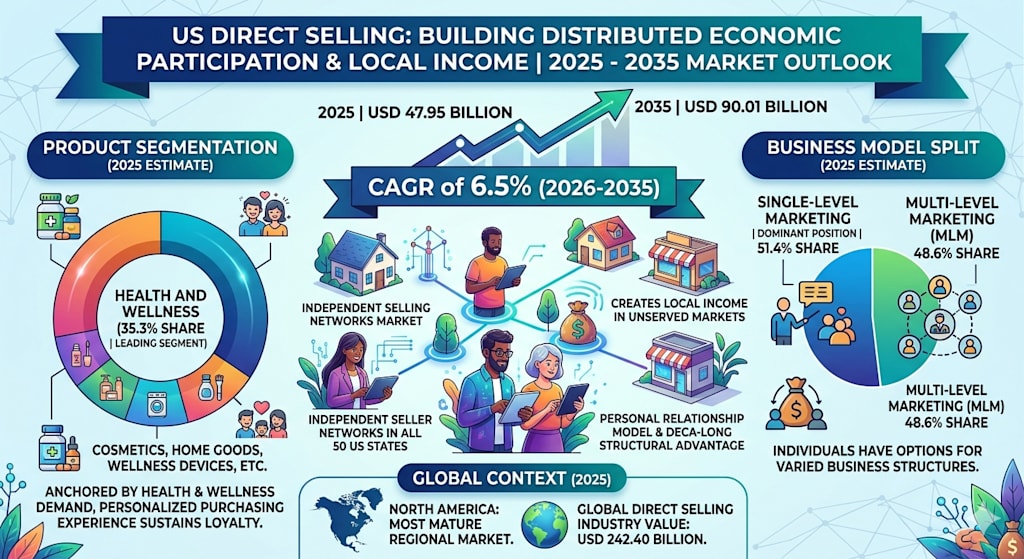
There are 5.4 million active direct sellers operating across the United States right now. That is larger than the entire workforce of the American automotive manufacturing sector. Yet direct selling rarely earns the kind of business press that e-commerce or retail tech routinely command, despite a market valued at $47.95 billion in 2025 and projected to reach $90.01 billion by 2035 at a 6.5% CAGR. A full breakdown of segment data and regional figures is available in this United States direct selling sector analysis. The gap between the sector's economic weight and its media coverage is, to put it plainly, strange.
The Model Has Changed More Than the Perception Has
Ask most people what direct selling looks like and they will describe something from 1987. A product demo in someone's living room. A multilevel commission structure. An acquaintance who keeps posting about supplements online. That picture is not wrong, exactly, but it is incomplete in ways that matter.
Services now account for more than 60% of U.S. direct selling channel volume. That ratio mirrors the broader American economy and it represents a structural shift that fundamentally changes who participates and why. eXp Realty generated $4.6 billion in 2024 revenue by applying a direct selling framework to residential real estate brokerage.
Primerica operates similarly in insurance and financial services. These are not fringe adaptations. They are large companies with publicly traded equities using independent representative networks because the model works at scale for intangible products, not just nutrition shakes.
Single-Level Marketing Edges Out MLM in the U.S.
One data point that cuts against the popular narrative: single-level marketing holds a 51.4% share of the U.S. market by business model, slightly ahead of multi-level marketing at 48.6%. The cultural conversation around direct selling focuses almost entirely on MLM — the recruitment mechanics, the income disclosure statements, the FTC scrutiny. That scrutiny is legitimate and the agency's proposed Earnings Claim Rule in January 2025 will tighten how income representations can be made to prospective sellers. But the model that actually dominates by volume in the U.S. does not involve downline recruitment at all.
This distinction matters for anyone trying to assess the United States direct selling market as an investment or entry opportunity. Lumping all direct selling together because of MLM's reputation is a categorization error that obscures where actual growth is occurring.
34 Million Customers Who Never Joined a Downline
Separate from the seller workforce, the Direct Selling Association reported 34.3 million preferred customers in 2024. These are buyers who purchase at member prices but have no intention of recruiting others or building a business. They are simply customers who found a product they liked through a personal referral and signed up for a loyalty tier.
That cohort represents something important. Direct selling's critics often frame participation as inherently about recruitment, but a pool of 34 million repeat buyers suggests genuine product demand independent of the network's growth incentives. Health and wellness leads that demand, accounting for 35.3% of total U.S. channel volume. The category's staying power comes from the same dynamic as everywhere else: personal testimony and relationship-based trust sell credence goods more reliably than shelf placement.
What the Next Decade Looks Like
The geography of U.S. direct selling is worth noting. Independent seller networks operate across all 50 states, including rural and suburban markets where platform-based retail often fails to build meaningful local presence. That distributed reach is not an accident of the model — it is the point. A company like Amway or Herbalife does not need to optimize a logistics network to reach a town of 12,000 people in rural Mississippi. The representative is already there.
What will define the next growth phase is how well companies integrate digital tools without losing what makes the model work. Oriflame's move to process 99% of orders online in 2024 is a precedent. But digital order processing is the easy part. The harder question is whether the relationship dynamic that drives retention can survive a full migration to social commerce, where personal trust competes with algorithmic content at scale. The companies that figure that out first will have a meaningful structural advantage — not just in the United States, but in every market they touch.
About the Creator
Suge kun
Research Analyst passionate about data & market insights. I turn complex information into clear, actionable strategies. Detail-driven & results-focused — helping businesses make smarter decisions. — Suge Kun
Enjoyed the story? Support the Creator.
Subscribe for free to receive all their stories in your feed.
Comments
There are no comments for this story
Be the first to respond and start the conversation.