
Tumor Profiling Market Set for Strong Growth as Precision Oncology Reshapes Global Cancer Care
Advanced Genomic Technologies, Rising Cancer Burden, and AI-Driven Diagnostics Accelerate the Global Tumor Profiling Industry Through 2033

Cancer treatment is undergoing one of the most transformative shifts in modern medical history, and tumor profiling stands at the center of this revolution. As healthcare systems worldwide move toward personalized medicine, tumor profiling technologies are becoming essential tools for oncologists, researchers, and pharmaceutical companies aiming to improve treatment outcomes and reduce unnecessary therapies.
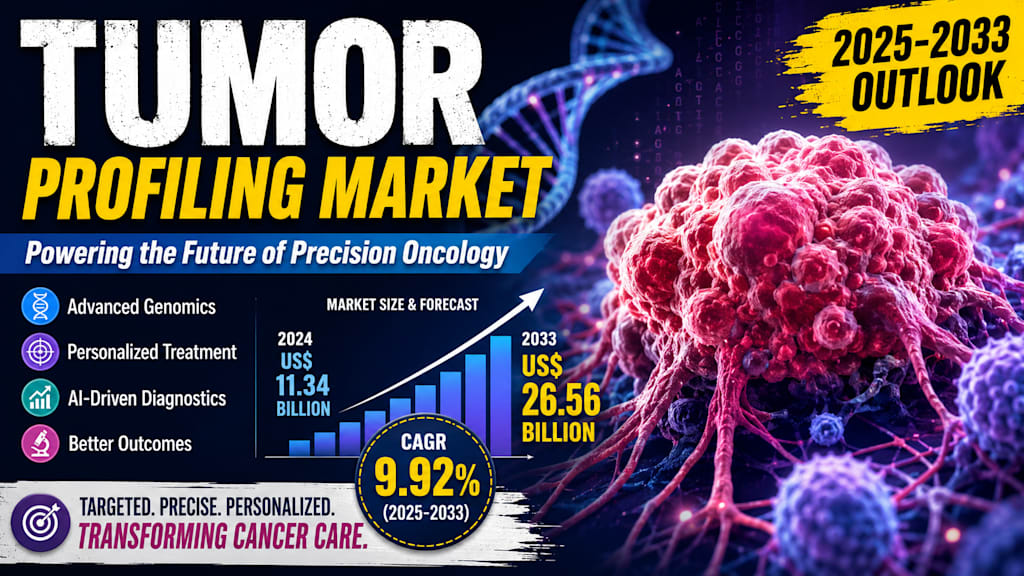
According to Renub Research, the Global Tumor Profiling Market is projected to grow from US$ 11.34 billion in 2024 to US$ 26.56 billion by 2033, expanding at a CAGR of 9.92% from 2025 to 2033. The growing adoption of precision oncology, increasing cancer prevalence, and continuous innovation in genomic technologies are fueling this remarkable market expansion.
Tumor profiling has transformed cancer diagnosis from a generalized approach into a highly personalized science. By analyzing genetic, proteomic, epigenetic, and molecular changes within tumors, physicians can now identify specific biomarkers that guide treatment decisions more accurately than ever before. This shift is dramatically improving patient survival rates while minimizing side effects associated with traditional therapies.
The Rising Global Cancer Burden is Driving Demand
Cancer remains one of the leading causes of death worldwide, creating immense pressure on healthcare systems to improve diagnosis and treatment strategies. The World Health Organization reported nearly 20 million new cancer cases and approximately 9.7 million cancer-related deaths in 2022. The growing number of cases is increasing the need for advanced diagnostic technologies capable of identifying cancer at earlier stages and guiding targeted therapies.
As populations age and unhealthy lifestyle habits continue to rise, the incidence of cancer is expected to increase substantially over the coming decades. Environmental pollution, smoking, alcohol consumption, obesity, and sedentary lifestyles are contributing heavily to the growing burden of disease.
Tumor profiling helps healthcare professionals understand the unique biology of each patient’s cancer. Instead of relying solely on traditional chemotherapy, doctors can now develop highly targeted treatment plans based on genetic mutations and molecular characteristics. This approach significantly improves therapeutic efficiency while reducing unnecessary treatment complications.
The increasing global focus on personalized medicine is therefore becoming a major catalyst for tumor profiling adoption across hospitals, research institutions, and oncology centers worldwide.
Next-Generation Sequencing Revolutionizing Cancer Diagnostics
One of the biggest contributors to tumor profiling market growth is the rapid advancement of next-generation sequencing (NGS) technology. NGS has revolutionized cancer genomics by enabling scientists to analyze multiple genes simultaneously with exceptional speed and accuracy.
Traditional diagnostic methods often focused on limited genetic markers. However, NGS allows comprehensive analysis of complex tumor structures, helping clinicians detect mutations, genomic alterations, and biomarkers that were previously difficult to identify.
The affordability and accessibility of NGS have improved significantly over the past decade, making tumor profiling more practical for large-scale clinical applications. Today, hospitals and cancer research centers increasingly rely on genomic sequencing to guide treatment selection for cancers such as lung cancer, breast cancer, colorectal cancer, and leukemia.
Furthermore, advancements in liquid biopsy technologies are enhancing non-invasive cancer diagnostics. Liquid biopsies analyze tumor DNA circulating in the bloodstream, allowing clinicians to monitor disease progression and treatment response without invasive surgical procedures.
As genomic technologies continue evolving, tumor profiling is expected to become a routine component of cancer care globally.
Artificial Intelligence Strengthening Tumor Analysis
Artificial intelligence (AI) and machine learning (ML) are adding another layer of sophistication to tumor profiling systems. Modern cancer diagnostics generate enormous volumes of molecular and genomic data that require complex interpretation.
AI-driven platforms can rapidly analyze genetic patterns, identify mutation signatures, and recommend targeted therapies with greater accuracy and efficiency than traditional manual analysis methods. This capability reduces diagnostic time and helps physicians make faster clinical decisions.
Machine learning algorithms are also improving predictive analytics in oncology. By studying historical patient data and treatment responses, AI systems can help predict how specific tumors may react to therapies, supporting better treatment personalization.
Pharmaceutical companies are increasingly integrating AI into drug discovery and biomarker identification processes, accelerating the development of targeted cancer therapies.
The combination of AI and genomic profiling is expected to redefine the future of oncology by enabling smarter, faster, and more personalized cancer treatment strategies.
Government Investments Supporting Market Expansion
Governments and healthcare organizations across the world are investing heavily in cancer research and precision medicine initiatives. Public funding programs are accelerating the adoption of advanced tumor profiling technologies while encouraging innovation in cancer diagnostics.
Countries such as the United States, Germany, China, and the United Arab Emirates are strengthening their genomic research infrastructure to support precision oncology programs.
The United Kingdom, for instance, has committed to increasing national research and development spending to 2.4% of GDP by 2027. Similar initiatives are being introduced globally to enhance cancer diagnosis, expand genomic databases, and improve patient access to personalized treatments.
These investments are not only supporting technological innovation but also encouraging collaborations between biotechnology firms, research institutions, and pharmaceutical companies.
As governments recognize the long-term benefits of early cancer detection and precision medicine, tumor profiling technologies are likely to receive continued policy and financial support.
North America Maintains Market Leadership
North America currently dominates the global tumor profiling market due to its advanced healthcare infrastructure, strong research ecosystem, and early adoption of genomic technologies.
The United States remains the largest contributor to regional growth. According to the American Cancer Society, more than 2 million new cancer cases are expected in the United States in 2025. This increasing disease burden is driving significant demand for sophisticated tumor profiling tools.
Major biotechnology companies and diagnostic laboratories in the United States continue investing heavily in genomic sequencing, companion diagnostics, and AI-based oncology platforms. The presence of leading industry players such as Illumina, Guardant Health, Exact Sciences, and Thermo Fisher Scientific further strengthens the country’s market leadership.
Additionally, favorable reimbursement policies and extensive clinical research activities continue supporting widespread adoption of tumor profiling technologies across American healthcare institutions.
Europe Expanding Precision Oncology Capabilities
Europe represents another major growth region for tumor profiling technologies. Countries such as Germany, the United Kingdom, and France are making significant investments in cancer genomics and personalized medicine research.
Germany has emerged as a leading hub for precision oncology due to its robust healthcare infrastructure and strong biotechnology sector. German hospitals and research institutions are increasingly adopting next-generation sequencing, liquid biopsy, and immunohistochemistry technologies to improve cancer diagnostics and treatment planning.
European governments are also prioritizing cancer prevention and early detection programs, creating additional opportunities for tumor profiling providers.
As awareness regarding personalized cancer medicine grows across Europe, the region is expected to maintain steady market expansion throughout the forecast period.
Asia-Pacific Emerging as a High-Growth Region
The Asia-Pacific region is witnessing rapid growth in tumor profiling adoption, driven by rising cancer incidence, expanding healthcare infrastructure, and increasing investments in biotechnology.
China is becoming one of the fastest-growing markets for genomic diagnostics. The country’s strong emphasis on healthcare modernization and cancer research is accelerating adoption of advanced tumor profiling technologies.
India is also experiencing growing demand for personalized cancer diagnostics as healthcare providers increasingly embrace precision medicine approaches. Rising healthcare expenditures, expanding laboratory networks, and increasing awareness about early cancer detection are contributing to market development across the region.
Meanwhile, countries like Japan and South Korea continue investing heavily in genomic research and oncology innovation, further strengthening Asia-Pacific’s position within the global market.
Key Challenges Continue to Impact Adoption
Despite strong market potential, several challenges continue limiting the widespread adoption of tumor profiling technologies.
One major obstacle is the high cost associated with genomic sequencing and advanced molecular diagnostics. Next-generation sequencing systems require expensive equipment, specialized reagents, and highly trained professionals to operate effectively.
These financial barriers are particularly significant in low- and middle-income countries where healthcare budgets remain limited. Many healthcare institutions struggle to implement sophisticated tumor profiling systems due to infrastructure and funding constraints.
Another challenge involves the complexity of interpreting genomic data. Tumors are highly heterogeneous, meaning genetic mutations can vary significantly even within a single tumor sample. Accurate analysis requires specialized expertise in bioinformatics and cancer genomics.
Furthermore, many rare genetic variations remain poorly understood, complicating clinical decision-making and treatment recommendations.
Addressing these challenges will require continued investment in education, standardization, and technology development to ensure broader accessibility and clinical integration.
Competitive Landscape Becoming Increasingly Dynamic
The tumor profiling market is becoming highly competitive as biotechnology firms, diagnostic companies, and pharmaceutical organizations race to expand their oncology capabilities.
Industry leaders are focusing heavily on product innovation, strategic partnerships, mergers, and AI integration to strengthen their market positions.
Companies such as Illumina Inc., Qiagen N.V., Exact Sciences Corporation, NeoGenomics Laboratories, Guardant Health, GenomeDX, Oxford Gene Technology IP Limited, and Bruker Spatial Biology are actively developing advanced genomic solutions designed to improve cancer diagnostics and treatment precision.
Collaborations between pharmaceutical companies and genomic technology providers are also becoming increasingly common. These partnerships aim to accelerate companion diagnostic development and support targeted therapy commercialization.
As precision oncology continues evolving, competition within the tumor profiling market is expected to intensify significantly.
10 Recent Developments in the Tumor Profiling Industry
Illumina partnered with AstraZeneca in October 2024 to develop advanced NGS-based companion diagnostics for oncology applications.
Thermo Fisher Scientific introduced the Oncomine Comprehensive Assay Plus in September 2024 to improve solid tumor mutation detection.
Guardant Health expanded its liquid biopsy portfolio to support earlier cancer detection and treatment monitoring.
Exact Sciences increased investment in molecular diagnostics research to strengthen personalized oncology capabilities.
NeoGenomics Laboratories expanded genomic testing services for precision cancer therapies across multiple healthcare networks.
Qiagen enhanced its biomarker discovery platform to support next-generation oncology research programs.
Bruker Spatial Biology introduced advanced spatial transcriptomics solutions for improved tumor microenvironment analysis.
GenomeDX expanded collaborations with pharmaceutical companies to accelerate biomarker-driven cancer treatment development.
Oxford Gene Technology strengthened its cancer genomics portfolio through expanded sequencing and data analysis solutions.
Several biotechnology firms increased AI integration into tumor profiling workflows to improve genomic interpretation accuracy and clinical decision-making.
Future Outlook
The future of the tumor profiling market appears highly promising as precision medicine becomes increasingly central to modern cancer care. Advances in genomics, AI, liquid biopsy, and molecular diagnostics are expected to continue transforming oncology over the next decade.
As healthcare providers seek more accurate, personalized, and efficient treatment strategies, tumor profiling technologies will play an increasingly vital role in improving patient outcomes and reducing cancer mortality rates.
Growing government support, rising research investments, and continuous technological innovation are likely to further accelerate market growth through 2033.
Although challenges related to cost and data complexity remain, ongoing advancements in automation, AI, and sequencing technologies are expected to improve accessibility and affordability over time.
The global shift toward personalized healthcare is no longer a future concept—it is already reshaping cancer treatment today. Tumor profiling stands at the forefront of this transformation, offering hope for earlier detection, smarter therapies, and better outcomes for millions of cancer patients worldwide.
Final Thoughts
Tumor profiling is rapidly redefining the future of oncology by enabling precision-driven cancer treatment approaches tailored to individual patients. With rising cancer prevalence and continuous innovation in genomic science, the market is positioned for sustained long-term growth.
As technologies become more advanced and accessible, tumor profiling is expected to become a standard component of cancer diagnosis and treatment worldwide. The companies and healthcare systems investing in this transformation today are likely to shape the next era of global cancer care.
About the Creator
Enjoyed the story? Support the Creator.
Subscribe for free to receive all their stories in your feed.
Comments
There are no comments for this story
Be the first to respond and start the conversation.