
Trump Hid in Catering Truck in Secret Plane Swap Over Iran Threat, Reports Say
A reported high-security deception operation saw Donald Trump secretly leave Turkey aboard a smaller military aircraft while journalists and some staff believed he was traveling on Air Force One.
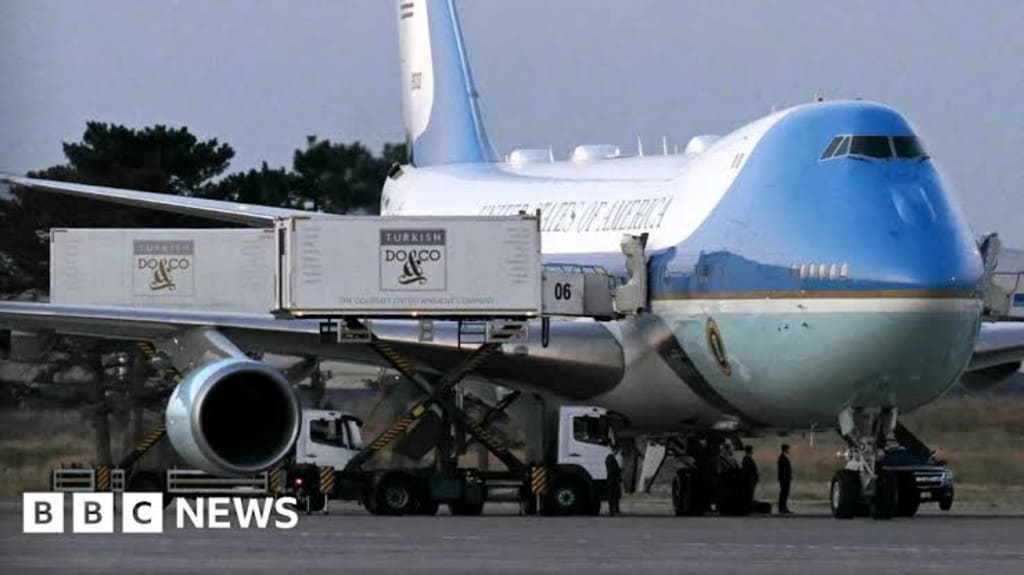
A dramatic security operation reportedly took place during U.S. President Donald Trump’s departure from Turkey last month, when officials secretly moved him from Air Force One to another military aircraft amid concerns about a possible Iranian threat. According to recent reports, Trump was transported from the presidential aircraft using an airport catering truck before boarding a smaller U.S. military jet bound for Britain.
The extraordinary operation reportedly followed a credible threat assessment involving Iran. Details of the incident have emerged through reporting by major news organizations, including The Washington Post and The New York Times, and were subsequently reported by Reuters and other international media.
The episode highlights the increasingly complicated security environment surrounding the U.S. president and demonstrates how presidential travel can involve elaborate deception measures when intelligence agencies believe a specific route or aircraft could become a target.
Why Trump’s Flight Was Kept Secret
Trump had attended a NATO summit in Turkey before preparing to leave the country. His journey to Turkey had involved a newly refurbished Boeing 747-8 associated with the presidential fleet and donated by Qatar. However, officials reportedly became concerned about the security of his return journey because of an Iranian threat.
Rather than allowing observers to know which aircraft actually carried the president, security officials reportedly developed a deception plan.
Trump publicly boarded an older Air Force One aircraft, creating the impression that he would fly back aboard that plane. Journalists and some White House personnel subsequently boarded the same aircraft, apparently believing the president remained on board.
Behind the scenes, however, Trump had reportedly been moved away from public view. A catering truck with a lifting platform was positioned beside the aircraft, allowing the president to leave through another door without being seen. He was then transferred to a smaller Air Force C-32A military aircraft.
Air Force One Became Part of the Deception
The most striking element of the reported operation was the use of the larger aircraft as a decoy.
According to reporting, journalists aboard the older presidential plane were instructed to keep their window shades closed during takeoff. The aircraft subsequently departed Turkey while Trump was reportedly flying separately.
This meant that anyone monitoring the movement of the presidential aircraft could have been led to believe that Trump was still aboard. The smaller C-32A, meanwhile, carried the president toward Britain.
The tactic reflects a fundamental principle of presidential security: protecting the president is not always about adding visible guards or aircraft. Sometimes the safest strategy is to make it difficult for potential attackers to determine where the president actually is.
Trump’s Destination Was Britain
Reports indicate that the smaller military aircraft carried Trump to RAF Mildenhall in England. The decoy aircraft arrived separately, helping preserve the appearance that the president had remained aboard the larger aircraft.
The operation reportedly remained secret even from some people traveling with the presidential party. That level of compartmentalization would reduce the number of individuals who knew the president's actual travel arrangements.
After arriving in Britain, Trump eventually appeared publicly, maintaining the appearance associated with the original presidential aircraft movement.
The unusual sequence only became widely known after journalists and news organizations investigated what had happened and obtained information about the security operation.
Why Iran Was Considered a Security Concern
The reported operation came against a backdrop of severe tensions between Washington and Tehran. Iran has previously threatened retaliation against Trump and former senior U.S. officials following the 2020 U.S. strike that killed Iranian military commander Qassem Soleimani.
U.S. authorities have acknowledged for years that threats linked to Iran have been taken seriously. Earlier reporting has documented continued security concerns involving Trump and former members of his administration.
The latest incident reportedly involved a more specific concern about the president's movements, prompting officials to consider extraordinary protective measures. Reuters reported that U.S. officials described the threat as credible and that the deception operation was designed to protect Trump from a potential attack.
A Reminder of the Risks of Presidential Travel
Presidential travel is normally highly visible. Air Force One movements attract global attention, flight trackers can monitor aircraft, and journalists accompanying the president routinely report on his schedule.
That visibility creates a security challenge.
If an adversary can accurately identify the president's aircraft, route or timing, it could potentially make planning an attack easier. For this reason, the U.S. Secret Service, military and intelligence agencies maintain extensive procedures designed to protect the president during international travel.
The reported Turkey operation demonstrates how those procedures can extend beyond conventional security measures. Instead of simply increasing protection around one aircraft, officials reportedly created uncertainty over which aircraft actually carried the president.
The Bigger Political and Security Picture
The incident also comes at a sensitive moment in U.S.-Iran relations. Any credible threat against the American president could have consequences far beyond Trump's personal security.
A successful attack attempt could trigger military retaliation, diplomatic escalation and further instability across the Middle East. Even an unsuccessful operation could intensify tensions between Washington and Tehran.
For that reason, presidential protection is closely connected to national security. Decisions about aircraft, routes and movements can become strategic decisions rather than routine travel arrangements.
What the Incident Reveals
The reported catering-truck transfer may sound unusual, but the underlying objective was straightforward: prevent potential attackers from knowing the president's true location.
The operation reportedly used several layers of deception—an apparent presidential departure, a decoy aircraft, restricted visibility and a separate military flight. Together, these measures were intended to make it harder for anyone monitoring Trump's movements to determine which aircraft carried him.
It also demonstrates the importance of intelligence in modern presidential security. A threat does not necessarily need to become public before it influences government decisions. Security agencies can act on classified information that the public may learn about only weeks or months later.
Conclusion
The reported secret plane swap involving Donald Trump and a catering truck is one of the most unusual presidential security stories to emerge this year. According to reporting, the operation was designed to protect Trump from a credible Iranian threat by concealing his true aircraft and destination.
While many operational details remain classified or independently unverified, the broader message is clear: presidential travel can involve sophisticated deception when authorities believe an American president may be at risk.
The episode also illustrates how tensions between the United States and Iran continue to influence security decisions at the highest levels. What appeared to journalists as a routine presidential departure from Turkey was reportedly something entirely different—a carefully coordinated security operation designed to keep the president's real location hidden.
About the Creator
Enjoyed the story? Support the Creator.
Subscribe for free to receive all their stories in your feed.
Comments
There are no comments for this story
Be the first to respond and start the conversation.