
Transplantation Market Trends: Bioprinting Progress, Regenerative Medicine & Industry Forecast to 2034
Analyzing how regenerative medicine, stem cell research, and bioprinting technologies are transforming the future of organ transplantation and market opportunities

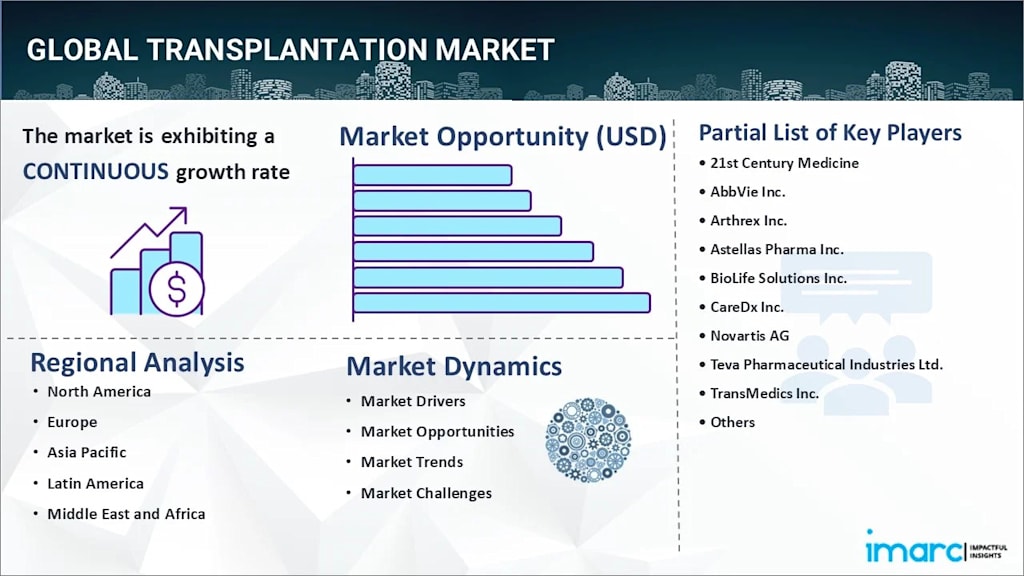
The rising incidence of chronic diseases, a growing geriatric population, and breakthroughs in regenerative medicine are fueling the global transplantation demand. Supported by government initiatives to increase organ donation rates and the rapid expansion of specialized transplant centers, the market is witnessing a shift toward advanced preservation techniques and personalized post-operative care. According to IMARC Group’s latest data, the global transplantation market size was valued at USD 18.7 Billion in 2025. Looking forward, IMARC Group estimates the market to reach USD 36.0 Billion by 2034, exhibiting a CAGR of 7.34% from 2026-2034.
Transplantation has evolved into a critical pillar of modern tertiary healthcare, now representing a multi-billion-dollar global industry that addresses end-stage organ failure and severe tissue damage. Demand is driven by a widening gap between the supply of donor organs and a growing waiting list, alongside significant improvements in immunosuppressive therapies that enhance long-term graft survival. Major segments include tissue products which currently hold the majority of the market share immunosuppressive drugs, and preservation solutions.
Download the Complete "Transplantation Market" Overview Today
Transplantation Market Growth Drivers:
- Rising Prevalence of Chronic Diseases and Organ Failure
The global health landscape is increasingly burdened by chronic conditions such as diabetes, hypertension, and cardiovascular diseases, which frequently culminate in end-stage organ failure. For instance, approximately 620 million individuals worldwide suffered from heart and circulatory diseases in recent years, significantly expanding the pool of candidates for heart and kidney transplants. This medical necessity is a primary driver, as transplantation remains the only viable life-saving intervention for many patients.
- Technological Advancements in Organ Preservation
Innovation in preservation technology is transforming the viability window for donor organs, moving beyond traditional static cold storage to advanced machine perfusion systems. Technologies like normothermic machine perfusion allow clinicians to assess organ function in real-time and "recondition" marginal grafts that were previously deemed unsuitable. By extending the time an organ can survive outside the body, these systems reduce the risk of delayed graft function and improve overall surgical outcomes.
- Supportive Government Policies and Donation Initiatives
Governments and non-governmental organizations are aggressively implementing "opt-out" donation registries and public awareness campaigns to boost organ procurement rates. Many nations have also introduced legislative reforms to streamline donor identification and allocation efficiency. For example, reimbursement schemes that offset travel and wage-loss expenses for living donors have encouraged altruistic participation. These structural improvements, combined with increased funding for specialized transplant infrastructure, ensure that more patients gain access to life-saving procedures while reducing the mortality rates associated with long waiting lists in many regions.
Transplantation Market Trends:
- Shift Toward Personalized Medicine and Pharmacogenomics
A major trend in post-transplant care is the adoption of AI-guided pharmacogenomics platforms to optimize the dosing of immunosuppressive drugs. Since every patient metabolizes medication differently, personalized protocols help clinicians minimize side effects while preventing organ rejection. By utilizing molecular assays and next-generation sequencing (NGS) to monitor immune status, doctors can identify genetic differences at a granular level. This precision medicine approach not only enhances long-term graft longevity but also reduces the total cost of care by preventing acute rejection episodes and subsequent hospitalizations.
- Breakthroughs in Xenotransplantation and Bio-Engineering
The industry is moving closer to solving the organ shortage through the clinical exploration of xenotransplantation and 3D bioprinting. Recent successful first-in-human trials involving gene-edited pig kidneys and livers have provided a proof-of-concept for using non-human organs to bridge the supply gap. Simultaneously, the development of regenerative scaffolds and bio-engineered tissues is gaining momentum, offering potential alternatives to traditional allografts. These cutting-edge applications represent a frontier where biotechnology and surgery converge to create a sustainable, on-demand supply of tissues and organs for various medical applications.
- Expansion of Specialized Transplantation Centers in Emerging Markets
There is a notable trend of increasing healthcare investment in developing regions, particularly across Asia-Pacific and Latin America. Countries like China and India are rapidly expanding their network of specialized transplant centers to cater to rising middle-class populations with better insurance coverage. This geographical shift is supported by improvements in medical tourism and a growing number of trained transplant surgeons. As these markets mature, the adoption of premium technologies such as digital tele-transplant platforms for remote patient monitoring is rising, making high-quality transplant care more accessible to a global demographic.
Recent News and Developments in Transplantation Market
- April 2026: Biogen Inc. entered into a strategic agreement with TJ Biopharma for the development of felzartamab in the Greater China Region. This monoclonal antibody is currently being evaluated in Phase 3 trials to treat antibody-mediated rejection in kidney transplant recipients, highlighting the industry's focus on innovative biologics.
- January 2026: Leading researchers reported a significant milestone in xenotransplantation, with a gene-edited pig heart successfully supporting a human patient for an extended period under compassionate-use protocols, signaling a potential shift in future organ procurement strategies.
- September 2025: A major medical device manufacturer received regulatory clearance for a next-generation normothermic perfusion system designed specifically for lung preservation, which is expected to significantly reduce the incidence of primary graft dysfunction in respiratory transplants.
Note: If you require specific details, data, or insights that are not currently included in the scope of this report, we are happy to accommodate your request. As part of our customization service, we will gather and provide the additional information you need, tailored to your specific requirements. Please let us know your exact needs, and we will ensure the report is updated accordingly to meet your expectations.
About the Creator
Andrew Sullivan
Hello, I’m Andrew Sullivan. I have over 9+ years of experience as a market research specialist.
Enjoyed the story? Support the Creator.
Subscribe for free to receive all their stories in your feed.
Comments
There are no comments for this story
Be the first to respond and start the conversation.