
Transaction Monitoring Market: AI and Compliance Demands Fuel a $47.60 Billion Opportunity
How regulatory pressure, digital payment growth, and machine learning are reshaping financial crime prevention globally
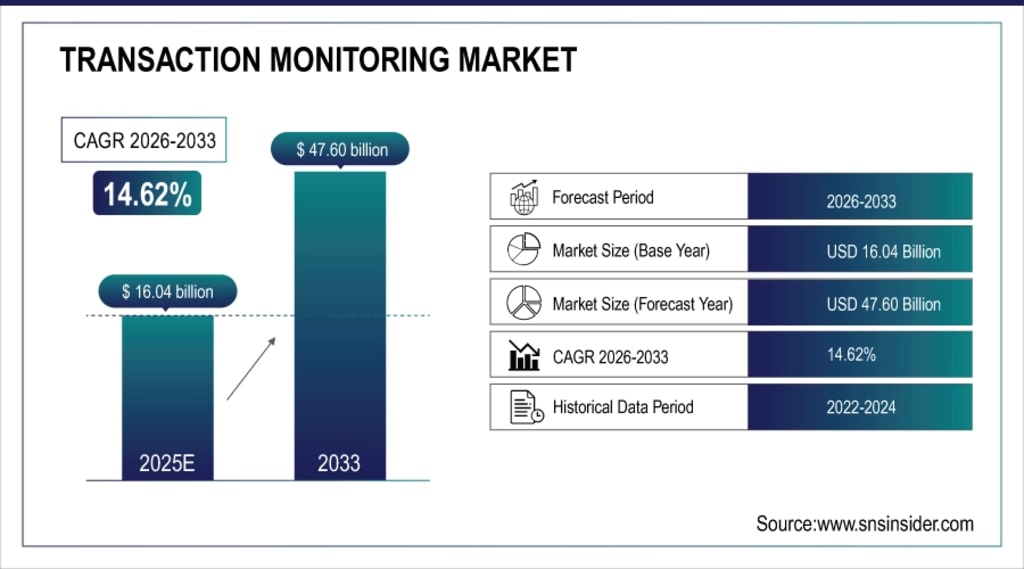
The global Transaction Monitoring Market will experience rapid changes during this era of growing instances of fraud, stringent regulations, and an upsurge in the number of digital payment transactions. The market size of USD 16.04 Billion in 2025 is expected to grow to USD 47.60 Billion by 2033, recording a CAGR of 14.62% over the forecast period. The Transaction Monitoring Market size increased by 42% in the US in 2025 due to the rise in the use of artificial intelligence, resulting in 35% reduction in fraud along with 1.2 trillion digital transactions every year.
Transaction monitoring refers to a combination of technology and processes that can be used by financial institutions to identify suspicious activities in real-time. This includes the process of ensuring compliance with anti-money laundering (AML), fraud management, cross-border payment transaction, and reporting regulatory requirements.
Request Industry-Focused Sample with Insights & Forecasts
Why the Market Is Growing So Rapidly
Regulatory pressure turns out to be the most potent driver of growth. Countries and their financial regulators have been putting in place strict Anti-Money Laundering and counter terrorist financing regulations, which require financial organizations to develop advanced technology for transaction monitoring. By 2025, 81% of banking and fintech companies had invested in advanced transaction monitoring to comply with tightening AML regulations – cutting down the compliance gap by 37% and saving on average USD 8.5 million in regulatory fines per year.
The sheer volume of digital transactions adds to this sense of urgency. Digital payment transactions crossed the mark of 1.3 trillion, which forced 79% of financial institutions to install real-time monitoring – decreasing the fraud risk by 32%. The increase in mobile wallets, peer-to-peer transactions, and cross-border payments increases the exposure to financial crimes.
The advent of AI and machine learning technology is revolutionizing what compliance can accomplish. The limitations of traditional rule-based technologies with regard to the amount of transactions that they can handle in today’s era are well recognized. As a result, in 2025, 77% of financial organizations have used AI, ML, and big data analysis in their transactions, improving fraud detection efficiency by 45%, and reducing false positives by 40%.
Lastly, cloud-based solutions will level the playing field. Cloud-based solutions decrease the costs for small firms by allowing them to avoid having to incur significant upfront infrastructure costs. By 2025, 74% of financial organizations use cloud-based solutions for their transaction monitoring systems, which reduce compliance costs by 35% and help in detecting fraud in real time.
What the Opportunities Are
The transaction monitoring market offers compelling avenues for growth across technology providers, financial institutions, and investors:
1. AI-Driven Accuracy Improvements: The deployment of generative AI and superior machine learning technology leads to the elimination of false positives while also facilitating faster resolutions of cases at the same time.
2. Cloud-Based Solutions for SMEs and Emerging Markets: Subscription-based cloud models make it possible for medium-sized banks, credit unions, and financial technology companies in emerging markets to have access to such solutions despite having limited budgetary provisions.
3. Fraud Detection & Prevention Expansion: With the growing sophistication of digital payment fraud, there is increased need for predictive and cross-channel fraud monitoring—a high growth segment of the market.
4. Telecom and IT Sector Penetration: As telecoms process increased amounts of mobile money transactions, they have to cope with increased requirements for compliance—becoming an increasingly large market of potential customers for monitoring providers.
5. Managed Services and Outsourcing: Operational complexity is becoming a reason why companies are turning to outsourcing of transaction monitoring, advisory, and managed compliance services—the fastest-growing market component.
6. Hybrid Deployment Models: Enterprises looking to reconcile data sovereignty needs with cloud flexibility are opting for hybrid solutions—the fastest-growing deployment model with CAGR of 17.4%.
7. RegTech Integration: Incorporating transaction monitoring solutions into comprehensive regulatory technology systems—which include KYC, digital identity, and risk scoring—leads to full-fledged compliance solutions with higher retention and cross-sell opportunities.
Recent News & Developments in the Transaction Monitoring Market
• ACI Worldwide released ReDAP (Real-time Data and Analytics Platform) in May 2024, which is a state-of-the-art monitoring platform specially designed for 24/7 real-time payment rail systems such as FedNow, RTP, SEPA Instant, UPI, and Pix.
• BAE Systems Digital Intelligence improved its Net Reveal platform with the capability of graph-based transaction monitoring, allowing it to resolve entities and analyze networks in relation to sophisticated money laundering strategies.
• NICE Actimize launched X-Sight Transaction Monitoring in February 2025, which comes with a generative AI investigation assistant for resolving AML and fraud cases.
Why You Should Know About the Transaction Monitoring Market
Transaction monitoring is positioned at the crossroads of financial security, compliance, and technological trends—the three major drivers behind the development of the global economy. Investors find in this market’s 2-digit CAGR and growing addressable market in banking, fintech, telecom, and insurance industries a sustainable and regulation-driven growth opportunity. Technology companies are involved in a high-stake battle where the quality of AI capabilities and their level of integration defines market position. For financial institutions, transaction monitoring is not anymore a luxury but an essential tool for building trust and compliance in the era of digital financial systems.
Fraud techniques become increasingly complex and regulatory requirements become tougher; hence, the financial institutions and vendors who invest in future-proofed solutions now will set the standards of security for tomorrow’s ecosystem.
About the Creator
Enjoyed the story? Support the Creator.
Subscribe for free to receive all their stories in your feed.
Comments
There are no comments for this story
Be the first to respond and start the conversation.