
Trade Finance Market Witnesses Strong Growth Through Digitalization
How digital trade platforms, blockchain integration, and automated workflows are transforming transaction efficiency, transparency, and risk management across global trade finance operations.

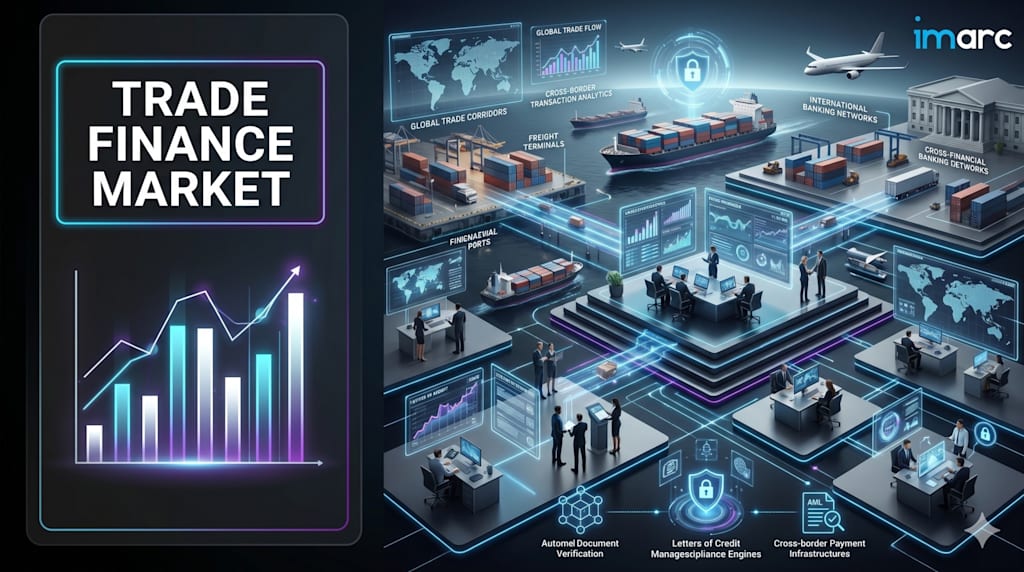
According to IMARC Group's latest research publication, The global trade finance market size was valued at USD 57.2 Billion in 2025. Looking forward, IMARC Group estimates the market to reach USD 91.9 Billion by 2034, exhibiting a CAGR of 5.41% during 2026-2034. The market is witnessing steady expansion, with projections indicating strong upside as international trade volumes grow, supply chains become more complex, and digital technologies reshape how exporters and importers manage liquidity and risk.
How AI is Reshaping the Future of Trade Finance Market
• Automated Risk Assessment and Credit Scoring: Artificial intelligence and data analytics are enhancing risk assessment processes, enabling financial institutions to make more accurate lending decisions and reduce funding gaps for businesses, particularly small and medium-sized enterprises. Machine learning models can evaluate creditworthiness, transaction history, and market conditions far more comprehensively than traditional manual underwriting, allowing banks to extend trade finance to a broader pool of qualified borrowers while maintaining disciplined risk controls.
• Blockchain-Enabled Document Automation: AI combined with blockchain is streamlining trade finance processes by automating tokenized documentation, payment triggers, and cross-border settlement. The Central Bank of Brazil's collaboration with Banco Inter, Microsoft Brazil, 7COMm, and Chainlink on its DREX digital currency pilot illustrates how blockchain's interoperability protocols are being used to automate trade documentation and enable secure, efficient international transactions at scale.
• Fraud Detection and Compliance Monitoring: As anti-money laundering and know-your-customer requirements become more stringent and complex, AI-driven systems are helping institutions monitor transactions in real time, flagging suspicious patterns and ensuring regulatory compliance. This capability is particularly valuable as cross-border commerce volumes rise, since manual compliance reviews cannot match the speed or scale required to screen high transaction volumes effectively.
• Supply Chain Visibility and Predictive Analytics: AI technologies are giving banks and trade finance houses greater visibility into supply chain risks, helping them anticipate disruptions from geopolitical conflicts or logistical bottlenecks before they affect financing arrangements. This predictive capability supports more resilient structured trade finance and supply chain finance solutions, helping businesses maintain working capital continuity even amid global supply chain uncertainty.
• Digital Platforms Expanding SME Access: Fintech-driven digital platforms are using AI to simplify and accelerate trade finance applications for smaller businesses that traditionally faced barriers accessing affordable financing. By automating much of the underwriting and documentation process, these platforms are helping SMEs secure liquidity faster, strengthening their relationships with suppliers and improving their ability to participate in international trade.
Trade Finance Industry Overview:
The global trade finance market is driven by the growing globalization of businesses and the increasing need for cross-border trade. The rising number of international trade agreements and collaborations is positively influencing demand for efficient financial instruments that facilitate large-scale transactions. Advancements in digital technologies, including blockchain and AI, are streamlining processes, enhancing transparency, and reducing operational risks across the sector. The Central Bank of Brazil's partnership with Banco Inter, Microsoft Brazil, 7COMm, and Chainlink for the second phase of its DREX digital currency pilot is exploring blockchain's potential in automating trade finance, focusing on tokenized documentation, automated payment triggers, and cross-border settlement using Chainlink's CCIP for interoperability, with the broader goal of enhancing supply chain management and facilitating secure, efficient international transactions. The rising focus on mitigating payment defaults and ensuring liquidity for exporters and importers continues to propel adoption of trade finance solutions, while emerging markets present significant opportunities given their rapid financial development.
Trade Finance Market Trends & Drivers
Rapid globalization and growing international trade volumes are bolstering market growth as businesses entering global markets invest in secure trade finance solutions to support cross-border transactions. The increasing dependence on e-commerce platforms is allowing businesses of all sizes to engage in international trade, with trade credit insurance and letters of credit becoming indispensable tools for reducing risks involved in cross-border commerce. As economies grow more interconnected and businesses search for new markets, trade finance services are becoming an increasingly necessary component of the global economy, with demand for financial instruments that facilitate international transactions continuing to climb.
The rising reliance on digital solutions is fundamentally improving how trade finance business gets conducted. Blockchain technology is helping reduce fraud and errors by offering unprecedented transparency and security in supply chain finance and trade settlements, while data analytics and artificial intelligence are enhancing risk assessment and enabling more accurate lending choices, particularly benefiting small and medium-sized firms that have historically struggled to access affordable credit. The rising emergence of fintech entrepreneurs developing innovative digital platforms to simplify trade finance is propelling market growth further, with India standing out as one of the most rapidly expanding fintech markets globally, reflecting the scale of digital transformation underway across emerging economies.
Changing regulatory environments are catalyzing demand for structured trade finance solutions as governing bodies and international organizations impose increasingly stringent rules on cross-border commerce. Anti-money laundering and know-your-customer requirements are becoming more complex, pushing businesses toward financial partners equipped to manage compliance efficiently. Supply chain complexity and resilience concerns are compounding this dynamic, as suppliers, logistics companies, and intermediaries spanning multiple nations face growing exposure to natural calamities and geopolitical conflicts. Businesses are increasingly turning to supply chain financing and trade credit insurance to mitigate these risks, improve working capital, secure short-term finance, and strengthen supplier relationships, with the International Credit Insurance and Surety Association noting that insured shipments under trade credit insurance reflect substantial coverage within the global trade sector.
Government initiatives are reinforcing this momentum across regions. In the United States, export promotion programs and favorable trade policies are providing additional impetus to market participants, supporting innovative financing solutions such as supply chain finance and electronic documentation. In Asia Pacific, India's RAMP scheme, backed by a government allocation of approximately USD 808 Million, is enhancing access to credit and institutional support for micro, small, and medium enterprises, empowering businesses with greater financing opportunities and sustainable practices. In the Middle East, rising energy investment is reinforcing trade finance activity tied to oil, gas, and infrastructure development, with regional governments channeling a meaningful share of new energy investment toward clean energy initiatives that are reshaping trade flows and associated financing needs.
Leading Companies Operating in the Global Trade Finance Industry:
• Asian Development Bank
• Banco Santander SA
• Bank of America Corp.
• BNP Paribas SA
• Citigroup Inc.
• Crédit Agricole Group
• Euler Hermes
• Goldman Sachs Group Inc.
• HSBC Holdings Plc
• JPMorgan Chase & Co.
• Mitsubishi UFJ Financial Group Inc.
• Morgan Stanley
• Royal Bank of Scotland
• Standard Chartered Bank
• Wells Fargo & Co.
Trade Finance Market Report Segmentation:
By Finance Type:
• Structured Trade Finance
• Supply Chain Finance
• Traditional Trade Finance
Supply chain finance stands as the largest segment, as it allows companies to extend longer payment durations to suppliers while securing early payment options for those needing liquidity, proving particularly beneficial for small and medium-sized enterprises.
By Offering:
• Letters of Credit
• Bill of Lading
• Export Factoring
• Insurance
• Others
Letters of credit lead the market, providing a secure method for international trade transactions by ensuring payment is made to the seller upon presentation of compliant shipping documents.
By Service Provider:
• Banks
• Trade Finance Houses
Banks lead the market, offering a wide range of trade finance services including letters of credit, trade credit insurance, and export financing, supported by well-established global presence and extensive networks.
By End-User:
• Small and Medium Sized Enterprises (SMEs)
• Large Enterprises
Large enterprises lead the market, engaging in extensive international trade activities and managing complex supply chains that require trade finance as a critical tool for optimizing working capital and mitigating risks.
Regional Insights:
• North America (United States, Canada)
• Asia Pacific (China, Japan, India, South Korea, Australia, Indonesia, Others)
• Europe (Germany, France, United Kingdom, Italy, Spain, Russia, Others)
• Latin America (Brazil, Mexico, Others)
• Middle East and Africa
North America exhibits a clear dominance in the trade finance market, supported by a robust economy, substantial international trade volume, and a strong financial infrastructure with well-established banking institutions.
Recent News and Developments in Trade Finance Market
• December 2024: Modifi announced plans to allocate a significant part of its recently secured Series C funding toward expanding its trade finance operations, with the investment focused on strengthening local markets and accelerating growth to enhance accessibility for SMEs in global trade.
• December 2024: HSBC and the World Bank's International Finance Corporation introduced a trade finance program to support emerging markets, aiming to strengthen cross-border trade and enhance exports in vital sectors while addressing global supply chain challenges.
• December 2024: The International Islamic Trade Finance Corporation and the United Nations Economic and Social Commission for Asia and the Pacific partnered to enhance exports in Central Asia through a regional trade connectivity program aimed at driving foreign direct investment and promoting sustainable development.
• November 2024: The African Development Bank approved a trade finance guarantee for Access Bank Sierra Leone Limited, aimed at enhancing access to financing for small and medium-sized enterprises and strengthening the country's private sector.
Note: If you require specific details, data, or insights that are not currently included in the scope of this report, we are happy to accommodate your request. As part of our customization service, we will gather and provide the additional information you need, tailored to your specific requirements. Please let us know your exact needs, and we will ensure the report is updated accordingly to meet your expectations.
About the Creator
Abhay Rajput
I am working in market research company that provides market and business research intelligence across the globe.
Enjoyed the story? Support the Creator.
Subscribe for free to receive all their stories in your feed.
Comments
There are no comments for this story
Be the first to respond and start the conversation.