
Top Epic Generative AI Tools Revolutionizing Healthcare in 2026
Epic Generative AI Tools
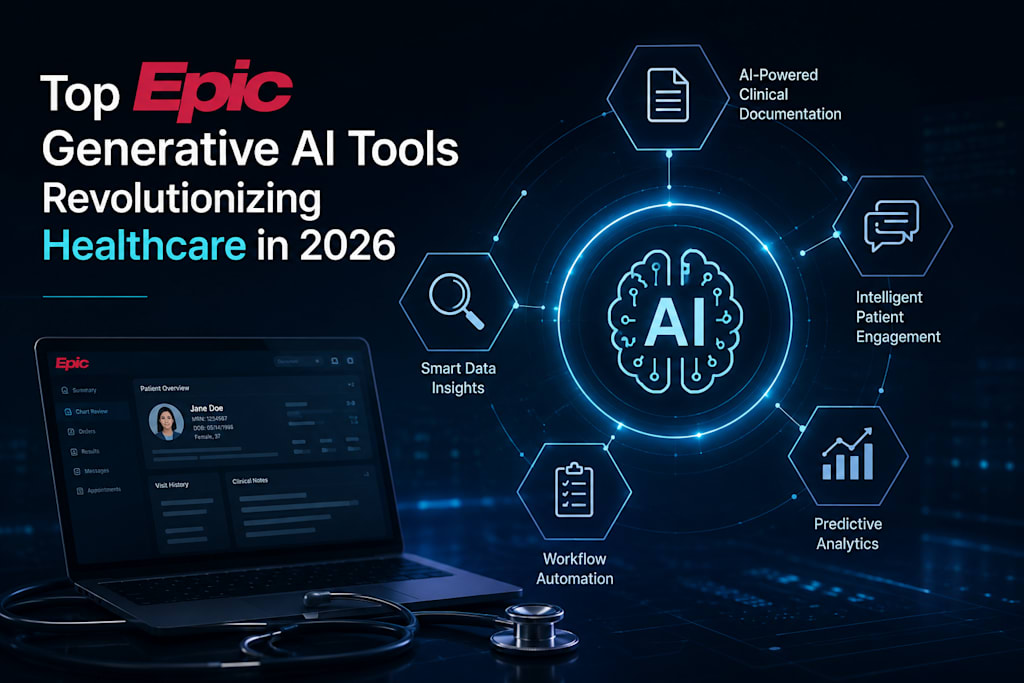
The healthcare industry has become faster than ever before. Providers are stretched in all directions, from regulation to patient expectations to a deluge of data. That is where the epic generative AI tools come into play and really are changing the landscape. They aren't only "tech buzz" items, they're functional and currently taking the place of conventional ways of thinking, recording, diagnosing and providing care.
This blog explains it in simple terms, and is perfect for any healthcare business that is unsure about AI's role in workflow, or any tech enthusiast that wants to know more.
Why Generative AI and Healthcare Are a Natural Fit
From clinical notes to imaging results, lab reports to insurance records, patient histories to a myriad of other datasets, healthcare produces more data than almost any other industry. The difficulty has always been the ability to rapidly and accurately make sense of it all. This is the type of challenge that Generative AI excels at. It can read, summarize, generate, and reason on an unimaginable amount of unstructured information without any time and without error.
When layered on top of platforms like Epic Systems, one of the most widely adopted electronic health record (EHR) systems in the US, the impact becomes even more significant. Organizations that work with certified Epic developers are already seeing how tightly integrated AI can streamline everything from patient intake to discharge documentation.
The Epic Generative AI Tools Making the Biggest Impact
1. AI-Powered Clinical Documentation Assistants
One of the biggest issues for doctors is documentation. Research has shown that doctors dedicate almost two hours on paperwork each hour they spend on patient care. Just as the tools are integrated into Epic's own environment, ambient AI tools listen to patient provider interactions in real time and create structured clinical notes automatically. This allows the doctor to concentrate on the patient in front of him rather than behind him.
The tools are among the most discussed epic generative AI tools currently in use and it's not surprising why. They eliminate burnout, minimize mistakes and enhance the quality of notes taken.
2. Generative AI for Radiology and Imaging
Time-sensitive and specialized, reading imaging scans. Machine learning algorithms that were fed millions of medical images can now identify abnormalities, generate initial radiology reports and even forecast the likelihood of disease progression. With an EHR, such as Epic, these results appear on the patient chart without having to transfer information from another system.
As one of the most well-established applications of artificial intelligence in healthcare, the American College of Radiology has been actively pushing the responsible use of AI in imaging workflow.
3. Clinical Decision Support Powered by LLMs
Reliable clinical data, treatment guidelines, and outcomes data are being used to fine-tune large language models for use as real-time decision support. These systems can surface relevant research, highlight drug interactions, or suggest next steps based on evidence when a physician is thinking about a diagnosis or treatment plan all in the EHR interface.
One of the more sophisticated categories of epic generative AI tools is a category that must be rigorously validated to guarantee the accuracy, but the initial results delivered by big health systems are promising.
4. Prior Authorization Automation
Prior authorization is a business problem that has been encountered before. It postpones treatment and takes up time of staff. With generative AI, prior authorization requests can now be automatically generated by extracting the appropriate clinical information from the patient chart to compare with the requirements of the payers. In some systems, turnaround times are being reduced by a lot, directly positively affecting patient outcomes.
5. Patient Communication and Engagement Tools
Patient communications, appointment reminders, care plans and post-visit instructions, created by AI, are becoming the norm. These tools extract data from the patient record to generate individualized and readable communication as opposed to form letters. Patients are more informed and staff is not as much engaged in routine outreach.
Often these features integrate directly into the health system's patient portal (MyChart), making them relatively easy to implement for Epic systems.
6. Revenue Cycle and Coding Assistance
Errors can be expensive, and the key to getting paid is accurate medical coding. A system powered by Generative AI and trained on ICD-10, CPT, and HCC codes can analyze clinical documentation and provide the most appropriate code, thus minimizing claim denials and revenue loss. This is one place where epic generative AI tools are giving tangible ROI in a matter of no time.
What to Keep in Mind
Adopting generative AI in healthcare is not a simple plug-and-play decision. Data privacy under HIPAA, model explainability, clinician trust, and workflow integration all require thoughtful planning. The best implementations are ones where AI augments human judgment rather than replacing it.
Organizations like Mayo Clinic Platform are doing important work in evaluating and validating AI tools before they reach the bedside, setting a benchmark for responsible adoption that others are beginning to follow.
The Road Ahead
2026 is a turning point year. The generative AI tools that are available today are much more capable, contextually aware and clinically aware than in the last two or three years. The healthcare organizations that think about moving forward and focus on creating the proper technical building blocks at this time will be best able to provide better care at lower cost in years to come.
From health systems and digital health startups to development teams creating EHR integrations, the potential to impact lives positively with generative AI has never been more significant.
About the Creator
Enjoyed the story? Support the Creator.
Subscribe for free to receive all their stories in your feed.
Comments
There are no comments for this story
Be the first to respond and start the conversation.