
Tomato Processing Market Outlook: Paste Production, Export Growth & Forecast to 2034
How convenience food consumption, advanced processing equipment, and strong retail demand are transforming the global tomato processing market outlook.

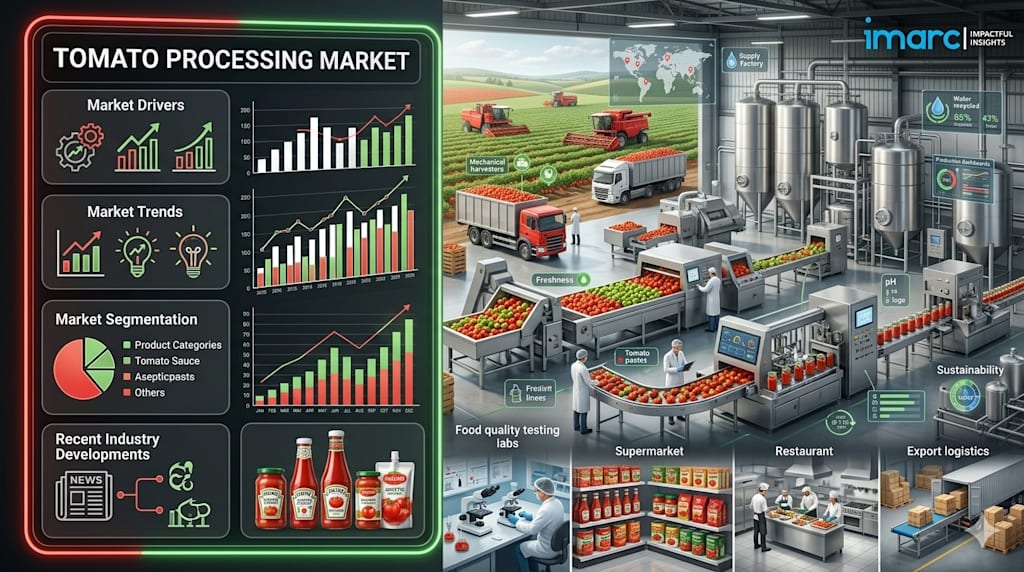
Rising demand for convenient, shelf-stable food products, expanding global cuisines, and growing consumer preference for nutritious ready-to-use tomato-based products are driving tomato processing market growth, supported by technological advancements, clean-label trends, and expanding retail and foodservice distribution channels. According to IMARC Group's latest data, the global tomato processing market size reached 50.1 Million Tons in 2025. Looking forward, IMARC Group expects the market to reach 66.3 Million Tons by 2034. Sauces currently dominate the product type segment, while the retail market accounts for the majority of the distribution channel share.
The tomato processing industry represents a critical pillar of the global food manufacturing ecosystem, converting perishable raw tomatoes into a wide array of shelf-stable, nutritionally rich products including sauces, pastes, canned tomatoes, ketchup, and juice. Demand is propelled by shifting consumer lifestyles favoring convenience, growing urbanization, and rising awareness of the superior lycopene bioavailability found in heat-processed tomato products compared to fresh alternatives.
Tomato Processing Market Growth Drivers:
Rising Demand for Convenience and Ready-to-Use Products
Busy urban lifestyles and evolving household structures are pushing consumers toward quick meal solutions that eliminate lengthy preparation without sacrificing taste or nutrition. Processed tomato products such as sauces, pastes, and ketchup fit this need precisely, offering cooking-ready formats for home users and foodservice operators alike. The sector continues to attract significant investment from manufacturers developing single-serve, resealable, and ambient-stable formats. Millennials and Gen Z consumers, who represent the fastest-growing grocery spending cohort, are a primary demand engine, consistently favoring products that combine ease of use with clean, recognizable ingredient lists.
Health and Nutritional Benefits of Processed Tomatoes
Tomatoes are rich in vitamins A and C and are among the most concentrated natural sources of lycopene, an antioxidant associated with cardiovascular health and reduced risk of certain chronic conditions. Importantly, heat processing increases the bioavailability of lycopene compared to fresh tomatoes, giving processed tomato products a scientifically supported nutritional edge. This distinction has driven brands to actively highlight health credentials on product labels and in marketing communications, attracting a growing base of health-conscious consumers. The industry is experiencing strong growth momentum in fortified and organic segments as manufacturers respond to demand for cleaner, more nutrient-dense formulations with reduced preservatives and lower sodium content.
Globalization of Cuisine and Foodservice Expansion
The global spread of Italian, Mexican, Indian, and Mediterranean cuisines, all of which rely heavily on tomato-based products as foundational ingredients, has created sustained cross-regional demand for sauces, purees, and pastes. International restaurant chain expansion across Southeast Asia, the Middle East, and Sub-Saharan Africa is generating significant B2B procurement volumes that directly benefit large-scale processing operations. The influence of digital food media, travel, and culinary tourism has further familiarized consumers across diverse geographies with tomato-centric dishes, reinforcing long-term structural demand well beyond traditional consuming markets in North America and Europe.
Tomato Processing Market Trends:
Advancements in Processing and Packaging Technology
Innovations in food processing technology are raising the quality ceiling and operational efficiency of the tomato processing market. High-pressure processing (HPP), which uses extreme water pressure rather than heat to eliminate pathogens, is enabling premium cold-pressed tomato products with superior flavor retention and extended shelf life. Advanced AI-powered sorting and grading systems, computer-vision quality control, and IoT-enabled production monitoring are reducing waste, improving product consistency, and lowering rejection rates at processing facilities. Vacuum sealing and aseptic packaging developments have further extended product shelf life to one to three years, making global distribution logistics more viable and cost-efficient for processors of all scales.
Clean-Label and Organic Product Innovation
Consumer preference for transparent labeling, recognizable ingredients, and free-from formulations is reshaping product development strategies across the tomato processing industry. Manufacturers are actively reformulating core products to eliminate artificial preservatives, reduce sugar content, and introduce certified organic and non-GMO variants. The farm-to-table movement and growing interest in traceable sourcing are influencing both retail and foodservice purchasing decisions, pushing processors toward more accountable supply chain practices. Market fundamentals remain highly favorable for brands that successfully communicate ingredient provenance, as purchase intent among health-aware consumers correlates strongly with clean-label claims and verified organic certification.
E-Commerce and Retail Channel Expansion
Online retail platforms have fundamentally altered the geographic reach of processed tomato products, enabling brands to penetrate tier-2 and tier-3 cities across Asia, Latin America, and Africa where traditional retail infrastructure remains underdeveloped. The retail segment, encompassing supermarkets, hypermarkets, specialty stores, convenience outlets, and online channels, commands the majority of the global distribution share. E-commerce specifically is removing the last-mile access barriers that previously limited branded product availability to urban centers. Simultaneously, private-label launches by major grocery chains are intensifying competitive pressure, compelling established brands to differentiate through premium positioning, unique flavors, and functional ingredient claims.
Recent News and Developments in Tomato Processing Market
August 2025: A major European food conglomerate announced a significant capacity expansion at its tomato paste processing facility in southern Italy, adding approximately 120,000 tons of annual processing volume to meet accelerating demand from North African and Middle Eastern markets.
March 2025: A California-based tomato processing cooperative partnered with an agri-tech firm to deploy AI-powered sorting and grading systems across three production plants, achieving an estimated 18% reduction in product rejection rates and measurable gains in throughput efficiency.
November 2024: The Indian government approved expanded support for tomato-based product manufacturers in Maharashtra and Andhra Pradesh under the Production Linked Incentive (PLI) scheme for food processing, reinforcing national infrastructure for the sector.
June 2024: A leading global ketchup brand reformulated its flagship product line to cut sugar content by 20% and remove all artificial preservatives, responding to clean-label consumer pressure and tightening regulatory standards in the UK and EU markets.
Note: If you require specific details, data, or insights that are not currently included in the scope of this report, we are happy to accommodate your request. As part of our customization service, we will gather and provide the additional information you need, tailored to your specific requirements. Please let us know your exact needs, and we will ensure the report is updated accordingly to meet your expectations.
About the Creator
Suhaira Yusuf
I specialize in Consumer Insights, focusing on transforming detailed market data into strategic business solutions that accelerate growth and improve customer engagement.
Enjoyed the story? Support the Creator.
Subscribe for free to receive all their stories in your feed.
Comments
There are no comments for this story
Be the first to respond and start the conversation.