
Time Travel
Do you remember when technology was a tool?

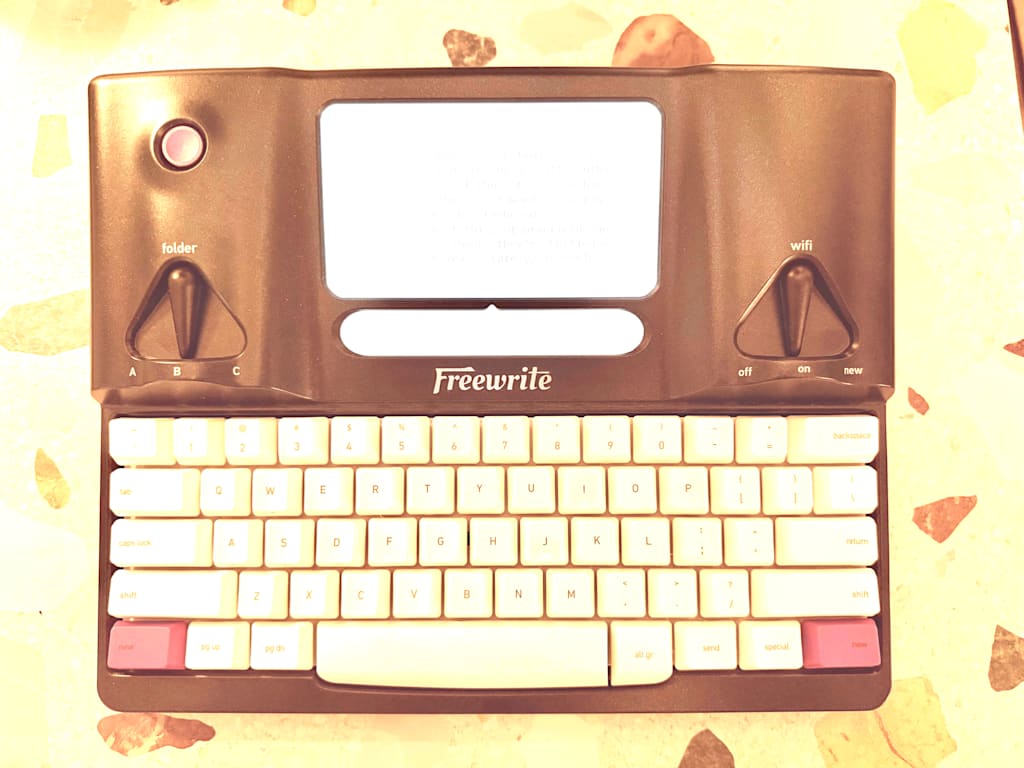
The keys under my fingertips are raised—tapered white cubes that subtly resist being pressed before giving way with a satisfying click. Although new, they feel strangely familiar, like a dredged-up memory: sounds and sensations colliding under the fluorescent lights of my high school typing class, fingers fumbling to find the right letters beneath paper-covered keys.
I'm writing on my new digital typewriter, its keyboard reminiscent of a 1990-something IBM, with a small screen where letters blink their way into words and lines and pages. It can connect to the internet, but only to back up the writing stored on the device. The non-keyboard buttons are large and tactile, too—physical toggles and switches.
I’m at once here, in 2026, and transported backward in time. I could be fifteen, playing Snake on my Nokia phone, waiting for a text message reply from a friend, bored in the ways that used to be an ordinary part of everyday life. We sang songs into fan blades just to hear our voices change; a choppy, vibrato-distorted rendition of Nelly Furtado’s “I’m Like a Bird” before there was an app for that.
I bought the typewriter mostly to see what would happen to my brain if I gave it more space. If I took away the option for distraction—no tabs waiting to be opened, no notifications asking to be cleared, no quick detour to look something up that somehow ends 45 minutes later somewhere entirely different.
And almost immediately, my brain clicked back into a way of engaging with technology that I had nearly forgotten.
Technology became a tool again: something separate from me. Not something constantly affecting my thoughts or augmenting my reality, but something tertiary. Something I physically sit down in front of and get up from. Something I power on and, perhaps more importantly, power off.
Do you remember sharing a computer with the entire family? The dial-up tone of connecting to the internet reverberating through the house, etched into our brains forevermore. The opening window of The Oregon Trail, a rattlesnake perched above the “Quit” and “Travel the Trail” buttons. The way it felt to forge down the river on a too-small raft. To die of dysentery. To hunt far more meat than you could carry because bison were the easiest targets.
Do you remember yelling at your sister to get off the phone so you could sign into AIM, then scanning the list of “Online” friends for your favorite people? Do you remember calling your friend’s house or just popping over to see if they were up to something? There was no anxiety about what you might be interrupting, because interrupting was the whole point.
Perhaps Millennials are so reluctant (or perhaps I am so reluctant) to accept this version of being perpetually connected because we know we didn’t start off this way.
Somewhere, stored in our earliest memories, in the ways we first learned to be people in the world, we remember what it felt like to be disconnected. To be offline when we wanted and online when we could.
We live at a time when we are constantly pulled toward stimulation, productivity, input (or at least the possibility of it). At the same time, we’re sold the idea that all of this is saving us time, even as we trade away some of our ability to think, wander, and synthesize the world around us.
Tools promising to make us more efficient come at us from every angle: “Do you want to try AI for this?” “Would you like a summary of that?” “Can we automate this for you?” Often delivered through the very platforms engineered to capture whatever attention we have left.
But lately, I’ve been thinking too much about that trade-off. I’ve been remembering what it felt like to be unproductive. To stare into a fan and daydream about who I wanted to be. I’m a Millennial, raised on buying stickers from coin machines and considering that a legitimate form of entertainment.
I remember too much to be entirely sold on the idea that boredom is bad. That space to think and feel is an emptiness waiting to be filled. Maybe augmenting myself with technology will help me produce something cleaner, more polished, more accurate. Maybe it will make me faster. Maybe it will make some of the things I create objectively better.
But I’m not willing to trade away the parts of me that change through the process of making them. Like a craftsperson whose hands are calloused from hours spent whittling a chunk of wood into something new—something beautiful, something flawed—I want to create imperfect things partly because of what creating them does to me.
I want to write and make art that could be better. That could be sharper. That could be produced faster and consumed more easily. But I also want it to remain wholly mine, made by a human who was changed, however slightly, in the act of making it.
This typewriter is a small step backward toward an analog life. An opportunity to return, if only for the time I’m sitting in front of it, to a time when I was a person who thought days were long. Who had hours I didn't know how to fill and had to invent ways to stay engaged. Who knew boredom not as a problem to solve, but simply as part of being alive.
About the Creator
Emily Erickson
Head in the clouds, dirt in strange places.
Writer of essays, fiction, and poetry.
Columnist – find my work here.
Enjoyed the story? Support the Creator.
Subscribe for free to receive all their stories in your feed.
Comments
There are no comments for this story
Be the first to respond and start the conversation.