
Time and Attendance Software Market Trends: Workforce Automation, Cloud Adoption & Forecast to 2034
How workforce automation, cloud-based solutions, and digital HR transformation are improving employee tracking and operational efficiency in the time and attendance software market

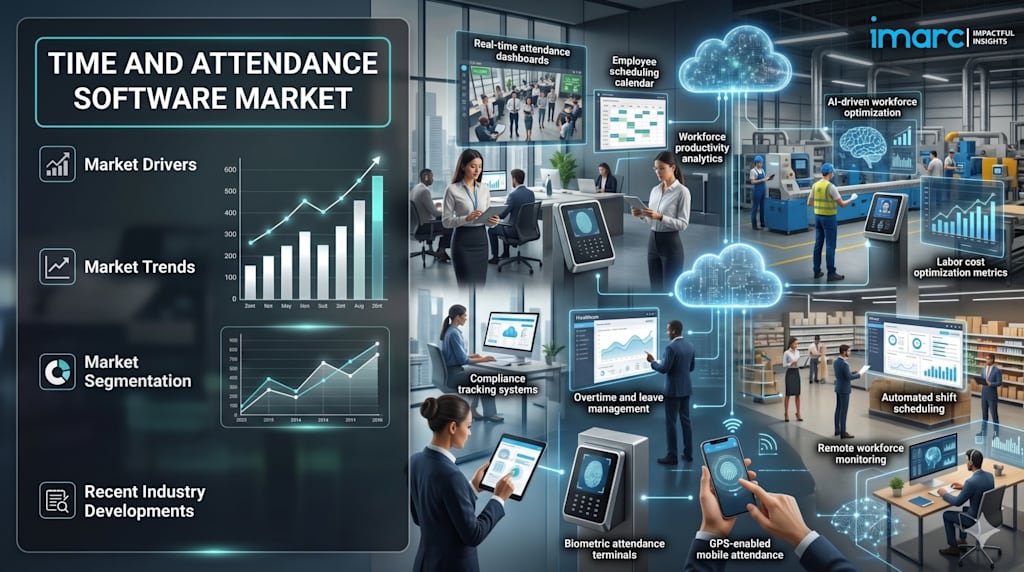
According to IMARC Group's latest research, The global time and attendance software market size was valued at USD 3.3 Billion in 2025. Looking forward, IMARC Group estimates the market to reach USD 5.7 Billion by 2034, exhibiting a CAGR of 6.29% during 2026-2034. North America leads all regions with a market share of over 37.8%, supported by advanced IT infrastructure, early cloud adoption, and growing remote workforce management needs.
How AI Is Reshaping the Time and Attendance Software Market
- AI-Powered Predictive Scheduling: Machine learning algorithms analyze historical attendance records, business activity volumes, and seasonal trends to auto-generate optimized shift schedules. This reduces both overstaffing and understaffing scenarios while cutting unnecessary labor costs. In the healthcare sector, where over 17 million workers are employed in the United States alone according to the Bureau of Health Workforce, intelligent scheduling tools are essential for managing complex, compliance-driven staffing rotations across multiple departments and facilities.
- Biometric Authentication and Buddy Punching Prevention: AI integrated with biometric tools such as facial recognition and fingerprint scanning has addressed one of the most persistent issues in manual timekeeping: proxy clock-ins. This capability is especially valuable in retail and e-commerce, the leading end-user segment with 20.6% market share, where large numbers of part-time and shift workers create significant exposure to attendance fraud without automated verification.
- GPS Geofencing for Remote Workforce Verification: Mobile-first platforms now embed GPS geofencing to confirm employee location at the time of clock-in, offering managers real-time visibility into distributed workforces. With at least 36.2 million American employees expected to work remotely according to the US Career Institute, tools that verify presence without physical supervision have become a baseline requirement for organizations managing location-independent teams.
- Integration With ERP and Payroll Systems via AI: AI-driven time and attendance solutions increasingly support native integration with enterprise resource planning and human resource management systems, enabling automated payroll computation and compliance reporting without manual data transfers. The ERP software market is projected to grow at approximately 10% in the near term, pulling demand for integrated attendance solutions as businesses pursue unified operational platforms.
- Anomaly Detection and Compliance Monitoring: AI systems continuously scan attendance data for irregular patterns such as unauthorized overtime, unexplained absenteeism, or scheduling policy violations. This real-time monitoring capability helps large enterprises, which lead the market by organization size, maintain compliance with labor regulations across multi-location operations without depending on manual HR audits.
- Mobile App-Based Tracking for Hybrid Workforces: Vendors are deploying AI-assisted mobile applications that support remote clock-ins, leave requests, shift swaps, and productivity monitoring from a single interface. These platforms are particularly relevant in Asia Pacific, where 48% of workers adopted new digital tools in 2023, driving organizational demand for automated workforce management solutions that scale with a digitally agile employee base.
Time and Attendance Software Industry Overview
Cloud-based deployment has become the dominant model, accounting for approximately 65.5% of market share by deployment mode. Businesses across sectors prefer cloud platforms for their remote accessibility, lower total cost of ownership, and continuous software updates without on-premises maintenance burdens. This has opened the market to small and medium-sized enterprises (SMEs) that previously lacked the IT budgets for legacy workforce management infrastructure.
North America holds over 37.8% of the global market, with the United States contributing 89.50% of the regional share. A key driver is the normalization of flexible work, with 65% of US companies offering some form of work flexibility as of 2024, a 14 percentage point increase from the prior year. This has made accurate, location-agnostic timekeeping a strategic HR priority rather than a back-office function.
Europe is growing steadily, with the European Commission documenting an 8% increase in the share of EU employees regularly working from home between 2019 and 2021. The influx of international healthcare professionals has added further complexity, with OECD data showing a 17% rise in foreign-trained doctors entering European countries in 2022 compared to 2019, creating additional demand for multilingual, compliance-capable attendance platforms.
Latin America is building momentum, with Brazil recording 7.4 million teleworkers as of 2022, representing 7.7% of total national employment according to the Brazilian Institute of Geography and Statistics. Manufacturing, retail, and healthcare sectors across the region are leading adoption, integrating attendance platforms with payroll and HR systems to meet labor law requirements in a rapidly digitalizing environment.
The Middle East and Africa region is leveraging healthcare sector expansion as a primary growth engine. The UAE alone reports over 181,000 healthcare professionals, creating structured demand for shift management and labor compliance tools. This trend extends across retail, manufacturing, and education, as governments in the region prioritize workforce optimization as part of broader digital transformation strategies.
Time and Attendance Software Market Trends and Drivers
Workforce Management Efficiency as a Core Business Objective: By 2023, 88% of large organizations and 56% of small-to-medium businesses had adopted workforce management solutions, signaling a decisive industry shift from manual to automated timekeeping. Organizations that previously relied on spreadsheets or punch cards are facing compounding costs from payroll errors, compliance penalties, and wasted administrative hours, creating a clear financial case for software-driven automation.
Sustained Growth of Remote and Hybrid Work Models: The work-from-home rate in the United States stabilized at 28% as of mid-2023 per the Bureau of Labor Statistics, confirming that remote work is a permanent structural shift rather than a temporary pandemic response. This has elevated demand for cloud-accessible, device-agnostic attendance platforms that give HR managers real-time visibility across geographically dispersed teams without requiring physical presence validation.
Labor Compliance Complexity Driving Software Adoption: Companies operating across multiple jurisdictions face increasingly complex labor law landscapes covering overtime thresholds, break entitlements, and maximum shift durations. Automated compliance monitoring embedded within time and attendance platforms reduces the risk of regulatory violations. The retail sector, with its high proportion of part-time, seasonal, and variable-hour workers, faces particularly acute compliance exposure, making automated tracking a risk management imperative.
SaaS Models Democratizing Enterprise Tools for SMEs: The shift to software-as-a-service delivery has fundamentally changed the buyer landscape. SMEs that previously could not justify the capital expenditure of on-premises deployments can now access real-time attendance tracking, leave management, and payroll integration at predictable monthly subscription costs. This has significantly broadened the addressable market for time and attendance vendors.
System Interoperability as a Key Vendor Differentiator: Businesses increasingly evaluate time and attendance solutions based on their ability to integrate with existing technology stacks including payroll processors, HRMS platforms, and ERP systems. Vendors that offer pre-built connectors and open APIs are gaining preference among large enterprises managing complex, multi-system HR ecosystems. The growing ERP market creates a natural expansion channel for time and attendance providers with strong integration capabilities.
Retail and E-Commerce Driving End-User Demand: The retail and e-commerce segment leads end-user adoption with 20.6% market share, reflecting the sector's reliance on 24/7 operations, high workforce turnover, and multi-shift scheduling. Features such as real-time attendance dashboards, mobile clock-in, and automated overtime alerts directly address the operational challenges faced by large retailers managing thousands of hourly workers across multiple store locations.
Time and Attendance Software Market Report Segmentation
By Component:
- Software
- Services
Software leads the component segment, driven by SaaS model adoption, real-time tracking capabilities, and seamless integration with payroll and HR platforms. Demand is particularly strong among SMEs seeking cost-effective, scalable solutions without large IT overhead.
By Deployment Mode:
- On-premises
- Cloud-based
Cloud-based solutions command approximately 65.5% of deployment share, preferred for their flexibility, remote accessibility, and elimination of hardware maintenance costs. Cloud platforms are well-suited for the growing number of organizations managing hybrid and remote workforces.
By Organization Size:
- Small and Medium-sized Enterprises
- Large Enterprises
Large enterprises lead this segment, requiring advanced multi-location tracking, ERP and HRMS integration, and enterprise-grade compliance management. SMEs are the fastest-growing adopters, enabled by affordable SaaS pricing and low implementation barriers.
By End User:
- BFSI
- IT and Telecom
- Healthcare
- Retail and E-Commerce
- Manufacturing
- Government
- Education
- Others
Retail and e-commerce leads with 20.6% end-user share, driven by large shift-based workforces, seasonal hiring cycles, and strict labor compliance requirements across multiple regional jurisdictions.
By Region:
- North America
- Asia Pacific
- Europe
- Latin America
- Middle East and Africa
North America dominates with over 37.8% of global market share, anchored by the United States which holds 89.50% of the regional market, backed by widespread cloud infrastructure and the highest concentration of remote-work-adopting enterprises globally.
Leading Companies Operating in the Global Time and Attendance Software Industry
- ADP, Inc.
- Dayforce
- Fingercheck, LLC
- nettime solutions
- Oracle
- Paychex Inc.
- Paycom Payroll LLC
- Paycor Inc.
- SAP SE
- UKG Inc.
- Workday Inc.
- Zebra Technologies Corp.
Recent News and Developments
- June 2024: Patriot Software launched the My Patriot mobile application, providing both hourly and salaried employees with a streamlined interface to track and manage work hours directly integrated with the company's Time and Attendance software, extending mobile access to a broader segment of the workforce.
- May 2024: Dell introduced a structured office attendance tracking policy for hybrid employees, using electronic badge scans, VPN login data, and color-coded visual dashboards to monitor workforce attendance patterns and enforce hybrid work commitments across its global operations.
- February 2024: Poll Everywhere launched an Attendance Management feature for the education sector, enabling faculty to track student attendance through geolocation technology, demonstrating the expanding application of time and attendance software beyond traditional corporate environments into academic institutions.
Note: If specific details, data, or insights beyond the current scope of this content are required, additional customization can be arranged to address particular regional markets, industry verticals, or competitive landscapes based on your specific research needs.
About the Creator
Abhay Rajput
I am working in market research company that provides market and business research intelligence across the globe.
Enjoyed the story? Support the Creator.
Subscribe for free to receive all their stories in your feed.
Comments
There are no comments for this story
Be the first to respond and start the conversation.