
Third-Party Banking Software Market Trends: Cloud Integration, Digital Transformation & Forecast to 2034
How rising defense modernization programs, military procurement activities, and homeland security investments are driving technological innovation and global demand growth in the firearms market

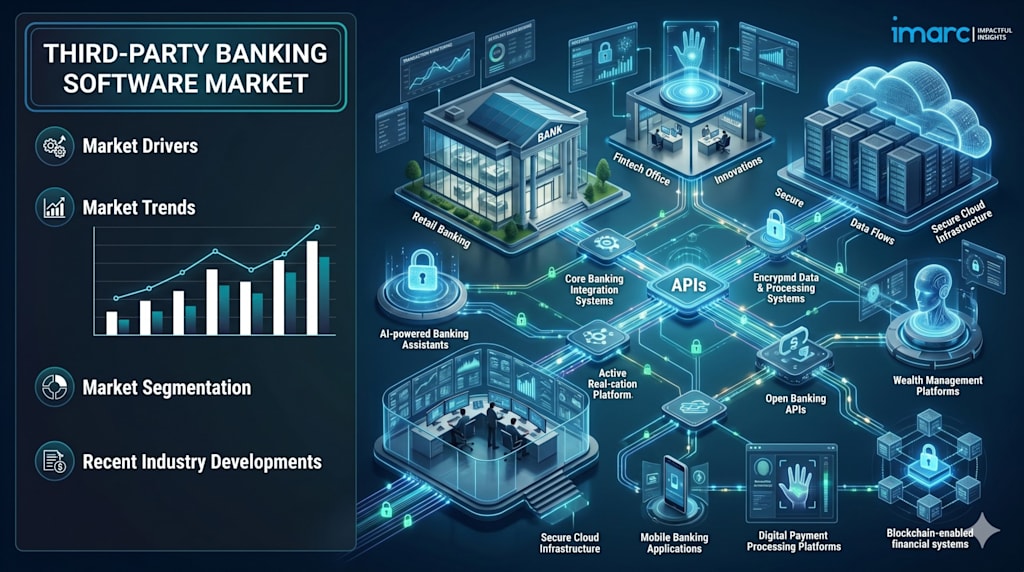
According to IMARC Group's latest research publication, The global third-party banking software market size was valued at USD 33.0 Billion in 2025. Looking forward, IMARC Group estimates the market to reach USD 58.0 Billion by 2034, exhibiting a CAGR of 6.27% during 2026-2034.
How AI is Reshaping the Future of Third-Party Banking Software Market
- Intelligent Risk Detection and Real-Time Threat Mitigation: AI-powered risk management modules embedded within third-party banking software analyze transaction streams, behavioral data, and market signals in real time to detect credit, operational, and cybersecurity risks before they escalate. Financial institutions deploying these solutions are achieving measurable improvements in proactive threat identification, minimizing financial exposure and reducing the volume of manual interventions required from compliance and risk teams. This capability is particularly critical given that cybercrime costs are projected to reach USD 10.5 Trillion globally, making AI-driven risk intelligence a non-negotiable priority for banks operating across digital channels.
- Automated Compliance Monitoring and Regulatory Reporting: Machine learning algorithms integrated into third-party banking platforms continuously monitor transaction activity, data-sharing practices, and operational workflows against evolving regulatory frameworks including CFPB guidelines, GDPR, and open banking data-sharing mandates. These automated compliance engines generate audit-ready documentation and flag deviations in real time, eliminating the burden of manual regulatory reporting and significantly reducing the risk of penalties. Financial institutions across North America and Europe are increasingly relying on these AI-enabled compliance tools to maintain operational integrity while simultaneously accelerating their digital transformation agendas.
- Predictive Analytics for Customer-Centric Banking: AI embedded in multi-channel banking software analyzes customer transaction histories, behavioral patterns, and engagement signals to deliver hyper-personalized product recommendations, credit assessments, and service interactions. Banks leveraging these predictive capabilities are improving customer retention, increasing cross-sell conversion rates, and building deeper digital engagement across mobile and online platforms. As digital banking users in the United States alone are forecast to reach 216.8 Million, the ability to anticipate customer needs through AI-powered analytics is becoming a defining competitive differentiator for retail and trading banks.
- Cloud-Native Architecture Optimization and Scalability Management: AI tools within cloud-based third-party banking platforms dynamically manage resource allocation, system load balancing, and infrastructure scaling based on real-time transaction volumes and demand forecasts. These intelligent systems enable banks to transition away from legacy on-premises infrastructure while maintaining performance reliability, regulatory compliance, and data security. The growing preference among financial institutions for cloud solutions that reduce operational expenditure and eliminate massive upfront infrastructure investments is accelerating the adoption of AI-optimized cloud-native banking software across all institution sizes and geographies.
- Fraud Prevention and Secure Transaction Authentication: AI technologies combined with biometric authentication, behavioral analytics, and advanced encryption enable end-to-end fraud detection throughout digital banking transaction lifecycles, allowing institutions to identify anomalous patterns and intercept unauthorized activity with exceptional precision. AI-powered fraud prevention systems reduce false positives that frustrate legitimate customers while simultaneously catching sophisticated fraud schemes that rule-based systems miss entirely. This comprehensive security intelligence helps third-party banking software providers and their financial institution clients maintain consistent trust standards, comply with data protection regulations, and protect the sensitive financial records and personal identification data of millions of customers.
Third-Party Banking Software Industry Overview:
The rising adoption of digital platforms and cloud-based technologies across the global banking sector is fundamentally transforming how financial institutions procure, deploy, and integrate software solutions. As of a recent reporting period, 602 banks were actively using UPI, with total digital transactions reaching 15.08 Billion and valued at Rs. 2,10,000 Crore, according to IBEF, illustrating the extraordinary scale at which digital financial infrastructure is now operating. Unlike traditional manual methods, financial institutions are increasingly shifting toward automated accounting systems for managing finances and transactions, with consumers simultaneously migrating to smartphones, laptops, and tablets as their primary banking interfaces. The regulatory environment is reinforcing this momentum, with the Consumer Financial Protection Bureau compelling banks to provide consumers simpler access to their financial information, accelerating the evolution of open banking frameworks that encourage third-party software integration across the United States. The European Investment Bank Group signed nearly USD 96.6 Billion in new financing for over 900 projects, mobilizing approximately USD 380 Billion in investment and supporting around 5.8 Million jobs, a scale of institutional activity that is directly accelerating digitization efforts and boosting demand for scalable third-party banking software across the European market. India's fintech industry, currently valued at approximately USD 111 Billion and projected to reach USD 421 Billion, has established itself as the third-largest fintech ecosystem globally, creating powerful institutional demand for agile third-party software capable of serving digitally native consumers at population scale.
Third-Party Banking Software Market Trends and Drivers
The explosive expansion of digital banking ecosystems and the deepening complexity of financial regulatory environments are the primary forces driving third-party banking software demand across global markets. U.S. bank executives have announced plans to increase IT and technology spending by at least 10% to enhance security measures following multiple data breaches, reflecting the direct link between cybersecurity pressure and software investment. The risk management application segment leads adoption with a market share of 41.6%, driven by the growing complexity and volatility of financial markets that require banks to proactively detect, assess, and address credit, market, operational, and cyber risks in real time. The integration of artificial intelligence and machine learning into risk management software has further revolutionized the ability of financial institutions to identify behavioral patterns and predict risk escalation before it materializes. Strategic acquisitions are simultaneously reshaping the competitive landscape, exemplified by Axway's acquisition of Sopra Banking Software in October 2024, which significantly strengthened its open banking capabilities and positioned the combined entity to meet newly introduced CFPB regulations with enhanced API management and a more streamlined data architecture. Over 70% of Brazilians now use digital banking services, while the Saudi Arabian digital banking market was valued at USD 87.60 Million and is projected to reach USD 278.19 Million, underscoring the breadth of geographic opportunity driving third-party software adoption across emerging and frontier markets.
Partnership-driven innovation and product diversification are accelerating the market's ability to address sector-specific operational requirements across retail banking, trading, commercial, and community banking segments. In May 2025, Tietoevry Banking entered a strategic partnership with Lokalbank to deliver a comprehensive, tailored banking platform for the Norwegian market integrating core banking services with mobile and online banking, payment systems, card services, and anti-financial crime tools, freeing up institutional resources for customer advisory and sales functions. The retail and trading banking segment leads end-user adoption with a market share of 62.3%, driven by demand for advanced customer relationship management software, omnichannel solutions, real-time trading platforms, and AI-powered portfolio management capabilities. Core banking software commands the largest product segment share at 37.3%, reflecting the institution-wide demand for integrated platforms that streamline daily transactions, account updates, and centralized data management while ensuring adherence to regulatory compliance and data protection requirements. On-premises deployment retains the dominant share at 82.4% as financial institutions with stringent compliance mandates and sensitive data management requirements continue to prioritize internal control over IT infrastructure, while cloud-based adoption is rapidly accelerating among institutions seeking scalability, cost efficiency, and seamless integration with emerging fintech platforms.
Infrastructure investment, financial inclusion mandates, and the growing penetration of mobile-first banking are creating additional and sustained growth avenues for the third-party banking software market across all major regions. North America maintains market leadership with a 36.6% share, underpinned by advanced technological infrastructure, growing fintech ecosystems, and IT budgets that have grown by an average of 26% overall, with North American enterprises outpacing European counterparts significantly. The Asia Pacific region is witnessing dynamic growth driven by rapid urbanization, expanding mobile internet penetration, and government-backed financial inclusion programs that are prompting banks to implement localized, scalable third-party solutions for digitally native consumer populations. Regional municipality frameworks, open finance initiatives across Europe, and the growing deployment of real-time payment platforms across Asia Pacific are collectively creating standardized market conditions that benefit established third-party software providers and accelerate the entry of innovative new solutions across previously underserved financial segments.
Leading Companies Operating in the Global Third-Party Banking Software Industry:
- Accenture
- Capgemini
- Deltek
- IBM
- Infosys
- Microsoft Corporation
- NetSuite Inc.
- Oracle Corporation
- SAP SE
- Tata Consultancy Services
Third-Party Banking Software Market Report Segmentation:
By Product:
- Core Banking Software
- Multi-Channel Banking Software
- Business Intelligence Software
- Others
Core banking software dominates the market with a share of 37.3%, driven by the growing demand for integrated, efficient solutions that streamline daily transactions, account updates, and centralized data management while ensuring scalability and regulatory compliance across financial institutions.
By Deployment Type:
- On-premises
- Cloud-based
On-premises deployment represents the largest segment with a share of 82.4%, as financial institutions prioritize internal control over IT infrastructure for enhanced security, privacy, compliance capabilities, and seamless integration with existing legacy systems.
By Application:
- Risk Management
- Information Security
- Business Intelligence
- Others
Risk management holds the largest application share at 41.6%, owing to the growing complexity and volatility in financial markets that require banks to proactively detect, assess, and address credit, market, operational, and cyber risks in real time.
By End User:
- Commercial Banks
- Retail and Trading Banks
Retail and trading banks hold the largest end-user share at 62.3%, driven by demand for personalized service delivery, advanced CRM software, omnichannel solutions, and real-time trading and portfolio management platforms powered by AI and data analytics.
Regional Insights:
- North America (United States, Canada)
- Asia Pacific (China, Japan, India, South Korea, Australia, Indonesia, Others)
- Europe (Germany, France, United Kingdom, Italy, Spain, Russia, Others)
- Latin America (Brazil, Mexico, Others)
- Middle East and Africa
North America exhibits a clear dominance in the third-party banking software market, accounting for a market share of 36.6%, driven by its advanced technological infrastructure, high digital banking adoption rates, and the presence of leading financial institutions and a robust fintech ecosystem.
Recent News and Developments in the Third-Party Banking Software Market
- April 2025: Backbase introduced an AI-powered banking platform integrating real-time data insights and modular Agentic AI for task automation. The platform unified digital sales and customer service capabilities while emphasizing responsible AI deployment, with its AI Factory delivery model enabling banks to implement solutions faster and accelerate their transition from legacy systems to AI-driven banking operations.
- February 2025: Galoy launched Lana, enabling banks to issue bitcoin-backed loans using open-source software. The platform offered customization for loan terms, collateral monitoring, and risk management, supporting financial institutions entering the crypto lending space while addressing regulatory shifts and integrating open banking tools to reduce borrowing costs and expand financial access.
Note: If you require specific details, data, or insights that are not currently included in the scope of this report, we are happy to accommodate your request. As part of our customization service, we will gather and provide the additional information you need, tailored to your specific requirements. Please let us know your exact needs, and we will ensure the report is updated accordingly to meet your expectations.
About the Creator
Abhay Rajput
I am working in market research company that provides market and business research intelligence across the globe.
Enjoyed the story? Support the Creator.
Subscribe for free to receive all their stories in your feed.
Comments
There are no comments for this story
Be the first to respond and start the conversation.