
Thermal Interface Materials Market: Powering the Next Generation of Electronics
As devices become faster, smarter, and more powerful, the materials that keep them cool are emerging as silent drivers of technological progress.

Modern technology thrives on performance. From artificial intelligence servers processing enormous datasets to electric vehicles navigating city streets, today's devices are expected to do more while operating reliably under intense conditions. Behind this performance lies a challenge that often goes unnoticed: heat management.
As electronic components become increasingly compact and powerful, controlling temperature has become critical. Excessive heat can reduce efficiency, shorten product lifespan, and even lead to system failures. This growing need for effective thermal management is transforming the Thermal Interface Materials Market from a niche segment into a strategic industry essential to innovation across multiple sectors.
Market Highlights
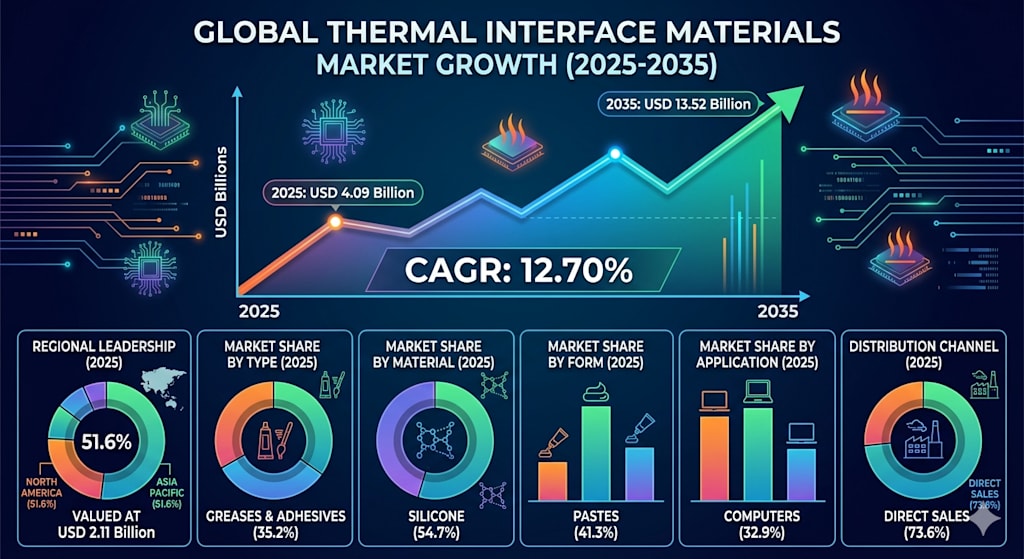
- The Thermal Interface Materials Market will grow from USD 4.09 Billion in 2025 to USD 13.52 Billion by 2035, at a CAGR of 12.70%.
- Asia Pacific leads all regions with a 51.6% share, valued at USD 2.11 Billion.
- Greases and Adhesives dominate the By Type segment with 35.2% share.
- Silicone leads By Material at 54.7%.
- Pastes lead By Form at 41.3%.
- Computers lead By Application at 32.9%.
- Direct Sales dominates By Distribution Channel at 73.6%.
The Unsung Heroes of Thermal Management
Thermal interface materials, often abbreviated as TIMs, are designed to improve heat transfer between components that generate heat and the cooling systems that dissipate it. Even surfaces that appear smooth contain microscopic imperfections that trap air, a poor conductor of heat. TIMs fill these tiny gaps, creating a more efficient thermal pathway.
These materials come in various forms, including greases, adhesives, pads, gels, films, and phase-change compounds. Each solution offers unique advantages depending on the application. Some prioritize ease of installation, while others focus on maximizing thermal conductivity or durability under extreme conditions.
Their role may not be visible to end users, but without them, many of today's technological advancements would struggle to achieve the reliability and efficiency consumers and industries demand.
Why Demand Is Accelerating Across Industries
Several industries are driving unprecedented growth in thermal management solutions. Among the most influential are artificial intelligence infrastructure and electric mobility.
AI accelerators and high-performance processors generate tremendous amounts of heat during operation. Data centers housing these systems are under pressure to improve energy efficiency while maintaining peak computational performance. Since cooling systems can account for a substantial portion of operational energy use, even modest improvements in thermal efficiency can translate into meaningful cost savings.
Electric vehicles present a different but equally demanding challenge. Battery packs, power electronics, and charging systems undergo continuous thermal cycling and vibration. Materials used in these environments must withstand harsh operating conditions without sacrificing performance over time.
Beyond these sectors, telecommunications, aerospace, healthcare devices, industrial automation, and consumer electronics continue to expand their reliance on sophisticated thermal solutions. As electronic complexity increases, the importance of effective heat transfer grows alongside it.
Innovation Is Redefining Performance Standards
The industry is experiencing a shift from cost-driven purchasing decisions toward performance-focused specifications.
Traditional silicone greases remain widely used because of their reliability, affordability, and versatility. However, emerging applications increasingly require higher conductivity levels and improved long-term stability. This demand is pushing manufacturers to explore advanced filler technologies and alternative material systems.
Recent developments demonstrate how rapidly the field is evolving. Composite materials that outperform conventional metals in thermal conductivity are challenging established benchmarks. High-performance liquid formulations designed specifically for advanced optical and computing hardware are enabling more precise application methods and improved heat dissipation.
This wave of innovation signals a broader transformation. Competitive advantage is no longer determined solely by the price of materials. Instead, customers increasingly evaluate solutions based on measurable outcomes such as reduced operating temperatures, improved energy efficiency, and enhanced equipment longevity.
Regional Dynamics Shape Competitive Advantage
Geography plays a major role in determining market leadership and supply chain strategies.
Asia-Pacific remains at the center of global electronics production. Countries including China, Japan, South Korea, and Taiwan host extensive semiconductor and electronics manufacturing ecosystems. Their established infrastructure and production capacity continue to support substantial demand for thermal management materials.
North America is experiencing renewed momentum through efforts to strengthen domestic manufacturing capabilities. Investments in semiconductor fabrication and electric vehicle production are creating fresh opportunities for regional suppliers capable of providing both technical expertise and reliable supply.
Europe brings its own distinctive characteristics to the landscape. Strong automotive and industrial sectors support steady demand, while sustainability initiatives encourage manufacturers to prioritize recyclable and environmentally compliant solutions.
These regional differences illustrate that growth is influenced not only by end-user demand but also by policy decisions, industrial priorities, and supply chain resilience.
Challenges That Could Influence Future Growth
Despite strong momentum, the industry faces several obstacles that could shape its trajectory.
Raw material availability remains a persistent concern. Certain high-performance fillers depend on concentrated supply chains vulnerable to geopolitical tensions and fluctuations in mining output. Sudden increases in input costs can pressure margins, particularly for smaller suppliers operating under fixed contracts.
Qualification requirements present another hurdle. Industries such as aerospace and automotive impose rigorous testing standards before approving materials for commercial deployment. Suppliers must demonstrate reliability through extensive thermal cycling and environmental evaluations, often requiring significant investments in research and validation.
The pace of technological advancement itself can also create pressure. Manufacturers must continually adapt formulations to meet evolving performance expectations while balancing manufacturability and cost considerations.
Successfully navigating these challenges will likely separate long-term leaders from those unable to keep pace with changing market demands.
Emerging Opportunities Beyond Traditional Applications
While established industries remain important, some of the most exciting opportunities lie in emerging use cases.
Wearable medical technologies represent one promising area. Devices that maintain direct contact with the human body require materials capable of dissipating heat without compromising comfort or safety. Suppliers able to develop biocompatible solutions may gain access to a highly specialized and potentially lucrative segment.
Automation in manufacturing also offers new possibilities. Materials optimized for robotic dispensing can improve production consistency while reducing manual intervention. In industries where precision directly affects product reliability, these process enhancements create meaningful value.
Space technologies are opening additional avenues for innovation. Expanding satellite deployments demand materials capable of performing under vacuum conditions with strict outgassing limitations. Suppliers meeting these stringent requirements may find opportunities in a market characterized by high barriers to entry and strong emphasis on performance.
As applications diversify, adaptability and specialized expertise will become increasingly important competitive differentiators.
Conclusion: A Critical Market Hidden in Plain Sight
The Thermal Interface Materials Market may operate behind the scenes, but its influence extends across some of the world's most transformative technologies. From enabling faster AI processing and supporting the transition to electric mobility to improving the reliability of medical devices and satellites, these materials have become indispensable building blocks of modern innovation.
As performance expectations rise and sustainability considerations gain prominence, the industry is evolving beyond its traditional identity as a commodity materials segment. Companies that invest in advanced formulations, rigorous validation, and customer-specific solutions will be best positioned to thrive in this dynamic environment.
In an era defined by technological acceleration, managing heat effectively is no longer a technical afterthought. It is a strategic necessity. The future of innovation depends not only on how much power devices can generate, but also on how intelligently that power can be controlled.
About the Creator
Yash Mule
SEO Specialist with 10+ years of experience at Evolvance Market Research. Expert in technical SEO, content strategy, and data-driven optimization, with a proven track record of significantly increasing organic traffic and search rankings.
Enjoyed the story? Support the Creator.
Subscribe for free to receive all their stories in your feed.
Comments
There are no comments for this story
Be the first to respond and start the conversation.