
The Water Bill Next Door: Your Town Is Paying for the AI Boom
Inside the quiet extraction of water, power, and peace from America’s communities—and why tech companies aren’t footing the bill.
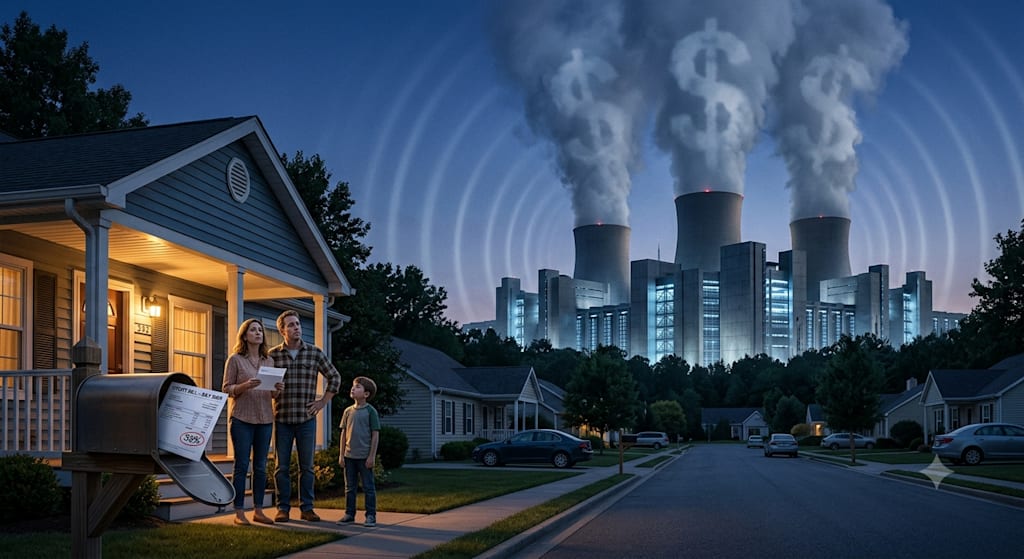
If you live in Mansfield, Newton County, Georgia, you probably haven’t needed a spreadsheet to track your water bill over the past two years. The water from the tap looks just as clear, but the number at the bottom of the monthly statement has changed. At a town council meeting, the mayor said something that left the room quiet for a long moment: “Over the next two years, because of the AI data centers the state is building, residential water rates are expected to rise 33 percent. In a normal year? Two percent.” The people sitting in those folding chairs weren’t economists; they were retired teachers, farmers, and remote‑working programmers. After they did the math, they realized they hadn’t done anything wrong. They just happened to live next to a building full of servers.
Water, Electricity, and Noise: Three Visible Forms of Extraction
An AI data center’s most conspicuous feature isn’t its “high‑tech” label but its “high‑consumption” reality. A large facility can use 5 million gallons of water per day, enough to fill seven Olympic‑sized swimming pools, or roughly the daily domestic water consumption of a town of 50,000 people. Most of that water goes into the cooling system: server racks run around the clock, generating so much heat that cooling towers must run at full tilt. The more puzzling part is where these centers are built. About 60 percent of planned U.S. data center projects are sited in arid regions, not because it’s cooler there, but because those states offer deep tax breaks to attract investment. Water was already scarce; now a single new customer appears that “drinks” an entire small town’s daily supply every day. The water utility, operating on market principles, responds in the most straightforward way possible: whoever pays more gets the water. Residents haven’t failed to bid; they never even got a chance to bid before the price was already pushed upward.
Electricity follows the same script. A data center is essentially a heavy‑industrial workshop running at full throttle, and local electricity demand spikes abruptly. Supply expansion, however, is never fast. The largest U.S. grid operator, PJM, which covers 67 million people, saw wholesale power prices jump 76 percent in the first quarter of 2026 compared with the same period last year. That increase shows up on corporate bills, and eventually gets passed down to every household. By conservative estimates, new data centers have already added an extra $13.8 billion to American consumers’ electricity costs. That $13.8 billion won’t appear on your bill as an “AI surcharge,” but every time a family turns down the thermostat in summer, they’re paying part of the tab for the server farm next door.
Noise is the easiest to overlook but the most irritating of the three. Once the massive cooling fans start spinning, they don’t produce a sharp screech; they produce a continuous, low‑frequency hum, like a freight train that never quite passes by. Microsoft’s data center in Fairwater, Wisconsin, was accused by residents of generating “constant, pervasive” excessive noise from those fans. Someone recorded the sound on a phone in their backyard and played it at a town council meeting, and everyone in the room could feel that dull pressure against their eardrums. This isn’t noise you can block by closing a window; low‑frequency vibrations travel through the ground and walls, like an invisible hand pressing against the house day and night.
No Visible Benefits, and You’re Also Paying More Taxes
If these costs had bought new jobs, new schools, or new roads, the community might have gritted its teeth and endured. But AI data centers bring none of that. The jobs they create are highly specialized: cooling system engineers, network architects, power dispatchers. And they sit completely out of sync with the local employment base, which leans toward agriculture, retail, and light manufacturing. In other words, the job postings go up, but locals can’t get hired.
Someone might argue that large projects have always faced this problem. When TSMC built its plant in the U.S., local plumbing and pipefitting unions sued to block out‑of‑state workers from coming in. Eventually, TSMC spent tens of millions of dollars training union members in welding and pipe installation, and only then did the unions agree to let the company hire experienced foreign workers “as needed.” It was a difficult path, but it worked.
Today’s AI giants aren’t even willing to take that path. Data centers go from groundbreaking to operation in a very short time frame. The companies are racing to secure compute capacity as fast as possible; they have neither the patience nor the inclination to haggle with local unions. So the surrounding residents become the ones who bear all the costs: water bills go up, electricity bills go up, a new hum invades their windows, and their tax bills don’t lose a single zero—and in fact, they get worse. To offer tax breaks to data centers, local governments cut school district budgets. In some towns, schools now ask parents to buy their own printer paper, and playground grass has cracked open with no money to fix it. Residents do a simple calculation: the data center gets a tax cut, and the resulting revenue gap gets filled by higher property taxes and sales taxes on local families. They didn’t get equity in the data center, but they got the data center’s bill.
Construction Won’t Stop, but Every Step Adds Cost
Despite the mounting opposition, the U.S. AI construction boom shows no sign of slowing down. The five major cloud providers—Amazon, Google, Meta, Microsoft, and Oracle—have raised their 2026 capital expenditure forecasts from $765 billion to roughly $805 billion, and 2027 could see that number climb to $1.1 trillion. The AI race looks a lot like the early internet era: whoever builds out compute infrastructure first can lock in a position in the coming ecosystem competition. No one dares take their foot off the accelerator, because lifting it means handing future pricing power to someone else.
But not letting up doesn’t mean costs won’t mount. Opposition will ultimately translate into obstacles that must be paved over with money. Not enough water? Then you have to invest in more expensive air‑cooling equipment and closed‑loop water recycling systems to cut daily consumption, but each piece of equipment adds to the budget. Not enough power? You can’t just rely on price hikes to squeeze more out of residents; you have to accelerate construction of supporting power stations and transmission lines, projects that take three to five years to complete, and every segment that crosses a community triggers another round of public hearings. Too many noise complaints? Either switch to low‑noise cooling, which often means reducing server density and thus increasing land area and construction costs, or buy out every house in the affected zone and build a new relocation community a few miles away, with residents moving in turnkey.
The more delicate route is “consent training.” Once one of the five majors starts offering paid training to residents—even if it’s just basic safety inspections and simple maintenance—the others will immediately face pressure from comparison. The data center in the next town over gave each trainee a $200 attendance fee; if you don’t, the resident representative will slap that check on the table at the next hearing. Training costs, compensation costs, and supporting infrastructure costs each drive a wedge into the unit cost of every data center, and layer by layer they pile onto the overall operating costs of the U.S. AI industry.
No One Dares to Call a Halt First
Can the big cloud providers agree to slow down and reduce this internal friction? The answer lies in the invisible line on the conference room wall: “We cannot lose to China.” That’s not just a slogan; it’s an iron rule. On the other side, Chinese cloud vendors and AI startups are pushing forward with their own compute build‑out, and the domestic GPU ecosystem is catching up quickly. The U.S. giants are competitors with each other, but on the issue of “don’t let China get out ahead first,” they all stand on the same starting line. The prisoner’s dilemma is a dilemma precisely because whoever betrays the pact and quietly accelerates first gets a better story to tell in the next funding round and the next customer pitch. A verbal “let’s all go a little slower” has never survived the first quarterly earnings call.
So every one of them runs as fast as they can. Every one of them runs into community opposition. And every one of them has to pay tolls along the way. The more expensive those tolls become, the thicker the final price tag that U.S. AI will present to the world. When water fees, electricity bills, noise compensation, community training, and grid upgrades are all converted into coins stacked on the table, America’s “first‑mover advantage” in AI will forever carry a silent but weighty surcharge: a long‑term premium born from the water flowing from local taps, the hum coming from outdoor air‑conditioning units, and the low drone heard in backyards late at night. Call it the “not‑in‑my‑backyard cost.”
About the Creator
Jin
Writer of reamstories
https://reamstories.com/jin
Enjoyed the story? Support the Creator.
Subscribe for free to receive all their stories in your feed. You could also become a paid subscriber, letting them know you appreciate their work.
Comments
There are no comments for this story
Be the first to respond and start the conversation.