
The Unexpected Battery Revolution: How Potassium Could Power the Future
From everyday minerals to global energy solutions, a new battery technology is quietly rising to challenge lithium’s dominance.

The Battery You’ve Never Heard Of Might Change Everything
The world is in the middle of an energy shift. Electric vehicles are everywhere, solar panels are spreading across rooftops, and giant batteries are quietly supporting power grids behind the scenes. But behind all of this progress lies one uncomfortable truth — we rely heavily on lithium.
Lithium has powered the modern battery revolution, but it comes with problems. Prices swing wildly. Supply chains are fragile. And mining it isn’t always environmentally friendly. That’s why scientists and companies are searching for alternatives.
One of the most surprising contenders? Potassium.
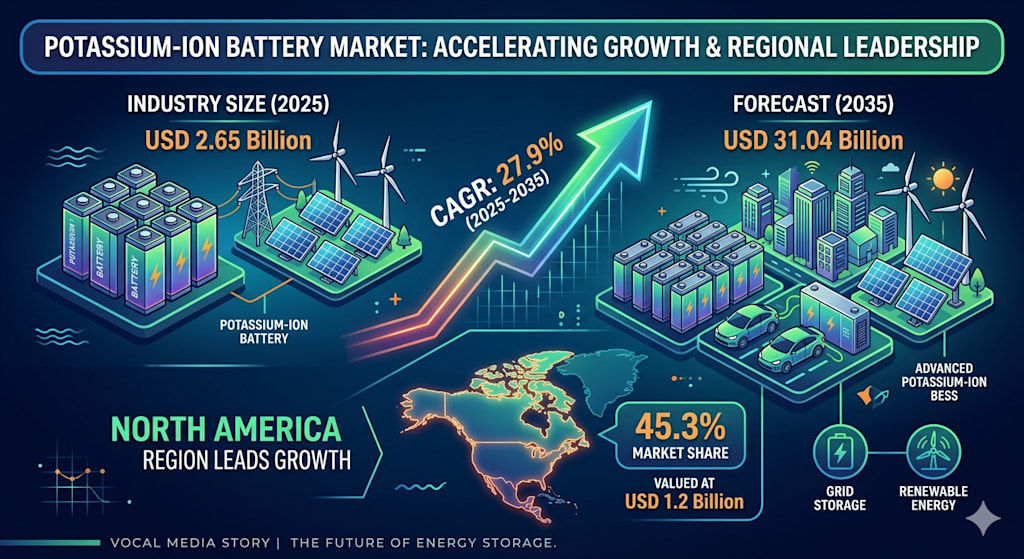
The global Potassium-ion Battery Market is expected to grow from USD 2.65 billion in 2025 to around USD 31.04 billion by 2035, expanding at a CAGR of 27.9%. These batteries work by moving potassium ions between the anode and cathode, using widely available and low-cost potassium instead of scarce lithium.
Yes, the same element found in bananas is now being tested as the heart of a new type of battery. It may sound strange, but potassium-ion batteries are starting to move from the lab into the real world — and they could change how we store energy.
Market Highlights
- Global Potassium-ion Battery Market valued at USD 2.65 Billion in 2025, forecast to reach USD 31.04 Billion by 2035 at a CAGR of 27.9%.
- North America leads all regions with a 45.3% market share, valued at USD 1.2 Billion.
- Rechargeable batteries dominate By Battery Type with a 61.2% share.
- Prismatic cell format leads By Cell Format with a 47.5% share.
- Carbon anode material holds the top position in By Anode Material with a 42.3% share.
- The >10 MW–50 MW capacity band leads By Capacity with a 49.1% share.
- Consumer Electronics leads By Application with a 41.6% share.
- Automotive leads By End-use with a 45.2% share.
So what makes potassium special?
First, it’s everywhere. Unlike lithium, which is concentrated in a few regions, potassium is widely available across the globe. That means fewer supply risks and more stable pricing. For companies and governments worried about depending on limited resources, this is a big deal.
Second, potassium batteries can be made using systems that already exist. Manufacturers don’t need to build entirely new factories from scratch. In many cases, they can adapt current lithium-ion production lines. This lowers costs and speeds up development.
But like any new technology, it’s not perfect.
The biggest challenge is energy density — in simple terms, how much power a battery can hold for its size. Lithium batteries still perform better here. That’s why your phone lasts all day and electric cars can travel long distances. Potassium batteries, for now, can’t match that level.
Because of this, they won’t replace lithium overnight. Instead, they are finding their place in areas where size and weight matter less.
One of the first major opportunities is grid storage.
Think about solar panels and wind turbines. They don’t produce energy all the time. Sometimes the sun isn’t shining or the wind isn’t blowing. Batteries help store extra energy so it can be used later. For this job, size doesn’t matter as much as cost and reliability.
Potassium batteries are a strong fit here. They’re cheaper, stable, and can handle repeated charging cycles. This makes them attractive for power companies looking to store energy at scale without breaking the bank.
Another early use is consumer electronics.
This might surprise you, but not every device needs the highest-performance battery. Many gadgets prioritize cost over maximum power. If potassium batteries can deliver decent performance at a lower price, manufacturers will pay attention.
Then there’s the long-term dream — electric vehicles.
Right now, potassium batteries aren’t ready for mainstream cars. Drivers expect long range, fast charging, and proven reliability. Lithium still dominates here. But things are changing.
Recent breakthroughs have shown potassium batteries lasting over 2,000 charge cycles, which is a key milestone. Some prototypes are also reaching energy levels closer to existing lithium batteries. It’s not enough yet, but it’s progress.
And progress matters.
Because the battery market is huge — and growing. The world doesn’t need just one solution. It needs many. Lithium, sodium, potassium — each has its role depending on the situation.
Interestingly, potassium batteries might follow a similar path to sodium-ion batteries. Start with grid storage and smaller devices, improve performance over time, and gradually move into larger applications.
There’s also a bigger picture here: energy independence.
Countries are becoming more aware of how vulnerable supply chains can be. Relying too much on one material or one region creates risk. By developing alternatives like potassium, they can reduce that risk and build more resilient systems.
Governments are already supporting this shift. Research funding is increasing, pilot projects are being launched, and companies are investing in early production. These are the signs of a technology moving out of theory and into reality.
Still, challenges remain.
One technical issue is stability at higher voltages. Some potassium batteries degrade faster under certain conditions, which limits their performance. Scientists are working on better materials and designs to fix this, but it will take time.
Another challenge is competition.
Potassium isn’t the only alternative to lithium. Sodium-ion batteries are already further ahead in commercialization. They face similar benefits and challenges, which means potassium developers need to move quickly to stay relevant.
But competition can be a good thing. It pushes innovation forward.
In the end, potassium batteries don’t need to replace lithium to succeed. They just need to find the right place in the market.
Maybe they power large energy storage systems. Maybe they run affordable electronics. Maybe, one day, they even help drive electric vehicles.
The point is, the future of energy won’t rely on a single solution. It will be a mix of technologies, each solving different problems.
And potassium — simple, abundant, and unexpected — might become one of the key players in that future.
About the Creator
Yash Mule
SEO Specialist with 10+ years of experience at Evolvance Market Research. Expert in technical SEO, content strategy, and data-driven optimization, with a proven track record of significantly increasing organic traffic and search rankings.
Enjoyed the story? Support the Creator.
Subscribe for free to receive all their stories in your feed.
Comments
There are no comments for this story
Be the first to respond and start the conversation.