
The Tiny Chips Powering Billion-Dollar Defense Systems
Why semiconductors have become one of the most valuable and strategically important technologies in modern warfare.

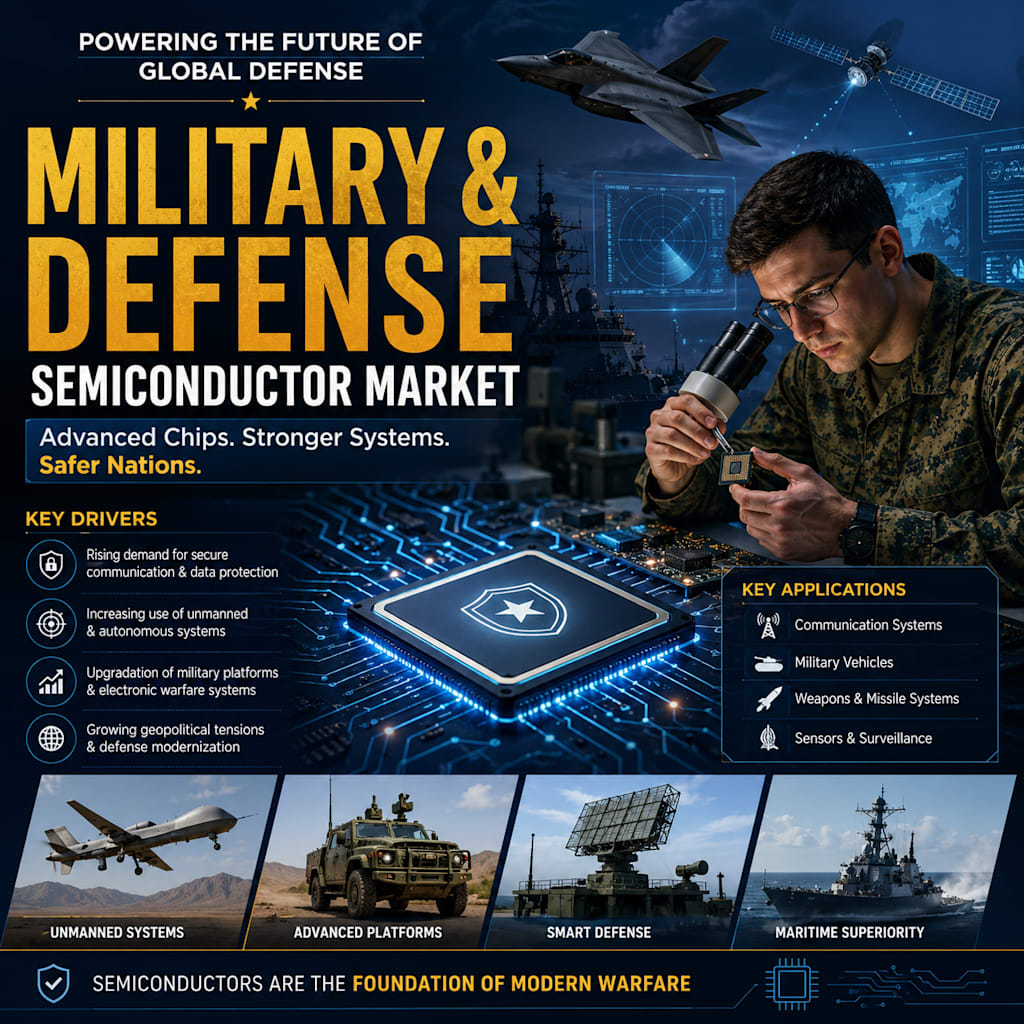
Why Military & Defense Semiconductors Are Becoming the Strategic Technology of the Modern Battlefield
When we envision a powerful military force, we might think of fighter jets, missile systems, aircraft carriers, or drones. However, what's often missed in the image is that these advanced systems could not exist without a critical piece of technology operating behind the scenes: semiconductors.
Known as the "brains" of modern electronics, semiconductors are now arguably one of the most important strategic technologies for defense. From secure communications and radar to AI and autonomous military vehicles, advanced chips power virtually every facet of modern warfare.
As countries around the world re-evaluate their defense priorities and invest heavily in next-generation capabilities, the demand for specialized, military-grade semiconductors is on a rapid rise.
A Market Driven by Technology and Security
The global military and defense semiconductor market size is estimated to be worth around USD 7.2 billion in 2025 and is projected to reach almost USD 12.9 billion by 2034.
This steady growth is driven by a major transformation underway in the global defense industry. Military operations are becoming more dependent than ever on advanced electronics, processing capabilities, cybersecurity, and automation.
Unlike commercial chips, defense-grade semiconductors need to perform in the most extreme environments. They are engineered to withstand significant temperature fluctuations, radiation, vibrations, and rugged operating conditions that conventional electronics would never survive.
As military technology becomes more sophisticated, the strategic significance of semiconductors has shifted from being just another component to becoming an essential technological asset.
The New Race for Technological Superiority
Modern military competition is no longer solely focused on the size of armies or the power of weapons systems.
Technological superiority has emerged as a key determinant of strategic advantage.
Governments globally are pouring billions of dollars into developing their domestic semiconductor capabilities and reducing their reliance on external supply chains. The capacity to design, manufacture, and secure advanced chips is now viewed as a critical national security imperative.
This re-evaluation of priorities has gained particular importance in a landscape reshaped by evolving geopolitical tensions. Nations are working diligently to ensure access to the fundamental semiconductor technologies that underpin communication networks, intelligence gathering operations, missile defense systems, and advanced surveillance capabilities.
In many respects, semiconductor manufacturing has become a new type of geopolitical battleground.
Secure Communication Is More Important Than Ever
One of the biggest contributors to market growth is the increasing need for secure military communication systems.
Modern military missions rely on rapid, seamless information exchange across land, sea, air, space, and cyber domains. Any disruption to these communication networks could have dire consequences for the success of a mission.
Advanced semiconductors enable encrypted communications, secure data transfer, and real-time coordination on the battlefield.
As cyber threats grow more complex, defense organizations are investing significantly in semiconductor technologies that enhance security and protect sensitive military data from interception or attack.
Artificial Intelligence Is Transforming Defense Operations
Artificial intelligence is rapidly becoming a central pillar in military decision-making.
AI-powered systems can analyze vast amounts of data, identify potential threats, support intelligence and surveillance, and aid in battlefield planning far more quickly than human operators.
The development of AI systems, however, demands enormous processing power.
This has created new opportunities for semiconductor manufacturers capable of designing specialized chips that can execute complex algorithms rapidly and efficiently.
Future military applications may include:
* Autonomous reconnaissance and surveillance systems
* AI-assisted threat identification and response
* Predictive maintenance for military hardware
* Advanced intelligence analysis
* Real-time decision support for combat operations
The accelerating adoption of AI by defense agencies will likely translate into significant growth for semiconductor technologies.
The Rise of Unmanned Military Systems
The expanding use of unmanned systems is another significant driver of market evolution.
Military forces are increasingly deploying:
* Unmanned Aerial Vehicles (UAVs)
* Unmanned Ground Vehicles (UGVs)
* Autonomous Naval Systems
* Remote Surveillance Platforms
These systems rely heavily on sophisticated semiconductor technologies for navigation, communication, sensor integration, and autonomous control.
For instance, modern drones require powerful processors for real-time image recognition, target tracking, mission execution, and maintaining stable communication links.
As unmanned military systems become more sophisticated, demand for related semiconductor components is expected to rise dramatically.
Why Advanced Materials Matter
One of the most exciting trends in the defense semiconductor sector is the incorporation of advanced materials. While silicon remains a core material, newer materials offer compelling performance advantages.
Gallium Nitride (GaN)
Gallium Nitride is proving invaluable in radar, electronic warfare, and communication systems.
Compared to silicon, GaN offers:
* Higher power efficiency
* Improved thermal performance
* Expanded operating frequencies
* A smaller form factor and lighter weight
These characteristics make it an excellent choice for modern military applications where performance and reliability are paramount.
Silicon Carbide (SiC)
Silicon Carbide is another material that is gaining significant traction across various defense domains.
Its exceptional ability to withstand high temperatures and harsh operating conditions makes it particularly well-suited for use in military aircraft, radar systems, and advanced power electronics.
As military platforms evolve and become more advanced, demand for these next-generation materials is poised to increase.
Miniaturization Is Changing Military Electronics
A key constraint in modern military systems is the need to balance high performance with portability and mobility.
This has driven a strong focus on Size, Weight, Power, and Cost (SWaP-C) optimization. Defense organizations are seeking systems that are:
* Smaller
* Lighter
* More energy-efficient
* Easier to deploy
This trend has accelerated the adoption of technologies such as System-on-Chip (SoC) designs and advanced semiconductor packaging. These innovations integrate multiple functions onto a single, compact chip, enhancing performance while reducing hardware complexity.
North America Continues to Lead
North America is currently the largest market for military and defense semiconductors.
Several factors contribute to this leadership position:
* Substantial defense spending
* Strong government support for the sector
* Highly advanced domestic semiconductor manufacturing capabilities
* A concentration of major defense contractors
* Continued investment in research and development
The United States, in particular, continues to invest heavily in defense modernization programs, creating robust demand for advanced semiconductor technologies. Government initiatives aimed at bolstering domestic chip manufacturing further support long-term market growth.
Asia-Pacific Is Emerging as a Major Growth Hub
While North America leads today, the Asia-Pacific region is quickly becoming one of the fastest-growing markets.
Key countries such as China, India, South Korea, and Japan are increasing their defense budgets and expanding their technological prowess.
Heightened regional security concerns and a drive to strengthen military readiness are fueling the demand for advanced semiconductor solutions. As a result, the Asia-Pacific region is set to play an increasingly crucial role in the future of the defense semiconductor industry.
Challenges Facing the Industry
Despite its strong growth trajectory, the military and defense semiconductor market faces several hurdles.
Supply chain disruptions remain a significant concern, particularly for highly specialized semiconductor components. Defense manufacturers are also under increasing pressure to ensure the security of the entire semiconductor production process.
Other challenges include:
* Geopolitical trade restrictions
* The inherent complexity of semiconductor manufacturing
* Rising research and development costs
* A shortage of skilled talent in advanced chip design
Addressing these challenges will be critical to maintaining innovation and ensuring long-term market stability.
Looking Ahead
The future of military technology will undoubtedly be shaped by advancements in semiconductors. Whether it's powering artificial intelligence, enabling autonomous systems, enhancing cybersecurity, or driving next-generation defense platforms, semiconductor technologies are becoming indispensable to modern military operations.
As nations continue to invest in defense modernization and strategic technologies, military-grade semiconductors will remain at the forefront of innovation.
About the Creator
Robert
Senior Market Researcher at IMARC Group, specializing in global market analysis, industry trends, and data-driven insights across diverse sectors.
Enjoyed the story? Support the Creator.
Subscribe for free to receive all their stories in your feed.
Comments
There are no comments for this story
Be the first to respond and start the conversation.