
The Solar Gold Rush: Why the PV Materials Market is About to Explode to $2.2 Trillion
We are standing on the brink of an energy revolution. The humble solar panel is getting a multi-trillion-dollar upgrade.

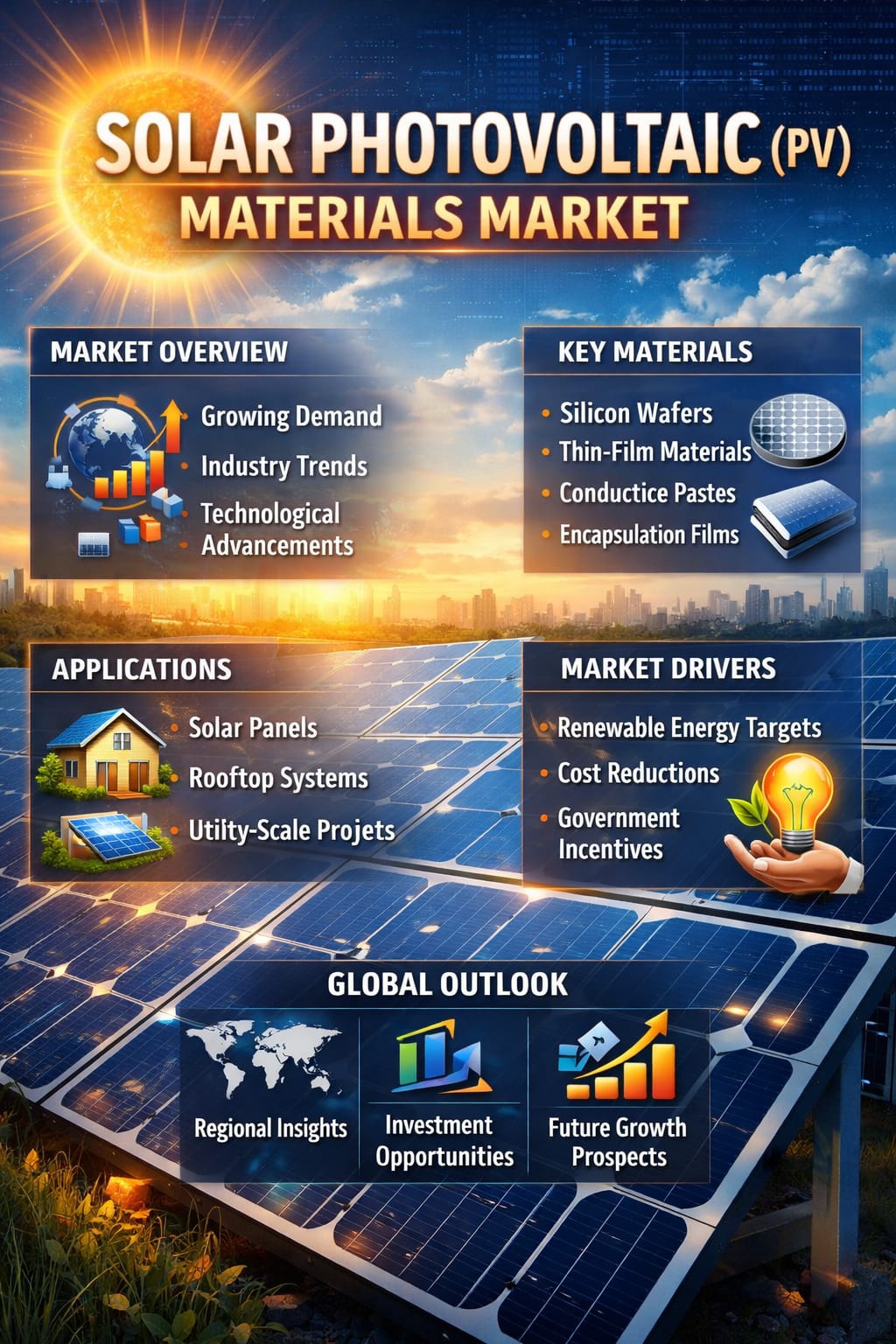
The $2.2 Trillion Solar Boom: What’s Really Powering the Panels?
You see solar panels on rooftops, in fields, and even floating on lakes. But have you ever wondered what they are made of?
Behind every shiny solar panel is a world of materials — silicon, glass, special pastes, and protective sheets. These are the unsung heroes of the clean energy revolution.
And here is the big news: The market for these materials is about to explode.
The global Solar Photovoltaic (PV) Materials Market was worth $391.30 billion in 2025. By 2035, it is expected to hit a massive $2,266.07 billion.
That is over 2.2 trillion dollars.
And it is growing at a jaw-dropping rate of 19.2% every year between 2026 and 2035.
Let me break down what this means, where the money is going, and why it matters to you.
The Simple Reason for the Boom
Why is this market growing so fast? Three simple reasons:
- The world needs more electricity. More people, more electric cars, more factories, more data centers. All need power.
- Solar is now cheaper than coal and gas. In most places, building a new solar farm costs less than running an old coal plant.
- Governments are forcing the change. From the US Inflation Reduction Act to Europe's green deals, governments are throwing money at solar.
But here is the catch: To build all those solar panels, you need materials. Lots of them. And that is what this market is all about.
The King of Materials: Silicon
You might hear fancy names like "perovskites" or "thin-film". But forget them for now.
Silicon-based materials rule the world.
In 2025, silicon held a massive 67.3% share of the entire market.
Why? Because silicon is the old reliable. It works well, lasts 25 years or more, and gets cheaper every year. About 95 out of every 100 solar panels sold today are made from silicon.
The other materials — thin-film, conductive pastes, back sheets — play supporting roles. But silicon is the star.
Where Are These Materials Going?
Not all solar panels are the same. The data shows two clear winners:
1. On-Grid Systems (74.2% share)
Most solar panels are connected to the main electricity grid. These "on-grid" systems feed power directly into the network. Homeowners get credits on their bills. Power companies sell the electricity to customers.
This is the big money zone.
2. Ground-Mounted Installations (65.3% share)
Forget rooftops for a moment. The real action is on the ground.
Huge solar farms — covering hundreds of acres — are being built everywhere. These ground-mounted systems are cheaper to build, easier to maintain, and produce way more power than rooftop panels.
And who is buying all that power?
Utility companies. They hold a 59.3% share of the end-use market. That means more than half of all PV materials go to big power plants, not homes or businesses.
The Region That Rules Them All: Asia Pacific
If you want to understand this market, look East.
Asia Pacific dominates with a 56.3% market share. In dollar terms, that is $220.4 billion in 2025 alone.
China is the 800-pound gorilla. It makes most of the world's silicon wafers, cells, and panels. India, Japan, and Australia are also massive buyers.
Why Asia? Cheap manufacturing, strong government support, and huge appetite for electricity.
North America and Europe are growing too, but they cannot match Asia's volume. Not yet.
The Big Problem: Price Swings
It is not all smooth sailing.
The prices of key materials — especially polysilicon and silver paste — go up and down like a roller coaster.
One month, polysilicon is cheap. The next month, a factory shuts down, and prices double. This makes life very hard for solar panel makers. They struggle to plan ahead and keep profits steady.
Also, building a new factory to make these materials costs hundreds of millions of dollars. Only big players can afford it. That keeps smaller competitors out.
What Comes Next? The Perovskite Dream
Every scientist in the solar world is chasing the same dream: Perovskites.
These are new materials that could be cheaper and more efficient than silicon. In labs, perovskite cells have already hit over 25% efficiency. Some multi-junction cells have crossed 45%.
That is huge.
But there is a catch. Perovskites are fragile. They break down in heat, moisture, and sunlight. No one has figured out how to make them last 25 years like silicon.
Once that problem is solved — and it likely will be in the next decade — the market will explode again.
Other Trends to Watch
Less silver, more copper. Silver is expensive and scarce. Companies are racing to replace it with copper in solar panels.
Green manufacturing. Buyers now care about how materials are made. Low-carbon solar panels are becoming a premium product.
Local production. Countries want to make their own PV materials instead of importing from China. The US and Europe are offering big subsidies to build local factories.
Final Takeaway: A Trillion-Dollar Sunrise
Let me leave you with this.
In 2025, the solar PV materials market is $391 billion.
By 2035, it is $2.27 trillion.
That is nearly a six-fold increase in just ten years.
Solar is no longer a niche green dream. It is a mainstream industrial giant. And the companies that mine, process, and sell the raw materials — the silicon, the glass, the pastes — are the ones that will win big.
Whether you are an investor, a homeowner thinking about solar, or just someone who likes to follow the money, keep your eye on this market.
The sun is rising on a new economy. And it is made of silicon.
About the Creator
Yash Mule
SEO Specialist with 10+ years of experience at Evolvance Market Research. Expert in technical SEO, content strategy, and data-driven optimization, with a proven track record of significantly increasing organic traffic and search rankings.
Enjoyed the story? Support the Creator.
Subscribe for free to receive all their stories in your feed.
Comments
There are no comments for this story
Be the first to respond and start the conversation.