
The Sleeping Beast Behind the Face of Democracy
“Democracy is not only what it shows…”

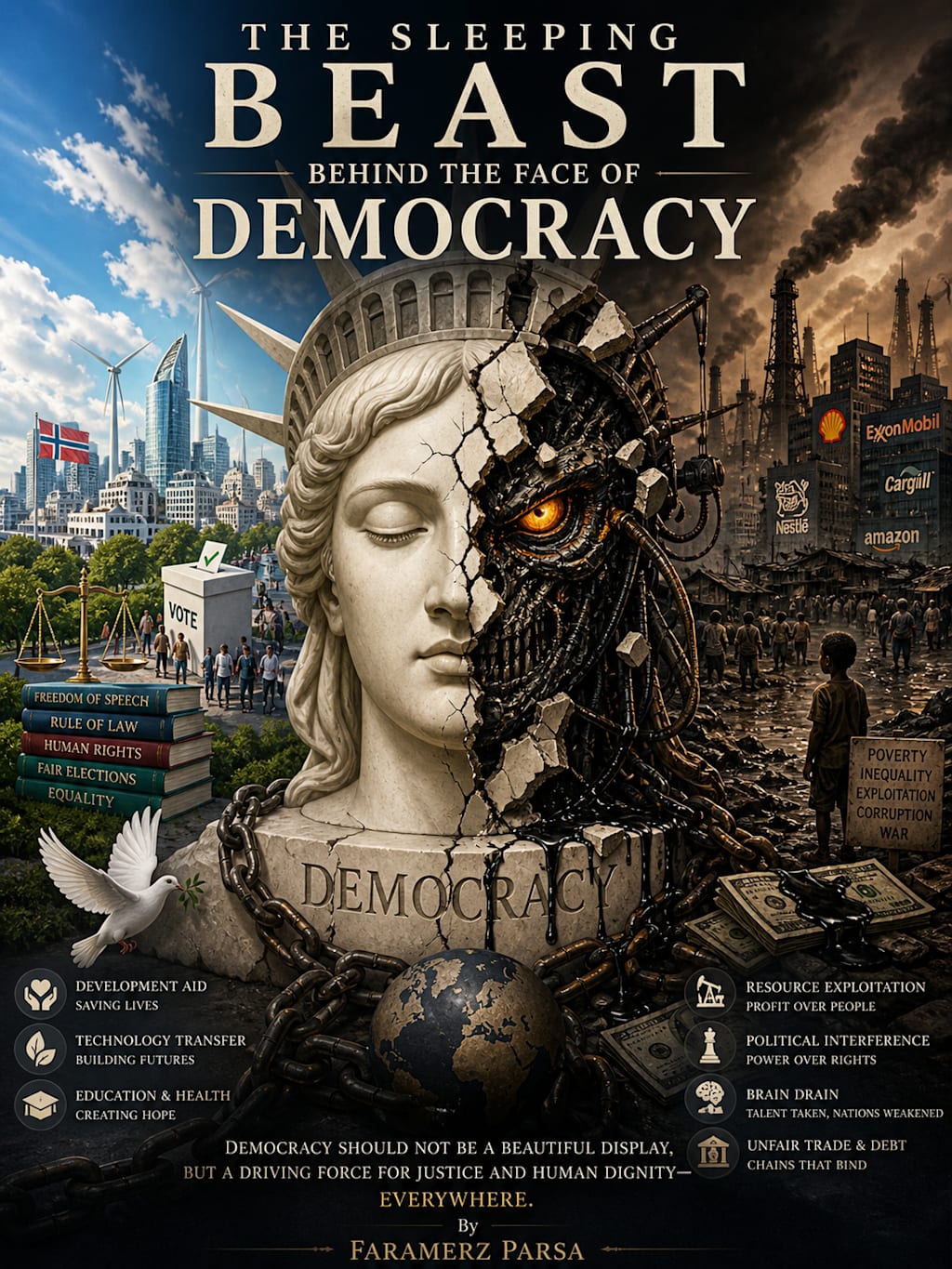
The Sleeping Beast Behind the Face of Democracy
Faramerz Parsa
In today’s interconnected world, democracy is often presented as the highest form of political achievement—a system built on freedom, justice, and the voice of the people. It is a concept that carries moral weight and global legitimacy, shaping how nations are judged and how power is justified.
Yet, beneath this widely accepted image, there exists a more complex reality. Global systems are not built solely on ideals; they are also shaped by interests, power dynamics, and economic structures that often remain hidden behind official narratives. The same system that promotes human rights and development can, at the same time, operate in ways that produce inequality, dependency, and silent forms of control.
This contradiction does not mean democracy is an illusion. Rather, it suggests that democracy, like any human system, is layered—capable of both progress and contradiction. Understanding these layers requires moving beyond surface definitions and examining how political and economic forces interact on a global scale.
The following reflection explores this tension. It does not reject democracy, nor does it fully idealize it. Instead, it attempts to look at the space between promise and practice—the space where reality becomes more complicated, and where the “sleeping beast” behind systems of power may quietly exist.
Democracy, in its classical definition, refers to “rule by the people”—a political system based on the principles of the rule of law, freedom of expression, fair elections, and the protection of minority rights. It presents an ideal image of governance that many nations strive to achieve. Yet, the gap between this ideal and the realities of the global system raises important questions.
Countries that rank high in democracy indexes—such as Norway, Sweden, and Canada—also play an active role in international affairs. Through development aid, technological transfer, and participation in global institutions, they contribute to improving conditions in developing nations. Global vaccination programs, for instance, have saved millions of lives, and investments in renewable energy have supported sustainable infrastructure in many regions.
However, this positive image represents only part of the story.
Behind it lies a global economic structure marked by deep inequalities. Multinational corporations, often based in developed countries, continue to benefit from cheap labor and natural resources in poorer regions. In many cases, the wealth generated does not translate into fair development for local populations, raising concerns about the balance between cooperation and exploitation.
Political history also reveals contradictions in the application of democratic values. During the Cold War, strategic interests often took precedence over democratic principles, leading to support for authoritarian regimes in various parts of the world. Such interventions highlight the tension between declared ideals and geopolitical realities.
Another important dimension is the phenomenon of “brain drain.” Developed countries, offering better living conditions and opportunities, attract skilled professionals from developing nations. While this creates individual opportunity, it often weakens the human capital of the countries of origin, slowing their long-term development.
At the same time, it would be simplistic to view the global system as purely exploitative. Countries such as South Korea demonstrate that integration into the global economy, combined with internal reforms and investment in education, can lead to rapid development and economic transformation. This shows that outcomes are not predetermined, but depend on internal governance and strategic choices.
In this context, democracy cannot be reduced either to a pure moral ideal or to a tool of domination. It exists within a complex system of competing interests, values, and power structures. Ignoring any of these dimensions leads to an incomplete understanding of the world.
For developing nations, the challenge is not only to critique the system, but to strengthen internal foundations—through transparency, education, institutional reform, and economic resilience. Only then can engagement with the global system become more balanced and less dependent.
Ultimately, if democracy is to remain meaningful, it must operate not only within national borders but also in international relations. Otherwise, it risks becoming a polished facade behind which inequality and strategic self-interest continue to operate.
——————-
2026/5/5
About the Creator
Ebrahim Parsa
⸻
Faramarz (Ebrahim) Parsa writes stories for children and adults — tales born from silence, memory, and the light of imagination inspired by Persian roots.
Enjoyed the story? Support the Creator.
Subscribe for free to receive all their stories in your feed.
Comments
There are no comments for this story
Be the first to respond and start the conversation.