
The Silent Power Shift: How Grid-Scale Batteries Are Changing the Energy Game
From backup support to backbone infrastructure, battery storage is quietly reshaping how the world produces, stores, and uses electricity

The Quiet Energy Revolution: How Grid-Scale Batteries Are Changing Our World
Most people don’t think about electricity until the power goes out. Lights flicker, devices shut down, and suddenly we realize how dependent we are on a steady flow of energy. But behind the scenes, something big is changing in how electricity is stored and delivered — and it’s happening quietly.
This change is driven by grid-scale battery storage.
These are not the small batteries you find in your phone or laptop. These are massive systems, sometimes as large as football fields, designed to store electricity and release it when needed. And they are quickly becoming one of the most important parts of modern energy systems.
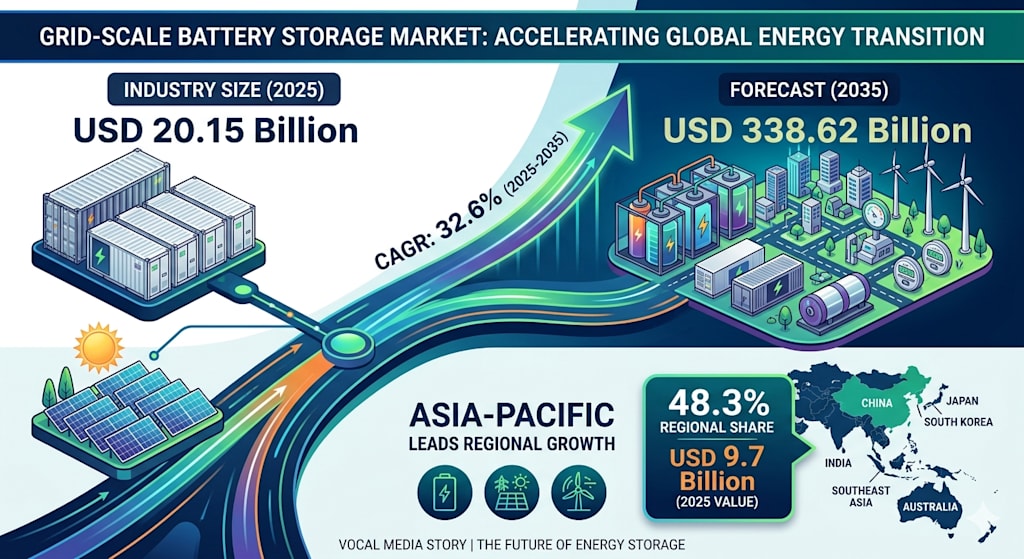
Over the next decade, this market is expected to grow at an incredible pace. What is worth just over $20 billion today could rise to more than $300 billion by 2035. That kind of growth doesn’t happen unless something fundamental is shifting.
And it is.
Market Highlights
- The Global Grid-scale Battery Storage Market value will grow from USD 20.15 Billion in 2025 to USD 338.62 Billion by 2035, at a CAGR of 32.6% from 2026 to 2035.
- Asia-Pacific leads with 48.3% regional share, valued at USD 9.7 Billion.
- Lithium-ion batteries dominate with 67.2% share of the battery type segment.
- The 100–250 MW range was the leading segment in By Power Capacity with a 54.1% share.
- Renewable Load Sharing was the dominant application with a 35.7% share.
- Utility Companies and Independent Power Producers (IPPs) accounted for the largest 42.3% share in the By End-User segment.
Why Batteries Are Becoming So Important
Electricity has always had one big problem: it’s hard to store. Traditionally, power plants generate electricity exactly when it’s needed. If demand rises, more power must be produced instantly. If demand falls, production must slow down.
This system worked fine when energy came mostly from coal, gas, or hydro plants. But today, the world is moving toward renewable energy like solar and wind. These sources are clean, but they are not constant. The sun doesn’t shine at night. The wind doesn’t always blow.
This is where grid-scale batteries step in.
They store extra energy when production is high — for example, during a sunny afternoon — and release it later when demand peaks, such as in the evening. In simple terms, they act like a buffer, smoothing out the ups and downs of energy supply.
A Shift Away from Old Power Systems
For decades, many countries relied on “peaker plants” — usually gas-powered — to handle sudden spikes in electricity demand. These plants are expensive to run and not very environmentally friendly.
Now, utilities are starting to replace them with battery systems.
Why? Because batteries are faster, cleaner, and increasingly cheaper. They can respond in seconds, not minutes. And as technology improves, their cost continues to drop.
This shift is already happening. Large energy buyers are investing in battery storage instead of building new gas plants. It’s not just about being green — it’s also about saving money in the long run.
Bigger, Smarter, and More Efficient Systems
Not all batteries are the same. While lithium-ion batteries dominate the market today, new types are gaining attention.
Some systems are designed to last longer, delivering power for many hours instead of just short bursts. Others use materials that are more widely available, reducing dependence on expensive or limited resources.
There’s also a clear trend toward larger projects. Many new installations fall in the 100 to 250 megawatt range — big enough to power thousands of homes. Even larger “mega projects” are starting to appear, pushing the limits of what these systems can do.
At the same time, companies are making batteries smarter. Advanced software now helps manage when to store energy and when to release it, maximizing efficiency and profits.
The Role of Governments
Governments are playing a huge role in this transition.
Many countries have introduced policies and incentives to encourage energy storage. Some require renewable energy projects to include batteries. Others offer financial support to make large-scale projects more affordable.
These policies are not just about climate goals. They are also about energy security. A stable grid is critical for economic growth, and batteries help make that possible.
In some regions, governments are even organizing auctions to quickly add storage capacity. These programs are attracting strong interest from private companies, showing that the market is ready to grow.
Challenges Still Exist
Despite all the progress, the industry is not without challenges.
One of the biggest issues is the supply chain. Batteries depend on raw materials like lithium, and prices can be unpredictable. Trade policies and tariffs can also affect costs and availability.
Another major hurdle is grid connection. In many places, new energy projects must wait years before they can connect to the grid. These delays slow down the deployment of battery systems, even when funding is already secured.
There’s also the challenge of scaling production. As demand rises, manufacturers must expand quickly. Companies that cannot keep up risk losing opportunities in this fast-moving market.
A Growing Opportunity
Even with these challenges, the future looks strong.
Falling costs are making battery storage more accessible to a wider range of users. It’s no longer limited to large utilities. Businesses, factories, and even data centers are starting to adopt these systems to reduce energy costs and improve reliability.
At the same time, new technologies are being tested and improved. Research centers are working on better, safer, and more efficient battery designs. These innovations could unlock even greater potential in the coming years.
A New Energy Backbone
Perhaps the most important change is how batteries are being viewed.
In the past, they were seen as optional — a nice addition to energy systems. Today, they are becoming essential infrastructure.
As renewable energy grows, batteries are no longer just supporting the grid. They are becoming a core part of how it operates.
This shift is subtle but powerful. It changes how energy is produced, stored, and used across the entire system.
Final Thoughts
The rise of grid-scale battery storage is not just a technological trend. It’s a transformation in how we think about energy.
It’s about making power more flexible, more reliable, and more sustainable. It’s about preparing for a future where clean energy plays a central role in our lives.
And while most people may never see these massive battery systems in action, their impact will be felt everywhere — from the lights in our homes to the stability of entire economies.
The revolution is already underway. It just happens to be silent.
About the Creator
Yash Mule
SEO Specialist with 10+ years of experience at Evolvance Market Research. Expert in technical SEO, content strategy, and data-driven optimization, with a proven track record of significantly increasing organic traffic and search rankings.
Enjoyed the story? Support the Creator.
Subscribe for free to receive all their stories in your feed.
Comments
There are no comments for this story
Be the first to respond and start the conversation.