
The Scheduled Sky
Glitching Seasons, Phantom Storms, and Our Lost Link to Nature.

Every morning in millions of kitchens worldwide, a quiet act of sorcery occurs. We fill a kettle, look toward a small plastic cylinder, and speak to it and the air around us: “Alexa, will it rain today?” Within a second, a synthetic, disembodied voice processes millions of data points from global satellites and what I assume are supercomputers to offer an hourly percentage of precipitation. We barely register this as technology. We just accept this ambient infrastructure.
For anyone, like myself, born in 1970, this casual interaction with an invisible, omniscient intelligence is the stuff of pure science fiction. The shift from scheduled, communal broadcasting to immediate, personalised AI assistance has done more than change how we buy our underwear. It has quietly altered our relationship with time, our connection to the physical world, and our tolerance for the unpredictable nature of our planet.
Growing up in the 1970s, information was a scarce commodity, delivered on a strict schedule. The weather was not a constant digital feed; it was an event. It was a television broadcast you had to actively wait for, usually arriving at the tail end of the evening news.
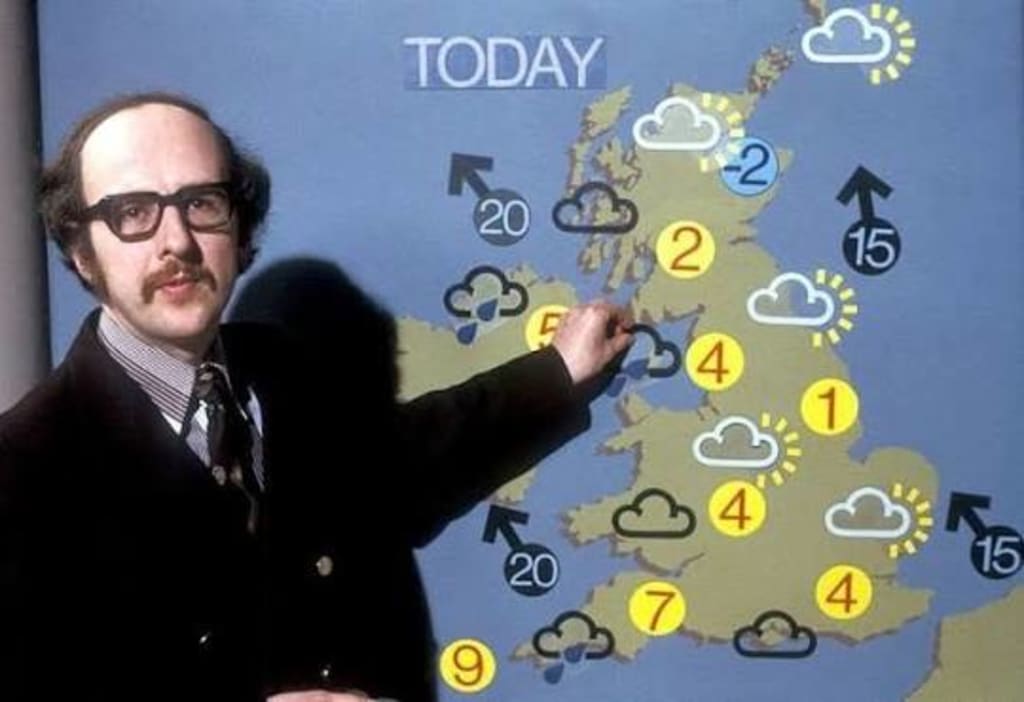
Check out one and you will see that the aesthetic of those early broadcasts now appears beautifully vintage. Presenters stood before physical wooden or plastic maps of the British Isles, manually sticking magnetic symbols onto the board. A plastic representation of a cloud meant rain; a yellow circle meant sun; isometric lines were drawn with thick markers to show pressure systems. If a symbol fell off mid-broadcast (which happened with amusing regularity) the illusion broke, reminding us of the human hands behind the science.
The information was broad, regional, and sweeping. You did not get a forecast for your specific postcode; you got a forecast for ‘the Midlands’ or ‘the South West.’ The delivery was formal, authoritative, and deeply woven into the fabric of national life. We gathered around the television set as a family, silent and attentive, because if you missed the 6:00 PM broadcast, your window of insight into the next day’s atmosphere was gone.
Because the technology of the era relied on sparse satellite telemetry, the forecasts possessed a distinct fragility. This fallibility created a unique cultural landscape where meteorologists became national figures, trusted but occasionally blamed for ruined weekends.
The zenith of this era’s technical limitation occurred on 15 October 1987, an event burned into the collective memory of my and my parents' generations. The meteorologist Michael Fish famously assured a viewer on television that there was no hurricane on the way. Hours later, the Great Storm of 1987 battered the United Kingdom, causing widespread destruction and claiming lives.
Yet, society did not abandon the weather presenters after such blunders. There was a collective understanding that the sky was a chaotic, untamed beast. The meteorologist was simply a brave interpreter trying his best with limited tools. When the television forecast failed us, we shrugged, adjusted our umbrellas, and accepted that nature ultimately held the upper hand.
When the television failed, or when the radio broadcast felt too distant to apply to our specific valley or street, we reverted to a much older, ancestral technology: pragmatic observation and folk wisdom.
Before we outsourced our awareness to microchips, humans were the sensors. We looked out of the window. We read the atmosphere with our skin and our eyes. Generational sayings acted as our algorithms: ‘red sky at night, shepherd's delight,’ or the belief that cows lying down in a field signaled rain was on the way.
There were times when these ancient signs genuinely outperformed the official state technology. A television broadcast recorded hours earlier in London could not tell you that a sudden, heavy mist was rolling over your specific East Anglican hill. But the sudden silence of the birds and the sharp, metallic smell of the scent of rain hitting dry soil told you everything you needed to know. We were forced to be active participants in our environment, reading the land because no one else was going to do it for us.
This intimate relationship with the land did more than help us predict tomorrow’s rain; it aligned our entire lives with the reliable rhythm of the four seasons. In the twentieth century, the calendar of the natural world was predictable. It was a chronological clock we could set our lives by.
My birthday falls at the very end of October, a time that historically ushered in the true chill of late autumn. When I was growing up, that late October school half-term was known reliably and universally as ‘Blackberry Week.’ It was the designated, unmovable time of year when the hedgerows heavy with dark, ripe fruit matched the turning leaves. We would trudge out into the crisp autumn air, fingers staining purple, to gather the final bounty of the year.
Today, global warming has quietly scrambled those reliable seasonal boundaries, stretching summers and compressing winters. The natural algorithms we relied on for generations are glitching. This year, by the beginning of our extra hot August, the wild brambles were already bursting with fully ripened blackberries, and the heavy cooking apples were dropping from the trees.
By the time the calendar hit mid-August, I had already picked the fruit, stood in a warm kitchen, and baked two crumbles and a pie. To do in the heat of early August what used to be a sacred late-October birthday ritual feels disorienting. It is a tangible, domestic manifestation of a planet out of sync. The physical world is running on an accelerated timeline, now completely uncoupled from the calendars we grew up with.
As the seasons blur, our reliance on modern tools only deepens, creating a strange dependency on what our devices promise will happen. This has introduced a completely new domestic dynamic into our home, centered around the predictive failures of our ambient AI.
My husband, for instance, absolutely loves a good thunderstorm. There is a primal thrill in watching the sky turn, feeling the pressure drop, and listening to the rumble of thunder crack across the roof. Because Alexa has access to cutting-edge meteorological modeling, she will frequently announce an impending storm with absolute certainty. The app on our phones will flash yellow warnings; the smart speaker will declare an eighty percent chance of lightning.
Spurred on by these digital prophecies, my husband prepares. He opens the bedroom curtains, lays on the bed and gets ready for the show, receiving updates from Alexa whilst waiting for the heavens to open. But more often than not, the storm simply never materialises. The hours tick by, the humidity lingers, and the sky remains stubbornly, mockingly clear.
Alexa essentially "ghosts" us, quietly scrubbing the storm icons from her display and replacing them with a calm sun symbol, as if she hadn't promised a tempest just an hour prior. In the 1970s, a missed forecast was just a bad guess by a man on the telly. Today, it feels like a digital betrayal, a phantom event conjured up by algorithms that can map the globe but still cannot capture the sudden, fickle shift of a summer breeze.
This is where our modern sci-fi reality reveals its deepest paradox. We no longer look at the sky to see if it will rain or storm; we look at a screen. The modern habit of querying Alexa has completely and importantly, democratised weather data, but it has also quietly severed an ancient cognitive link.
By transforming the atmosphere into an on-demand digital service, we have stopped observing our immediate environment. We have traded ambient environmental literacy for hyper-local digital dependency. When we rely entirely on an AI assistant to tell us the temperature, we stop noticing the subtle shifts in wind direction or the way the morning light filters through high clouds. We have transitioned from being active observers of nature to passive consumers of data.
Furthermore, our psychological relationship with error has shifted dramatically. When Michael Fish got the forecast wrong in 1987, it was viewed as a human error at the edge of science. Today, when Alexa insists a storm is coming that never arrives, the reaction is different. It feels like a glitch in the matrix. We feel a strange sense of irritation because we expect our science-fiction present to be flawless.
There is a profound irony in our current reality. We have placed satellites in orbit, laid oceanic cables, and built artificial intelligences that can speak to us in warm, human tones. We possess tools that would look like witchcraft to a meteorologist from 1970. Yet, as the seasons warp and the climate shifts, we find ourselves increasingly reliant on devices that are still completely baffled by the chaotic movement of a moisture front.
We live in a world where we can talk to our houses, a reality that would have seemed utterly miraculous to me as a child laughing as I watched a magnetic cloud fall off a weather board. But every time the AI gets it wrong, every time a highly anticipated thunderstorm vanishes into thin air, and every time we find ourselves making autumn apple crumbles in the sweltering heat of an early August afternoon, we are gently reminded of an old truth. Human technology has leaped into a science-fiction future, but the earth and its atmosphere remain vast, chaotic, and terrifyingly indifferent to our data.
About the Creator
Alyson Smith
Neurodivergent, working-class writer and artist diagnosed with Bipolar. Based in Newcastle-upon-Tyne. MA in Creative Writing. Currently waitressing while finishing my novel.
Enjoyed the story? Support the Creator.
Subscribe for free to receive all their stories in your feed. You could also become a paid subscriber, letting them know you appreciate their work.
Comments
There are no comments for this story
Be the first to respond and start the conversation.