
The Rise of Sodium-Ion Batteries: A New Chapter in Energy Storage
Why the world is looking beyond lithium for a more stable and affordable battery future

The global energy story is changing fast. For years, lithium-ion batteries have been the backbone of electric vehicles, renewable energy storage, and portable electronics. But recently, a new player has started gaining attention—sodium-ion batteries.
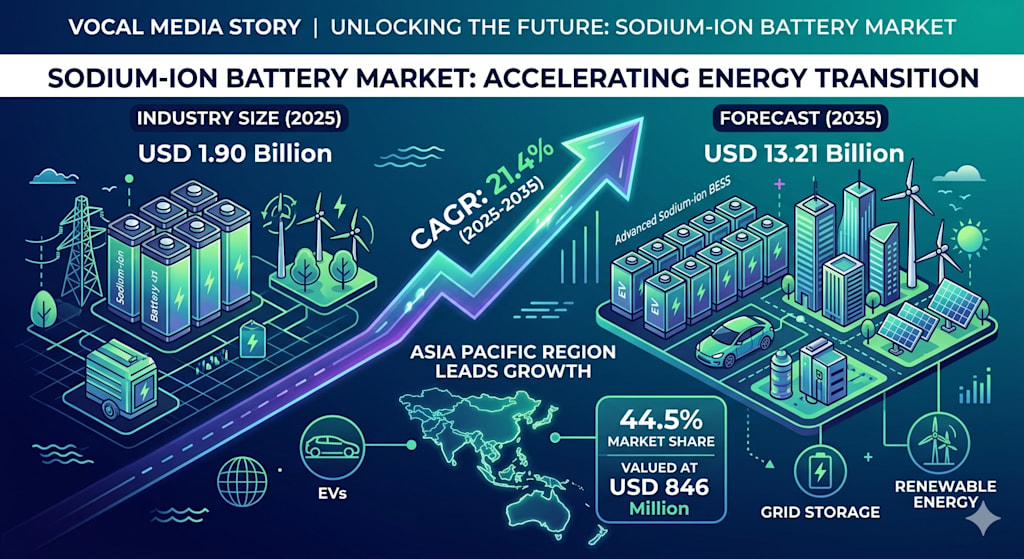
By 2035, the Sodium-ion Battery Market is expected to grow from around USD 1.90 billion in 2025 to over USD 13.21 billion. That kind of growth doesn’t happen without strong reasons. And in this case, those reasons are becoming hard to ignore.
At first glance, this might sound like just another technical shift. But it’s actually a much bigger story. It’s about cost, supply chains, global competition, and the future of clean energy.
Market Highlights
- The Global Sodium-ion Battery Market size grows from USD 1.90 Billion in 2025 to USD 13.21 Billion by 2035, at a CAGR of 21.4%
- Asia Pacific leads with a 44.5% market share, valued at USD 846 Million
- Electric Vehicles dominate the By Application segment with a 51.2% share
- Energy Utilities lead the By End User segment with a 47.5% share
- Sodium Sulfur Battery leads the By Product Type segment with a 37.4% share
- Anode Materials lead the By Material Type segment with a 42.3% share
One of the biggest drivers behind this shift is the instability in lithium prices. Over the past few years, lithium costs have gone up and down sharply. This has made it difficult for manufacturers and energy companies to plan long-term projects. When your main raw material keeps changing price, everything becomes uncertain.
That’s where sodium-ion batteries come in. Sodium is far more abundant than lithium. It’s easier to source, widely available, and less affected by geopolitical tensions. This makes it a more stable option for companies that want predictable costs.
Because of this, many industries are starting to take sodium-ion seriously. Electric vehicle makers, energy utilities, and storage companies are not waiting for perfection. Instead, they are testing and adopting sodium-based solutions now, even if the technology is still improving.
Of course, sodium-ion batteries are not perfect yet. One of their biggest challenges is energy density. In simple terms, they store less energy compared to lithium batteries of the same size. This means vehicles using sodium-ion batteries may not travel as far on a single charge.
But here’s the interesting part: not every application needs maximum range.
In many real-world situations, especially in cities, short-range vehicles are enough. Two-wheelers, three-wheelers, and small urban cars don’t require long-distance performance. For these use cases, sodium-ion batteries can be a practical and cost-effective solution.
This is especially true in countries like India and across Southeast Asia, where millions of small electric vehicles are being adopted. In these markets, affordability matters more than long-range performance.
Sodium-ion batteries are proving to be very useful in energy storage systems. These are large battery setups connected to power grids. They store electricity when supply is high and release it when demand increases.
In this area, size and weight are less important. What matters more is cost, safety, and long life. Sodium-ion batteries perform well here. They are more stable at high temperatures and have lower risk of overheating. This makes them safer for large-scale installations.
Governments around the world are also pushing this transition. Policies and funding programs are encouraging companies to explore alternatives to lithium. This is not just about technology—it’s also about reducing dependence on limited resources.
However, there is a twist in the story.
Even though sodium itself is abundant, the production of sodium-ion batteries is currently heavily concentrated in one region. A large share of global manufacturing capacity is based in China. This creates a new kind of dependency.
So while sodium-ion reduces reliance on lithium, it introduces another challenge—geographic concentration of supply. For countries trying to build independent energy systems, this becomes an important issue.
Because of this, regions like Europe and North America are starting to invest in their own sodium-ion production capabilities. New factories, research centers, and partnerships are being announced to balance the global supply chain.
Another interesting development is the variety of sodium-ion technologies being explored. Unlike lithium-ion, where one design dominates, sodium-ion includes multiple approaches. Some are better for high-temperature use, others for electric vehicles, and some for stationary storage.
This diversity means the market is still evolving. No single design has taken full control yet. For companies entering this space, this creates both opportunity and risk. The winners will likely be those who focus on specific use cases rather than trying to compete everywhere.
Innovation is moving quickly. New materials, better designs, and improved manufacturing methods are closing the performance gap with lithium. While sodium-ion may not replace lithium entirely, it is becoming a strong complementary option.
Another factor pushing growth is investment. Large funding rounds, government support, and partnerships between companies are helping the industry scale faster. When serious money starts flowing into a technology, it usually means the market sees real potential.
Still, not every company will succeed. The battery industry is known for its high costs and tough competition. Building factories requires huge investment, and without strong demand, projects can fail. We’ve already seen examples where promising ventures struggled despite good technology.
This shows that success in this market is not just about innovation. It also depends on timing, partnerships, and the ability to secure long-term buyers.
Sodium-ion batteries are unlikely to replace lithium-ion batteries completely. Instead, they will find their own space in the market. They will be used where cost, safety, and stability matter more than maximum performance.
In many ways, this shift reflects a broader trend in energy. There is no single solution for everything. Different technologies will serve different needs.
Sodium-ion batteries are part of that future—a future where energy systems are more diverse, more resilient, and less dependent on a few critical resources.
The story is still unfolding, but one thing is clear: sodium-ion is no longer just an experiment. It’s becoming a real option, and its role in the global energy transition is only going to grow.
About the Creator
Yash Mule
SEO Specialist with 10+ years of experience at Evolvance Market Research. Expert in technical SEO, content strategy, and data-driven optimization, with a proven track record of significantly increasing organic traffic and search rankings.
Enjoyed the story? Support the Creator.
Subscribe for free to receive all their stories in your feed.
Comments
There are no comments for this story
Be the first to respond and start the conversation.