
The Rise of Machine Condition Monitoring in the Age of Smart Industry
How predictive maintenance, AI, and industrial automation are transforming the future of machinery management worldwide.

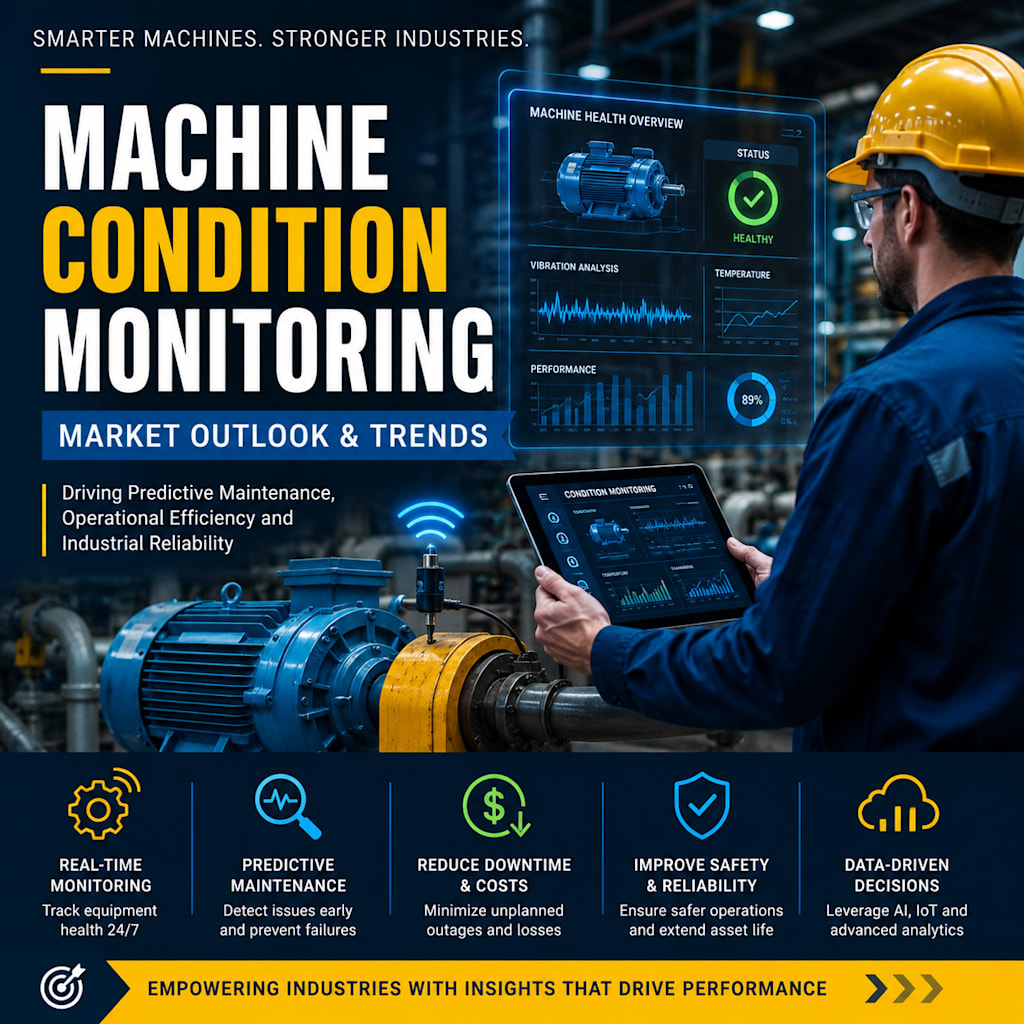
Industries are getting increasingly smart, efficient, and automated. But the rapid growth in this field also brings a big issue - making sure machinery does not break down unexpectedly.
For manufacturers, power plant owners, mining operations, or oil refineries, even short downtime can cause huge losses. This is why machine condition monitoring is a globally growing necessity.
A service that once was merely an additional maintenance option is rapidly becoming an essential part of modern industrial facilities around the world.
A Market Driven by the Automation of Industries
The global machine condition monitoring market size was worth around $3.2 billion in 2025, and it is expected to reach $5.1 billion in 2034. This indicates a compound annual growth rate (CAGR) of approximately 5.22% for the years 2026-2034.
The growth is attributed to increasing automation in industries, increasing adoption of predictive maintenance techniques, and the rising demand for energy-efficient operations in various industrial sectors. As industries move toward digitizing their operations, the machine condition monitoring systems become an indispensable tool for increasing productivity and decreasing operational risks.
What is Machine Condition Monitoring?
Machine condition monitoring is the ongoing evaluation of industrial equipment to detect potential failures or performance issues, enabling them to be resolved before they lead to breakdown. Unlike conventional scheduled maintenance or reactive maintenance, industrial facilities today use machine condition monitoring systems to track warning signs of impending failure, such as:
* Excessive vibration
* Fluctuations in temperature
* Contamination of oil
* Signs of corrosion
* Unusual noises
These systems typically utilize sensors, software applications, data analysis platforms, and interconnected technologies to analyze real-time equipment condition data. The core objective is to avoid costly downtime and improve efficiency.
How Predictive Maintenance is Reshaping the Industry
The rise of machine condition monitoring is driven by the shift from traditional to predictive maintenance practices. Historically, industries adopted either scheduled maintenance or reactive maintenance (repairing after failure), both of which were often inefficient and costly. However, predictive maintenance changes the paradigm entirely by enabling the prediction of failures in advance, hence leading to repairs being done only when they are needed.
The benefits offered by the predictive maintenance strategy are many:
* Reduction in downtime of machinery
* Lower maintenance costs
* Extended equipment lifespan
* Increased safety of the workplace
* Higher operational efficiency
For industries heavily reliant on their costly machinery operating 24/7, this strategy can result in millions in annual savings.
The Rise of Smart Factories and Industrial Automation
Automation is reshaping every industrial sector. Modern factories increasingly rely on interdependent machinery, robotics, and digital control systems, which inherently leads to a more complex machinery and thus, a greater necessity for reliable machinery. Machine condition monitoring systems help industries manage this complexity by providing real-time feedback on machinery condition.
In a smart factory, the continuous monitoring systems can quickly detect any deviation and alert workers before critical damages take place. In sectors that are highly prone to disruption with even minor failure, such as supply chain, this capability becomes very valuable.
How Artificial Intelligence and IoT are Revolutionizing Condition Monitoring Systems
Recent advancements in technologies such as Artificial Intelligence (AI), Machine Learning (ML), Internet of Things (IoT), and cloud computing are revolutionizing condition monitoring systems, moving them from passive data gathering to an intelligent, proactive process. IoT sensors are continuously monitoring industrial equipment to collect various performance parameters; AI systems then analyze this data to predict machine failure. Cloud-based platforms facilitate the remote monitoring of machinery from anywhere in the world, thus improving response time. With rapid progress in these technologies, the machine condition monitoring systems are becoming smarter, faster, and more effective.
Energy Efficiency: A Key Driver in the Market
Energy efficiency has become a global imperative. Strict government regulations worldwide require industries to decrease their energy consumption and their contribution to greenhouse gas emissions. The role of machine condition monitoring is paramount in meeting these goals. Malfunctioning machinery is an inefficient use of energy, due to various factors like misalignment, friction, wear of components or unfavorable operating conditions. Machine condition monitoring systems help detect such inefficiencies early on and rectify them, which in turn translates into a better operational performance and energy saving.
Vibration Monitoring: The Dominant Segment
In the machine condition monitoring market, vibration monitoring is the most significant segment. Any minor change in the vibration characteristics of machinery can indicate severe underlying problems, such as imbalances in components, bearing failures, or shaft misalignments. This method is cost-effective, non-invasive, highly accurate, and ideally suited for continuous monitoring, making it suitable for a wide range of machinery.
Cloud-Based Monitoring Gaining Traction
Cloud-based machine condition monitoring systems are rapidly gaining popularity. Unlike on-premise solutions that require physical setup, cloud-based systems enable remote monitoring and data access. These offer advantages such as enhanced scalability, reduced infrastructure costs, quick deployment and better cross-facility collaboration. Global organizations with widespread operations across multiple geographical locations find the cloud-based platforms highly beneficial. With ongoing industrial digitization, their use will likely increase further.
Oil and Gas: The Largest End-Use Industry
The oil and gas industry is one of the largest consumers of machine condition monitoring systems. This is due to its heavy reliance on expensive, complex machinery like pumps, turbines, compressors, and drilling rigs. Any failure of these critical components could lead to enormous costs, significant delays, and serious safety and environmental risks. Machine condition monitoring systems play a vital role in reducing operational downtime, controlling maintenance costs, and ensuring compliance with strict environmental and safety regulations, hence establishing predictive maintenance as an integral part of this industry.
Regional Dynamics in Growth
The machine condition monitoring market in North America currently leads globally. This growth is fueled by the strong industrial infrastructure, adoption of high technology, and a high rate of automation in this region, besides the presence of key market players. The Asia-Pacific region is identified as the fastest-growing region, mainly driven by burgeoning industrialization and increased production capacity across its key countries like China and India. European markets are also witnessing steady growth, owing to efforts related to industrial modernization and increased focus on sustainability.
Competition Driving Innovation
The machine condition monitoring market is characterized by intense competition. Industry players are focusing on advanced R&D in AI-based analytical solutions, wireless smart sensors, predictive maintenance software, and remote monitoring capabilities. Mergers, acquisitions, and strategic expansion plans are being adopted to bolster their market presence. The continuous drive for greater efficiency and connectivity will only lead to further intense competition, pushing innovation to the forefront.
Challenges Remain
Despite the immense growth and promise, the machine condition monitoring market still faces certain challenges. High initial costs of implementation, particularly for SMEs, and concerns regarding data security and integration, along with a need for skilled workforce, are some of the deterrents. However, the constant progress toward more cost-effective and user-friendly technologies is gradually diminishing these barriers.
Future of Machine Condition Monitoring
The future of industrial maintenance lies in highly connected and intelligent systems where machine condition monitoring will become more predictive, autonomous and AI-driven. Future innovations may include self-learning maintenance systems, real-time digital twins and advanced predictive simulations of machinery behavior. As industrial efficiency and sustainability remain key priorities, machine condition monitoring will increasingly become an essential component of industrial operations and will play a pivotal role in the digital transformation of the industry.
Conclusion
Machine condition monitoring is no longer merely a maintenance function, but has evolved into a strategic asset in modern industrial settings. By enabling companies to reduce downtime, improve efficiency, save energy, and extend the life of their machinery, it is fundamentally reshaping industrial operations for the better.
About the Creator
Robert
Senior Market Researcher at IMARC Group, specializing in global market analysis, industry trends, and data-driven insights across diverse sectors.
Enjoyed the story? Support the Creator.
Subscribe for free to receive all their stories in your feed.
Comments
There are no comments for this story
Be the first to respond and start the conversation.