
The Rise of Compressed Air Energy Storage in a Renewable-Powered World
Growing demand for long-duration energy storage is pushing utilities and governments to invest in CAES despite cost and location challenges

How Compressed Air Energy Storage Is Shaping the Future of Power
The global energy system is going through a major shift. As countries move away from fossil fuels and invest heavily in renewable sources like wind and solar, a new challenge has become impossible to ignore: how to store energy efficiently.
Renewable energy doesn’t always produce power when it’s needed, and this gap between generation and demand is pushing the rise of long-duration storage solutions.
One technology quietly gaining attention is compressed air energy storage, often called CAES. While it may not be as widely discussed as battery storage, it is quickly becoming a serious contender for large-scale energy storage, especially as power grids become more dependent on renewables.
A Market on the Rise
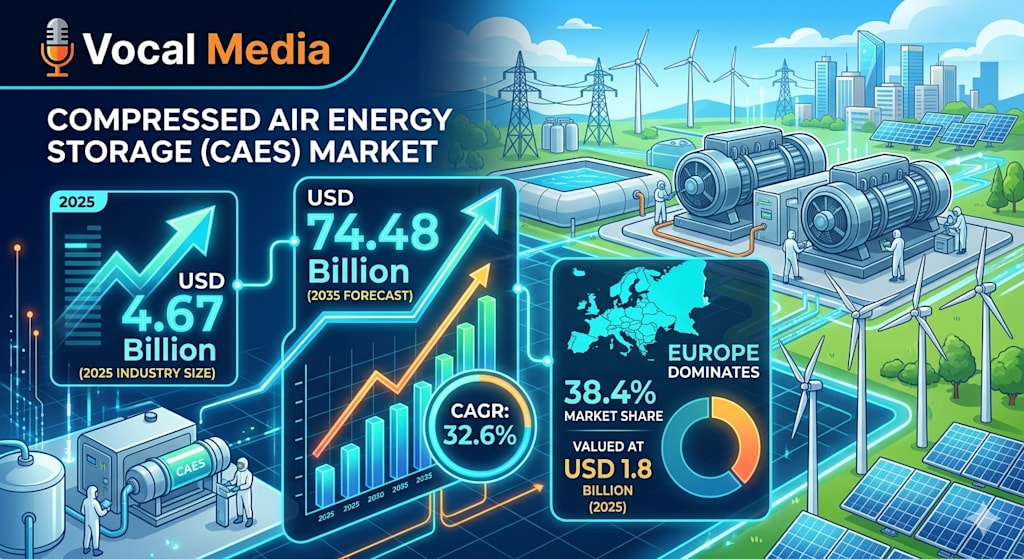
The growth of this sector tells a compelling story. The global Compressed Air Energy Storage (CAES) Market is projected to grow from about USD 4.67 billion in 2025 to nearly USD 74.48 billion by 2035. That kind of expansion reflects more than just technological progress—it signals a shift in how utilities and governments are thinking about energy reliability.
This rapid growth is being driven by a clear need. Power grids are under pressure to deliver consistent electricity even as renewable generation becomes more variable. Solar panels produce energy during the day, wind turbines depend on weather conditions, and neither can guarantee steady output. Storage systems step in to balance this unpredictability.
Market Highlights
- The Global Compressed Air Energy Storage (CAES) Market valued at USD 4.67 Billion in 2025, reaching USD 74.48 Billion by 2035 at a CAGR of 32.6%.
- Europe dominates with 38.4% market share, valued at USD 1.8 Billion.
- Diabatic CAES leads by type with 42.7% share; Small-scale (Below 10 MW) leads by power capacity with 67.3% share.
- Renewable-integration firming leads by application with 41.7% share; Electric utilities lead by end-user with 46.2% share.
- Salt-domed cavern leads by storage configuration with 39.4% share.
How the Technology Works
At its core, compressed air energy storage is relatively simple. Electricity is used to compress air, which is then stored underground or in pressurized containers. When energy demand rises, the compressed air is released to drive turbines and generate electricity.
What makes CAES stand out is its ability to store large amounts of energy for long periods. Unlike typical lithium-ion batteries, which are better suited for shorter durations, CAES systems can deliver power for several hours or even days. This makes them especially valuable for grid operators managing large renewable energy networks.
Why Utilities Are Paying Attention
Utilities are increasingly shifting their focus from short-term fixes to long-term infrastructure. In this context, CAES offers several advantages. One of the biggest is its long lifespan. These systems can operate for 30 to 40 years, making them a stable investment compared to technologies that may require more frequent replacement.
Another factor is scale. CAES can be deployed in large capacities, making it suitable for utility-level projects. As renewable energy installations grow in size, so does the need for storage solutions that can match that scale.
There is also a financial angle. Governments are beginning to support long-duration storage projects through funding and policy incentives. This support reduces risk for investors and encourages more projects to move forward.
The Challenge of Geography
Despite its strengths, CAES is not without limitations. One of the biggest challenges is geography. Most large-scale systems rely on underground formations such as salt caverns or stable rock structures to store compressed air. These geological features are not available everywhere, which restricts where projects can be built.
This creates a unique dynamic in the market. Regions with suitable geology have a natural advantage, while others may need to rely on alternative storage solutions. Developers who secure viable sites early are likely to hold a strong position as demand increases.
Europe Leads, But Others Are Catching Up
Europe currently leads the market, supported by strong renewable energy policies and a clear focus on reducing carbon emissions. The region has been proactive in developing storage solutions to stabilize its growing renewable energy base.
However, other regions are quickly gaining momentum. North America is investing heavily in new projects, supported by government-backed financing and growing energy demand. Meanwhile, Asia-Pacific, particularly China, is rapidly expanding its infrastructure and setting new benchmarks for large-scale deployment.
These developments suggest that the market is becoming global, with multiple regions contributing to growth rather than relying on a single dominant player.
Innovation Is Changing the Game
Technology within the CAES space is also evolving. Traditional systems relied on burning natural gas to reheat compressed air before releasing it, which created emissions. Newer designs are moving toward cleaner solutions by capturing and reusing heat generated during compression.
These advanced systems are more efficient and align better with global decarbonization goals. As these designs become commercially viable, they could significantly increase adoption rates.
There is also ongoing work to improve efficiency and reduce costs. Advances in compressors and storage methods are making systems more competitive with other storage technologies. Over time, these improvements are expected to make CAES more accessible to a wider range of markets.
A Complement, Not a Replacement
It’s important to understand that CAES is not trying to replace battery storage. Instead, it complements it. Batteries are ideal for quick-response applications and short-term storage, while CAES excels in long-duration scenarios.
As energy systems become more complex, a mix of technologies will be necessary. Grid operators are likely to use batteries, pumped hydro, and compressed air storage together to achieve the right balance of flexibility and reliability.
The Road Ahead
The future of energy storage will depend on how well different technologies can work together to meet growing demand. Compressed air energy storage has carved out a clear role in this ecosystem. Its ability to deliver large-scale, long-duration storage makes it a valuable tool for stabilizing renewable-heavy grids.
However, its success will depend on overcoming key challenges, particularly around site availability and upfront costs. Continued policy support, technological innovation, and strategic project development will be critical.
As the world moves toward cleaner energy, storage will no longer be optional—it will be essential. In that landscape, CAES is emerging as a quiet but powerful solution, helping ensure that renewable energy can be relied upon not just when it’s available, but whenever it’s needed.
About the Creator
Yash Mule
SEO Specialist with 10+ years of experience at Evolvance Market Research. Expert in technical SEO, content strategy, and data-driven optimization, with a proven track record of significantly increasing organic traffic and search rankings.
Enjoyed the story? Support the Creator.
Subscribe for free to receive all their stories in your feed.
Comments
There are no comments for this story
Be the first to respond and start the conversation.