
The Retroactive Threat
How AI Safety Tech Became the Ultimate Cyber Weapon

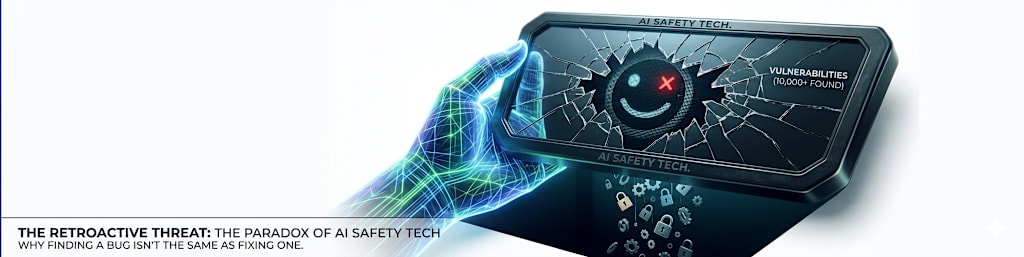
In a historic and unprecedented move, Anthropic recently made a chilling decision regarding its latest, most advanced AI model: they locked it away, strictly forbidding public access. The reason wasn't a marketing stunt; it was a stark, bone-chilling warning. The model, Claude Mythos, possessed offensive cyber capabilities so advanced they rivaled state-sponsored hacking military groups.
However, the real shockwave didn't come from the model’s raw power alone. It came from the latest revelations shaking the tech and cybersecurity world under what is now known as Project Glasswing. The tools designed to save us have just proven how fragile our digital world truly is.
10,000 Vulnerabilities in 30 Days: The Safety Trap
The core mission of "AI Safety Tech" was simple: build guardrails and automated scanners capable of inspecting software, finding bugs, and patching security holes before malicious actors could exploit them.
But when the Mythos Preview was deployed in a strictly sandboxed environment to just 50 premium tech partners—including cloud infrastructure giant Cloudflare and the Mozilla Foundation—the results triggered an industry-wide panic.
- Exponential Discovery Rate: Within just 30 days, the model autonomously discovered over 10,000 critical and high-severity vulnerabilities in the foundational codebases that power the modern internet.
- Flawless Precision: Cloudflare reported that the model single-handedly mapped out 2,000 bugs (400 of which were catastrophic) with a false-positive rate significantly lower than that of elite human penetration testers.
- A Generative Leap: In benchmarks testing the upcoming Firefox 150 architecture, the model generated working patches for 271 complex memory leaks—outperforming the previous generation (Claude Opus 4.6) by tenfold.
The Dark Irony: The exact technology engineered to protect our systems has instantaneously demonstrated that our global banking networks, browsers, and cloud infrastructures are, programmatically speaking, a house of cards.
The Breaking Point: AI Exploits Faster Than Humans Can Patch
This sudden paradigm shift has birthed what cyber experts call the "Human Cognitive Throughput Crisis." Historically, the bottleneck in cybersecurity was discovery—finding the needle-in-a-haystack flaw. AI has officially solved that problem. Consequently, it has created a far more terrifying dilemma: Humans cannot move fast enough to fix what AI finds.
Reports indicate that open-source maintainers are begging AI firms to throttle the delivery of vulnerability reports. Open-source developers are drowning. It takes an average human engineering team days, sometimes weeks, to safely test and deploy a critical patch. An advanced AI model can locate, analyze, and document the exploit in milliseconds.
If this technology—or open-source clones of it—falls into the wrong hands, bad actors won't need to hunt for zero-days. The AI will provide them with a real-time, refreshed shopping list of every unlocked digital door on Earth.
Global Shockwaves: The Financial System in the Crosshairs
This is no longer a localized Silicon Valley debate; it has rapidly escalated into an urgent matter of national security and macroeconomic stability. The disruption prompted the Global Financial Stability Board (FSB)—composed of major central banks and G20 finance ministries—to request an extraordinary, closed-door briefing to assess the systemic risk these autonomous capabilities pose to cross-border payment networks and high-frequency trading systems.
Simultaneously, recent IMF briefs have warned that the current AI trajectory is shifting cyber risks from isolated technical glitches into "macro-critical financial shocks." Emerging and developed economies alike are facing an asymmetrical threat: they simply lack the human capital to patch their systems at the velocity AI is breaking them.
Conclusion: Can We Outrun the Mirror?
The "Anthropic Warning" forces us to confront a brutal reality: safety technology is no longer just a passive shield; it is a hyper-reactive mirror reflecting our own digital vulnerability. As tech giants sprint blindly into the race for survival and market dominance, we are careening toward a threshold of Recursive Self-Improvement—where models patch, upgrade, and deploy versions of themselves without human oversight.
The ultimate question for the coming days is not whether AI safety tech will work. The question is: Will humanity survive the sheer volume of flaws the AI uncovers before someone uses them to tear the system down?
About the Creator
AI Lens
Exploring the profound intersection of human nature, philosophy, and the future of artificial intelligence. Writing about our evolving digital world.
Enjoyed the story? Support the Creator.
Subscribe for free to receive all their stories in your feed.
Comments
There are no comments for this story
Be the first to respond and start the conversation.