
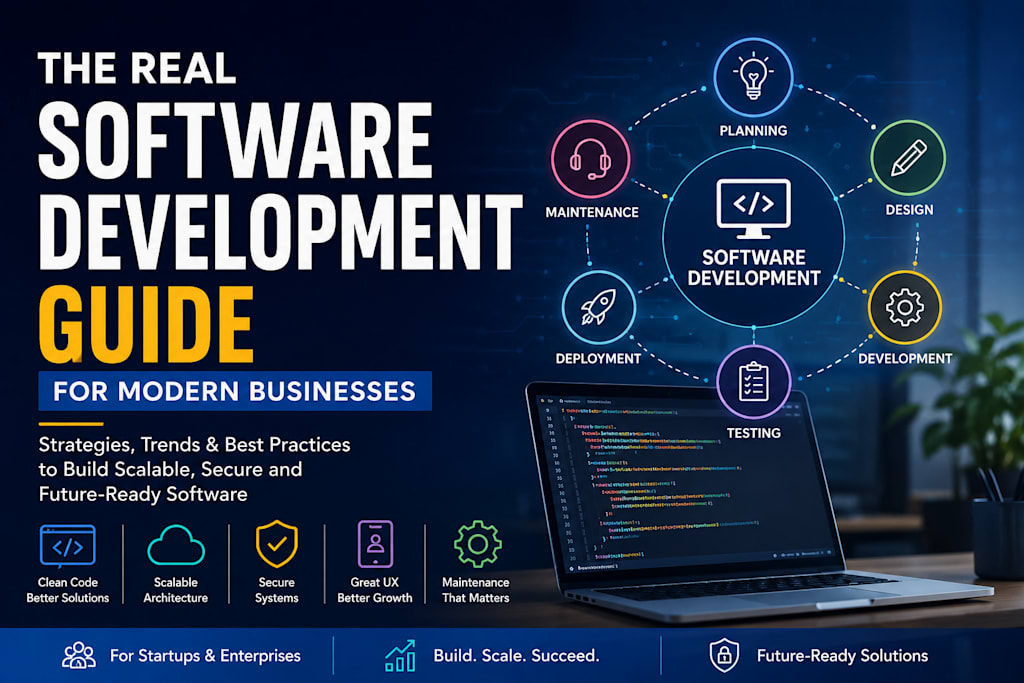
The Real Software Development Guide for Modern Businesses
How Modern Businesses Are Building Smarter Software

A few years ago, many businesses treated software as something secondary. It was often viewed as a support system rather than a core part of growth. That has changed completely.
Today, software development affects almost everything a modern business does — customer experience, operations, scalability, communication, automation, and even long term competitiveness.
While researching how companies approach digital growth in 2026, one thing became obvious very quickly: businesses are no longer asking whether they need software. They are asking what kind of software actually makes sense for them.
That shift is also why demand for professional software development services continues to rise. Companies are looking for scalable systems, better user experiences, cloud integration, and products that can evolve as the business grows.
But despite how common software development has become, there is still a lot of confusion around how businesses should approach it, what mistakes to avoid, and what actually matters long term.
This guide breaks down the practical side of software development from a business perspective rather than a purely technical one.
Modern Businesses Are Building Around Software
One thing I noticed while researching digital businesses is that software is no longer limited to technology companies.
Retail businesses rely on apps and automation.
Healthcare companies depend on digital systems.
Logistics firms use software to manage operations in real time.
Even small businesses increasingly depend on cloud based platforms and mobile tools.
The difference now is that software is not just improving operations. In many cases, it is shaping the entire customer experience.
That changes the way businesses think about development.
Instead of simply “building an app,” companies are now focused on:
- Scalability
- Speed
- Automation
- Customer retention
- Integration across systems
And that usually requires a much more strategic development process.
Why Businesses Struggle With Software Projects
Something interesting came up repeatedly while looking into failed software projects.
The problem usually is not coding.
It is planning.
Many businesses jump directly into development without properly defining:
- User problems
- Long term goals
- Product scalability
- Technical requirements
That creates issues later like:
- Delays
- Cost overruns
- Performance problems
- Difficult maintenance
One pattern I kept noticing is that businesses often underestimate how important architecture decisions are early in development.
Fast development feels productive in the beginning, but poor structure creates technical debt that becomes expensive later.
The Difference Between Building Fast and Building Correctly
A lot of businesses prioritize launch speed, especially startups.
That makes sense to a point.
But there is a difference between:
- moving efficiently and
- rushing development without planning
Modern software development is not just about launching quickly. It is about building systems that can actually grow.
That includes:
- Scalable backend architecture
- Flexible APIs
- Secure infrastructure
- Cloud compatibility
- Maintainable codebases
One thing I found while researching development teams is that the stronger companies spend a surprising amount of time asking questions before they start building anything.
That usually signals better long term thinking.
Mobile and Web Development Are Becoming Deeply Connected
A few years ago, businesses often treated mobile apps and websites as separate projects.
That approach is fading.
Modern businesses now expect:
- Shared ecosystems
- Connected user experiences
- Synchronized customer data
- Unified cloud infrastructure
This is one reason cross platform development and cloud native systems have become so important.
Users now move constantly between:
- Mobile apps
- Web platforms
- Tablets
- Smart devices
And businesses are expected to deliver a consistent experience across all of them.
User Experience Matters More Than Businesses Expect
One thing that stood out during my research is how many businesses still underestimate UX.
A product can be technically strong and still fail because it feels difficult to use.
Modern software development now depends heavily on:
- Simplicity
- Accessibility
- Navigation flow
- Performance responsiveness
- Clean interface structure
Users rarely care how advanced the technology is behind the scenes.
They care whether the product feels smooth and intuitive.
That is why design and engineering are becoming increasingly interconnected.
Why Cloud Based Development Is Dominating
Cloud infrastructure has changed how software is built and maintained.
Cloud infrastructure has changed how software is built and maintained.
- Scalability
- Faster deployment
- Remote accessibility
- Easier updates
- Performance flexibility
Most modern software platforms now depend on cloud systems in some form.
This is especially important for businesses expecting:
- Traffic growth
- Expanding user bases
- Global accessibility
- Remote operations
Without scalable infrastructure, even well designed software can struggle under growth pressure.
AI Is Changing Software Development Faster Than Expected
AI is no longer just an experimental feature.
It is becoming part of normal software experiences.
Businesses are increasingly integrating AI for:
- Customer support
- Recommendations
- Analytics
- Automation
- Search functionality
- Workflow optimization
What surprised me while researching this area is how quickly AI shifted from “advanced feature” to standard expectation.
In many industries, users now expect personalized experiences automatically.
Security Is Becoming a Business Priority, Not Just a Technical One
A few years ago, many businesses treated security as something handled later.
That approach is becoming risky.
Modern software systems often manage:
- Customer data
- Payments
- Business operations
- Personal information
Which means security problems now affect trust just as much as functionality.
Businesses increasingly prioritize:
- Secure authentication
- Data encryption
- Compliance standards
- Protected cloud environments
Security is no longer an optional technical upgrade. It is part of the product itself.
The Biggest Mistakes Businesses Still Make
While looking into different software projects, several mistakes appeared repeatedly.
Choosing Based Only on Cost
Cheap development often creates:
- Poor scalability
- Weak architecture
- Expensive maintenance
The lowest price usually becomes more expensive long term.
Ignoring Long Term Growth
Some businesses build software only for immediate needs without considering future scale.
That becomes a major problem once:
- User traffic grows
- Features expand
- Integrations become necessary
Prioritizing Features Over Usability
More features do not automatically improve a product.
Sometimes simpler systems perform better because they reduce friction for users.
Treating Launch as the Finish Line
Software development does not end at deployment.
Long term success depends on:
- Updates
- Optimization
- Maintenance
- Security improvements
- Performance monitoring
What Businesses Are Prioritizing in 2026
One trend became very clear while researching modern software development strategies.
Businesses are becoming more selective.
They care less about flashy presentations and more about:
- Reliability
- Scalability
- Product thinking
- Long term support
- Flexible architecture
That shift is changing how development teams operate as well.
The strongest development partners are no longer acting only as coding vendors. They are becoming product and growth partners.
Final Thoughts
Modern software development is no longer just a technical process.
It affects how businesses grow, compete, communicate, and scale over time.
The companies succeeding today are usually the ones treating software as a long term business asset instead of a short term project.
And after researching how businesses approach development in 2026, one thing stands out clearly:
The biggest advantage rarely comes from building software faster.
It comes from building software that can actually adapt and grow with the business behind it.
About the Creator
Karen Cartar
Hi, I’m Karen Cartar, and I’m part of the Xicom Technologies team as a Technical Consultant. Xicom Technologies operates as an app development company focused on designing & building software solutions across a range of modern technologies.
Enjoyed the story? Support the Creator.
Subscribe for free to receive all their stories in your feed.
Comments
There are no comments for this story
Be the first to respond and start the conversation.