
The Quiet Upgrade Powering Our Future Grids
How smarter electricity systems are reshaping reliability, cost, and control

The way electricity reaches our homes and businesses is changing—and most people won’t notice it happening. There are no dramatic switches being flipped, no sudden overnight transformation. Instead, it’s a steady, behind-the-scenes upgrade that is quietly making power systems smarter, faster, and more reliable.
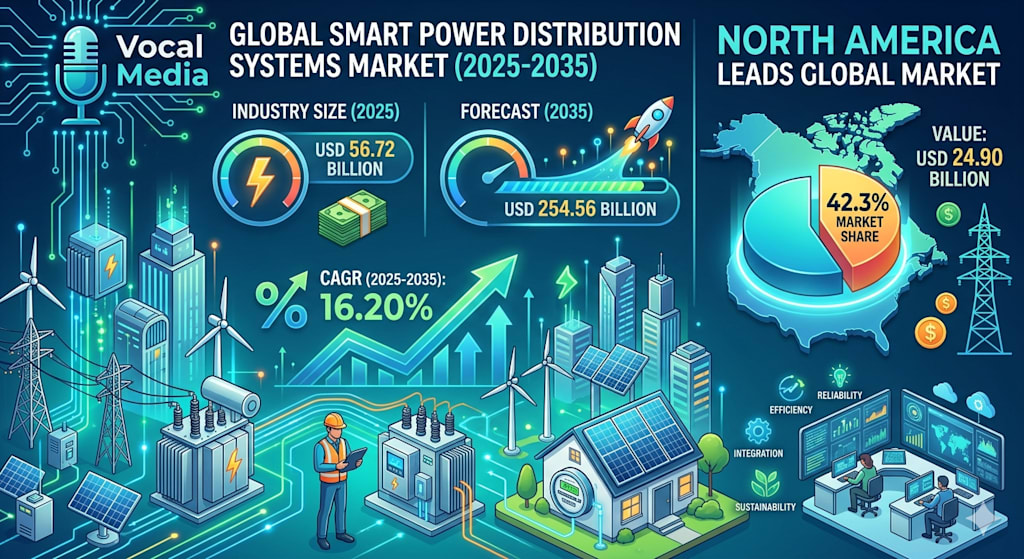
The global smart power distribution systems market is projected to grow from USD 56.72 billion in 2025 to about USD 254.56 billion by 2035, at a strong CAGR of 16.20%. Growth is driven mainly by national grid upgrades and large-scale smart meter rollouts, as utilities shift toward digital monitoring to improve reliability.
At the center of this shift are smart power distribution systems. These are modern tools and technologies that replace older, manual grid infrastructure with digital monitoring, automation, and real-time data. In simple terms, they allow electricity networks to “think” and respond instead of just delivering power in one direction.
Right now, the scale of this change is massive. The market for these systems is expected to grow sharply over the next decade, driven largely by government investment and rising demand for reliable energy. Countries around the world are pouring billions into upgrading their grids—not as an option, but as a necessity.
Market Highlights
- The Smart Power Distribution Systems Market will grow from USD 56.72 Billion in 2025 to USD 254.56 Billion by 2035, at a CAGR of 16.20%
- North America leads with a 42.3% market share, valued at USD 24.90 Billion
- Advanced Metering Infrastructure (AMI) dominates the Technology Type segment with a 47.2% share
- On-Premise deployment holds a 67.4% share of the Deployment segment
- Hardware leads the Component segment with a 54.6% share
- Residential applications hold a 42.8% share of the Application segment
- Energy and Utilities is the top end-use vertical with a 39.7% share
Why does this matter? Because the old way of running power systems no longer fits today’s world.
Electricity demand is rising fast. Homes are using more devices. Businesses rely on uninterrupted power. Electric vehicles are adding new pressure to local grids. And renewable energy sources like solar and wind are unpredictable by nature. All of this creates a more complex system that older infrastructure struggles to manage.
Smart distribution systems solve this by giving utilities better control.
Instead of waiting for a power outage and sending crews to find the problem, operators can now detect faults instantly. Sensors and smart meters send constant updates, allowing issues to be identified and fixed much faster. In some cases, the system can even reroute electricity automatically, restoring power within minutes.
This shift from reactive to proactive management is one of the biggest changes happening in the energy sector.
Governments are not just encouraging upgrades—they are funding them directly. Large-scale programs in countries like the United States, China, and India are pushing utilities to install smart meters, automate substations, and digitize their networks.
These are long-term commitments, not short-term experiments. Once a country starts upgrading its grid, it creates years of steady demand for equipment, software, and services.
Smart meters are one of the most visible parts of this transformation. They replace traditional meters and provide real-time data on energy use. For consumers, this can mean more accurate billing and better insights into how electricity is used. For utilities, it creates a detailed view of demand patterns, helping them plan and operate more efficiently.
But the real power of these systems lies in how everything connects.
Smart grids are built on layers. At the edge, there are devices like meters and sensors collecting data. In the middle, there are control systems that manage operations. At the top, there are software platforms analyzing information and guiding decisions.
Together, these layers turn a passive network into an active system.
Of course, building this kind of infrastructure is not easy. One of the biggest challenges is cost. Upgrading an entire distribution network requires significant investment, especially for smaller utilities. There are also technical hurdles—installing new hardware, integrating software, and training staff all at the same time.
And then there’s the issue of supply. Equipment like transformers and advanced components often have long lead times. This can slow down large projects, even when funding is available.
Despite these challenges, the momentum is strong. Utilities are under pressure to improve reliability and meet stricter standards. In many regions, regulators now impose penalties for long outages, making smart upgrades a financial necessity.
There’s also a growing push toward cleaner energy. Renewable sources like solar and wind are expanding rapidly, but they require more flexible grid management. Smart systems make it easier to balance supply and demand, helping integrate these energy sources without destabilizing the network.
Another important trend is the use of artificial intelligence.
Utilities are starting to use AI to analyze data from sensors and predict problems before they happen. For example, systems can identify signs of equipment failure or detect unusual patterns that signal a potential outage. This reduces maintenance costs and improves reliability at the same time.
Even field inspections are changing. In some cases, technicians use smartphones to capture images of power lines and equipment. AI systems then analyze those images to find faults that might be missed by the human eye.
This kind of innovation shows how the industry is moving beyond basic automation into more advanced, data-driven operations.
At the same time, there’s a shift in how these systems are deployed. Most critical control functions still run on-site, within utility-controlled environments. This is mainly due to security concerns—power grids are considered critical infrastructure, and operators want full control over their systems.
However, cloud-based solutions are growing in areas like data analytics and customer services. This creates a hybrid model, where control stays local but insights and processing can scale through the cloud.
From a business perspective, this market is becoming increasingly competitive. Large companies are offering complete solutions that combine hardware, software, and services into one package. This approach reduces risk for utilities, which prefer working with fewer vendors on complex projects.
At the same time, companies are focusing more on long-term relationships. Once a utility installs a system, switching to another provider can be difficult and costly. This creates ongoing revenue through maintenance, upgrades, and software subscriptions.
The importance of smart distribution systems will only grow.
As cities expand and energy needs increase, the pressure on power networks will continue to rise. Electrification of transport, heating, and industry will add new layers of demand. Without smarter systems, managing all of this would be extremely difficult.
In many ways, these upgrades are laying the foundation for the future energy system. They enable everything from renewable integration to electric vehicle charging and advanced energy management.
Most people may never think about how electricity gets to them—until something goes wrong. But behind the scenes, a major transformation is underway.
It’s not flashy. It’s not immediate. But it’s essential.
And over time, it will change how power systems operate in ways that are more efficient, more reliable, and better suited to the demands of a modern world.
About the Creator
Yash Mule
SEO Specialist with 10+ years of experience at Evolvance Market Research. Expert in technical SEO, content strategy, and data-driven optimization, with a proven track record of significantly increasing organic traffic and search rankings.
Enjoyed the story? Support the Creator.
Subscribe for free to receive all their stories in your feed.
Comments
There are no comments for this story
Be the first to respond and start the conversation.