
The Quiet Engine Behind Every Mobile App: Why PHP Web Services Still Run the Show
While the app store gets the spotlight, the PHP backend powering most mobile experiences rarely gets mentioned — until it breaks.

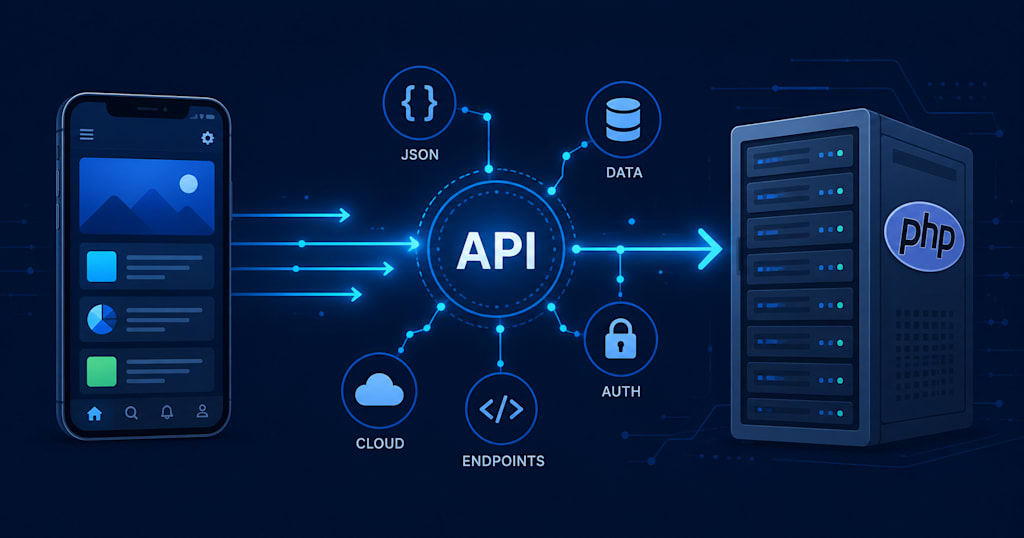
Pull up your favourite food delivery app, hit 'track order,' and watch the map update in real time. Behind that 30-second interaction, something unspectacular but essential just happened: a PHP web service received a location ping, queried a database, formatted a JSON response, and sent it back to your phone in under 200 milliseconds.
Nobody talks about this part. The app store reviews praise the icon design and the checkout flow. The tech press covers the AI personalization engine. But the PHP backend running the API layer? It sits quietly in a cloud server rack, handling millions of requests a day, earning roughly zero column inches.
This article is about that quiet engine — why PHP remains a dominant force in mobile backend development, how web services actually work, and what development teams need to get right when building the invisible infrastructure that mobile apps depend on.
Why PHP Still Powers Mobile Backends in 2026
The death of PHP has been predicted roughly once every two years since 2010. It has not arrived. According to industry surveys, PHP continues to run on more than 75% of all websites with a known server-side language — and a significant portion of those sites serve as the backend API layer for companion mobile applications.
The reasons are pragmatic rather than ideological. PHP is mature, extensively documented, and supported by a vast ecosystem of developers. Its deployment costs are low relative to alternatives, its frameworks — particularly Laravel and Symfony — have kept pace with modern development requirements, and its performance profile, improved substantially by PHP 8.x's JIT compilation, is competitive for the majority of mobile application use cases.
For a startup building a mobile app with a 6-month runway, this matters enormously. The combination of available developer talent, lower hourly rates compared to Node.js or Python specialists in many markets, and the availability of battle-tested frameworks makes PHP a commercially rational backend choice — not a legacy one.
What a PHP Web Service Actually Does for a Mobile App
The term 'web service' covers a lot of ground. In the context of mobile apps, it refers specifically to the server-side component that handles requests from the app, processes them, and returns structured data — almost always in JSON format.
Consider a travel booking app. When a user searches for flights, the app sends a request to a PHP web service endpoint. That endpoint validates the request, authenticates the user session, queries a database or a third-party airline API, formats the results, and returns them to the app. The user sees a list of flights. What they do not see is the request routing, error handling, rate limiting, caching logic, and security checks that ran in the background.
Well-architected PHP web service development for mobile apps handles several critical responsibilities beyond data retrieval: user authentication and token management, data validation and sanitisation to prevent injection attacks, response formatting that the mobile client can parse efficiently, and error handling that gives the app useful feedback without exposing internal system information.
REST vs GraphQL: The Choice Most Mobile Teams Get Wrong
The dominant architectural pattern for PHP mobile APIs remains REST — Representational State Transfer. REST structures the API around resources (users, products, orders) and uses standard HTTP methods to interact with them: GET for retrieval, POST for creation, PUT or PATCH for updates, DELETE for removal.
GraphQL has gained significant traction, particularly for mobile applications where network efficiency matters. Research from Postman's State of APIs report shows REST APIs continue to power 83% of all web services, while GraphQL has seen a 340% adoption surge among large enterprises. For mobile apps specifically, GraphQL's ability to request exactly the data needed — rather than receiving a full resource endpoint response and discarding unwanted fields — reduces payload sizes, which matters on constrained mobile connections.
The honest recommendation: for most mobile applications, a well-designed REST API built on Laravel or Slim is faster to build, easier to maintain, and adequate for performance requirements. GraphQL earns its complexity only when the mobile client's data needs are highly variable — such as a social platform where different user types see radically different views of the same underlying data.
The fastest API is not always the most complex one. For most mobile apps, a cleanly structured PHP REST service with proper caching outperforms a poorly implemented GraphQL layer every time.
Building Secure PHP Web Services: The Non-Negotiables
Security in mobile API development is not a feature to be added later. It is a design constraint that shapes every architectural decision. The most common vulnerabilities in PHP web services fall into predictable categories:
- SQL Injection: PHP web services that construct database queries from raw user input are vulnerable to injection attacks. Using prepared statements — a standard feature of PHP's PDO extension — eliminates this class of vulnerability entirely.
- Broken authentication: Mobile tokens (typically JWTs) must be properly validated on every request. Implementing OAuth 2.0 or a well-tested library like Laravel Passport removes the most common authentication errors.
- Excessive data exposure: APIs that return full database records — including fields the mobile app does not use — create unnecessary risk. Resource transformation layers (sometimes called 'API resources' in Laravel) control exactly what data leaves the server.
- Rate limiting: Without request throttling, a PHP API is vulnerable to brute-force attacks and accidental DDoS from misbehaving client apps. Laravel's rate limiting middleware handles this with a few lines of configuration.
- CORS misconfiguration: Incorrectly configured Cross-Origin Resource Sharing headers either block legitimate requests or permit access from unauthorised origins. This is among the most common and easily-fixed security issues in PHP APIs.
The PHP Frameworks Worth Knowing in 2026
Not all PHP frameworks are created equal for mobile API development. The choice of framework has downstream implications for security, scalability, and the availability of developer talent who can maintain the codebase.
Laravel remains the most widely used PHP framework for REST API development. Its ecosystem — Sanctum for API authentication, Eloquent for database interaction, Horizon for queue management — covers the majority of mobile backend requirements without requiring custom solutions. Its artisan command-line tooling and comprehensive documentation reduce onboarding time for new developers.
Lumen, Laravel's lightweight sibling, is designed specifically for microservices and API-only applications. It strips out the full-stack components of Laravel and retains only the API-relevant ones, resulting in a faster, lower-memory footprint that suits high-throughput mobile backends.
Symfony sits at the other end of the complexity spectrum — more configurable, more verbose, and preferred by larger enterprise teams with complex integration requirements. For teams evaluating a PHP development company to build or scale their mobile backend, asking about framework choices and the rationale behind them is a useful qualifier for technical depth.
What Mobile Apps Demand That PHP APIs Must Deliver
Mobile applications place specific demands on their backend web services that browser-based applications do not always surface as clearly:
- Latency sensitivity: Mobile users expect sub-500ms responses for interactive operations. This requires proper indexing, query optimisation, and response caching — often using Redis or Memcached alongside the PHP layer.
- Offline resilience: Well-designed mobile APIs support partial synchronisation, allowing the app to function with stale data when connectivity is poor and reconcile changes when connectivity returns.
- Versioning: Mobile apps cannot be forced to update. An API must maintain backward compatibility across versions, which requires a deliberate versioning strategy (URI versioning being the most widely adopted) built into the initial architecture.
- Push notification integration: PHP web services frequently serve as the trigger point for push notifications, integrating with Firebase Cloud Messaging or Apple Push Notification Service to alert mobile users to relevant events.
Frequently Asked Questions
Is PHP a good choice for mobile app backend development in 2026?
Yes, for most use cases. PHP's mature ecosystem, strong framework support (particularly Laravel), and wide developer availability make it commercially and technically sound for mobile backend work. High-throughput real-time applications may benefit from Node.js, but PHP handles the majority of mobile backend patterns well.
What is the difference between a PHP web service and a PHP website?
A PHP website generates and serves HTML pages for browser consumption. A PHP web service generates and serves structured data — typically JSON — for consumption by mobile apps, other servers, or browser-based JavaScript. The language is the same; the output and architecture differ.
How does authentication work between a PHP API and a mobile app?
The most common pattern is token-based authentication. The app sends credentials once, receives a JWT (JSON Web Token) or OAuth token, and includes that token in the headers of every subsequent request. The PHP API validates the token on each request without maintaining session state on the server.
How long does it take to build a PHP backend for a mobile app?
A basic CRUD API covering user authentication, core data models, and standard endpoints can be built in 4 to 8 weeks. Complex integrations, payment processing, third-party APIs, and advanced real-time features extend that timeline proportionally.
The Part of Your App You Will Never See — But Your Users Always Feel
Every mobile app's user experience is ultimately bounded by its backend. A beautiful interface loading slow data, or returning errors at peak load, or leaking user data through a misconfigured endpoint — these are backend failures that the user experiences as product failures.
The PHP web service layer is not glamorous infrastructure. But it is foundational. Getting it right — secure, documented, versioned, and performant — is what separates mobile apps that scale from ones that struggle to survive their own success.
About the Creator
Maria Smith
Software developer and tech writer interested in app development, software engineering, AI, web technologies, developer tools, and programming. Writing about technology, coding workflows, and trends shaping modern software development.
Enjoyed the story? Support the Creator.
Subscribe for free to receive all their stories in your feed.
Comments
There are no comments for this story
Be the first to respond and start the conversation.