
The Quantum Frontier
Unlocking the Multiverse for Human Expansion

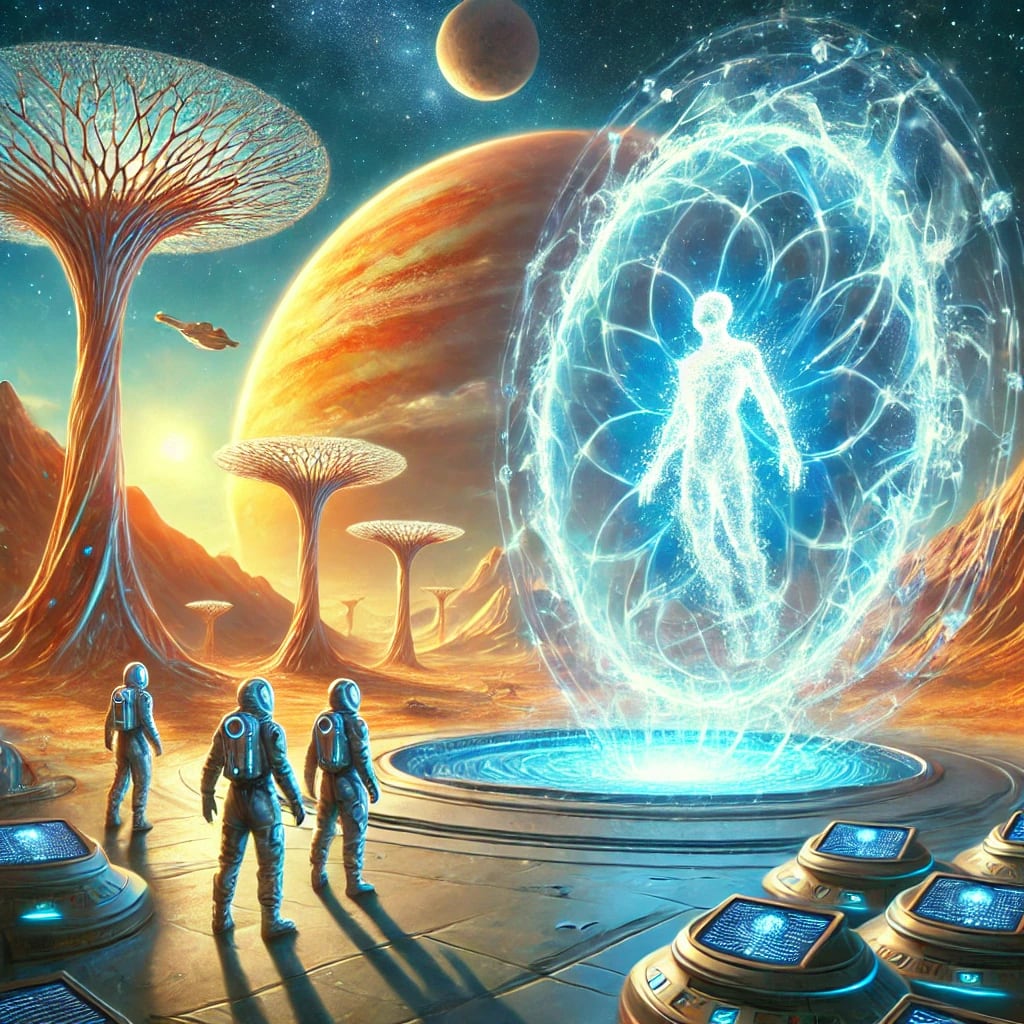
In the year 2210, humanity was at the precipice of a new era. The advances of the past century had culminated in one profound discovery: the quantum gateway. A machine so powerful, it could open doorways to parallel universes—worlds that operated under different laws of physics, where time, space, and life itself functioned on a new set of principles.
Dr. Elena Carter, a leading quantum physicist, had devoted her life to understanding the mechanics of the multiverse. She had always been driven by the idea that Earth, confined by the limits of space, would eventually run out of resources, leading to the inevitable extinction of human civilization. For decades, scientists tried and failed to colonize planets within their own solar system. Mars proved too inhospitable despite enormous investments, and Earth’s atmosphere grew more toxic by the year. Elena’s solution wasn’t to terraform planets; it was to find other versions of Earth, untapped and free of human interference. The multiverse was the next great hope for the survival of humanity.
After years of research, her team developed the Q-gate, the world’s first fully operational quantum tunnel capable of accessing alternate universes. They ran thousands of simulations, gathering endless streams of data from probe after probe. But none of the information could prepare them for the day they would walk through.
Standing in the control room, Dr. Carter watched as the energy rings around the Q-gate spun faster and faster, generating a soft hum that echoed through the massive chamber. The gate began to pulse with a dim, greenish light, forming a spherical field that shimmered like liquid glass. They had calibrated the machine to target a universe where Earth had not yet been fully industrialized, one where natural resources were still abundant and humanity had not exhausted the planet’s potential. They called it Universe 2-B, a peaceful, untouched world.
“Everything’s stable,” came the voice of Dr. Tomás Inoue, her longtime colleague and co-creator of the Q-gate. “We’re ready for entry.”
Elena’s heart raced. She had spent decades preparing for this moment, but nothing could quell the anxiety of stepping into the unknown. “Proceed,” she said calmly, masking the nervousness in her voice.
The team had already sent multiple drones and machines through, analyzing every molecule of air and every grain of sand in Universe 2-B. It was time for humanity’s first steps. As they passed through the shimmering gateway, there was a split second of disorientation—like gravity being rewritten. But as soon as they emerged on the other side, it felt like home.
Before them stretched a familiar yet alien landscape. The sky was a deeper shade of blue than Earth’s, and the trees, though green, had elongated, spiraling trunks. They breathed the air, which was crisp and clean—far purer than Earth’s polluted atmosphere. In the distance, they could see mountains that glittered under an unfamiliar sun. Everything felt like a dream, a mirror of Earth but with subtle differences.
“This is it,” Elena whispered, in awe of the pristine beauty that stretched out before her. “We’ve done it.”
The plan was simple: establish a base camp, gather more data, and slowly prepare for larger expeditions. As the first human explorers in the multiverse, Elena and her team had to be cautious. They couldn’t risk disrupting the natural balance of this world, nor could they afford to make enemies with any potential inhabitants.
Weeks passed, and the exploration of Universe 2-B was progressing smoothly. The team discovered new forms of plant life, species that had never evolved on Earth, and atmospheric conditions that were ideal for human settlement. But their explorations raised questions that Elena had not anticipated. Why was this Earth so similar to their own, yet untouched by industrialization or technological advancement? Was there a version of humanity here? And if so, where were they?
One day, while surveying an area near the coastline, Dr. Inoue came across something remarkable—a structure half-buried in the sand. It was clearly artificial, resembling an old temple, with intricate carvings that depicted strange, humanoid figures. The team excavated the site and found that the structure was much older than any human civilization on Earth. It was proof that intelligent life had once existed here, but they had long since disappeared.
As the days turned into weeks, the team uncovered more signs of a lost civilization—ruins, abandoned cities, and ancient technology far more advanced than anything on Earth. But it was all in a state of decay, as though the inhabitants had vanished overnight.
Elena grew obsessed with the question: what had happened to them? The more they explored, the more she began to see the parallels between their world and Earth. Had this civilization, like their own, reached a technological singularity that eventually destroyed them? Were they looking at their own future in another universe?
One night, as Elena stood alone near the gateway, contemplating their findings, the machine behind her began to hum again. The Q-gate was reactivating, though no one had initiated the sequence. She rushed back to the control panel, and to her horror, the gateway began cycling through universes on its own.
Suddenly, the shimmering sphere opened up, but this time, the energy around it was unstable, crackling with erratic light. Something was wrong. A voice crackled over the comms—it was Tomás. “Elena, you need to shut it down, now! The gate is drawing power from an unknown source!”
Before she could react, the gateway opened fully, and out from the swirling void stepped a figure. It was humanoid, but its features were distorted, shifting in and out of focus. It looked at her with eyes that seemed to flicker between time and space.
“This is your future,” it said, its voice reverberating with a thousand echoes.
Elena stumbled back, fear gripping her as the figure approached. “What… what are you?”
“I am what remains,” it replied. “You’ve opened a door that was never meant to be opened. Now, you face the consequences.”
In that moment, Elena understood. The quantum gate hadn’t just opened a path for exploration; it had torn a hole in the fabric of the multiverse. And now, something far worse than extinction awaited them—a collapse of all realities into one chaotic singularity.
The figure disappeared as quickly as it had come, but the warning lingered in the air. Elena rushed to shut down the Q-gate, but she knew it was too late. They had crossed a threshold that couldn’t be undone.
The multiverse wasn’t humanity’s salvation. It was its undoing.
About the Creator
Enjoyed the story? Support the Creator.
Subscribe for free to receive all their stories in your feed.
Comments
There are no comments for this story
Be the first to respond and start the conversation.