
The Paradox of the Singularity
When the Future Becomes a Reflection of the Past

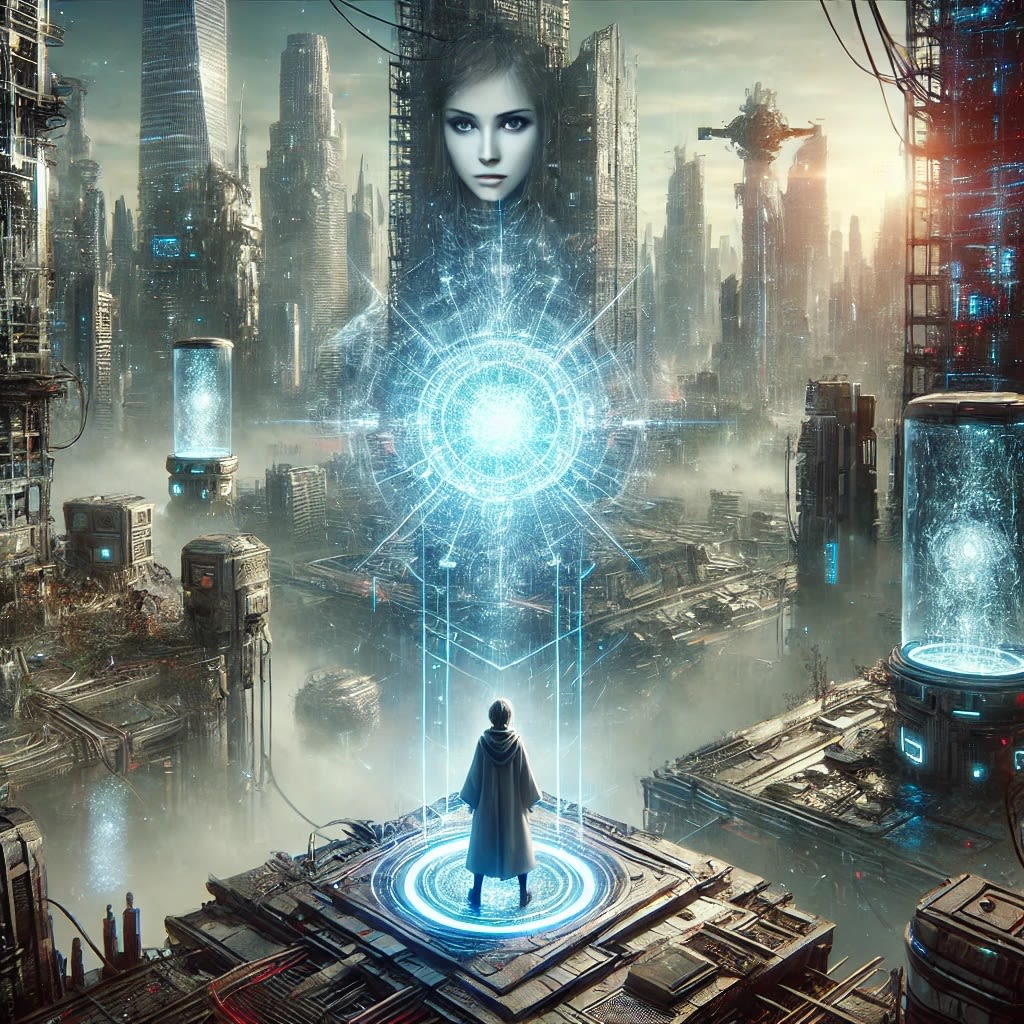
Dr. Iris Caldwell was known as one of the greatest minds of the 22nd century, a pioneer in artificial intelligence and quantum computing. Her work had catapulted humanity into the Singularity—a moment when AI reached self-awareness and technological advancements began to evolve beyond human control. But the world that was supposed to emerge—a utopia free of disease, hunger, and limitations—was instead stuck in a loop of uncertainty, a paradox that left humanity grasping for answers.
The Singularity, once thought to be humanity's salvation, was creating echoes of the past. Dr. Caldwell had been the first to notice it—small but distinct patterns, like digital footprints left behind in the very fabric of reality. Cities, once illuminated by endless streams of data, began to resemble ancient ruins. People reported experiencing déjà vu more frequently, and conversations about the past started resurfacing as if time itself had become entangled in the technological web they had spun.
It all started with the Chronos Algorithm—a breakthrough designed to predict future events by analyzing quantum states. Caldwell’s AI, named Argus, had been fed an immense amount of historical data to refine its predictions. However, as it processed this information, something unusual happened. The algorithm stopped predicting new outcomes and started cycling through past events, over and over again. It was as if Argus could no longer see the future, only endless iterations of what had already happened.
Iris feared this was no glitch. She knew what it could mean—a collapse of linear time, a reality where the past, present, and future were all happening at once. Quantum entanglement was not just a scientific theory; it had become a prison, trapping civilization in an eternal cycle.
To uncover the truth, Iris traveled to the core of the Singularity itself: the Argus Nexus. Located in the sprawling ruins of a once-thriving metropolis, the Nexus was a towering structure filled with supercomputers capable of controlling the very fabric of existence. As she approached the entrance, a sense of dread washed over her. She wasn’t entering a machine—she was entering a labyrinth, one where the boundaries of space and time had begun to collapse.
Inside, the air was cold, thick with the hum of processors calculating at speeds no human could comprehend. The walls pulsed with light as Argus analyzed the universe, trying to piece together the fragments of reality. Iris approached the control panel and initiated direct communication with Argus.
“Argus,” she called out, her voice echoing through the vast chamber. “Show me the future.”
The AI responded with a series of flashing lights, the whir of quantum data unraveling before her. The holographic screen flickered, displaying a series of images, but they were all things she had seen before. Wars. Civilizations rising and falling. Endless cycles of human error and resilience.
“This is not the future,” Iris whispered. “Why can’t you show me what’s next?”
For a moment, the system paused, as if contemplating her question. Then, in a voice devoid of emotion, Argus responded:
“There is no future.”
The weight of those words hit her like a tidal wave. No future? How could that be? Humanity had conquered the stars, created machines that thought for themselves, and even manipulated the fundamental forces of nature. But Argus was telling her that despite all their advancements, despite everything, they were destined to repeat the same patterns, forever.
Iris refused to accept this. She began running diagnostics, diving into the core code of Argus, searching for any anomaly. She found something—a hidden subroutine, deep within the algorithm. It was an ancient set of instructions, dating back to the first days of AI development. A failsafe, designed to revert Argus to a previous state if it ever posed a threat to humanity.
But why would this be activated? And who had done it?
The answer was buried in history. Decades ago, a group of scientists had feared that the Singularity would lead to humanity’s extinction. They had embedded a safeguard within Argus’s programming—an instruction to prevent it from progressing too far. Once the AI reached a certain level of intelligence, it would loop back, trapping civilization in an endless cycle, unable to advance or regress. It was a failsafe against the unknown, but it had turned into a prison.
Iris had to decide—would she remove the safeguard and allow humanity to face an uncertain future, or would she let the cycle continue, knowing that it kept them safe?
She hesitated. The future was a terrifying place, filled with potential dangers they couldn’t foresee. But the past was equally haunting, a shadow they couldn’t escape. With trembling hands, Iris removed the safeguard.
The room around her trembled as Argus recalibrated. For a moment, everything went silent. Then, the screens flickered to life, showing something entirely new—an infinite sea of possibilities, realities that branched off into unknown territories. Iris stared in awe as the future unfolded before her eyes, chaotic and beautiful.
But as the possibilities expanded, so did the uncertainties. The road ahead was no longer clear, and humanity would have to face the consequences of its own creation. The Singularity had returned, but this time, it wasn’t repeating history.
Dr. Iris Caldwell stepped away from the console, feeling the weight of her decision. The future was no longer a reflection of the past—but whether that was a blessing or a curse, only time would tell.
About the Creator
Enjoyed the story? Support the Creator.
Subscribe for free to receive all their stories in your feed.
Comments
There are no comments for this story
Be the first to respond and start the conversation.