
The Next Generation of Telehealth Won’t Be About Video Calls
AI is transforming healthcare from occasional virtual visits into continuous, intelligent patient care.
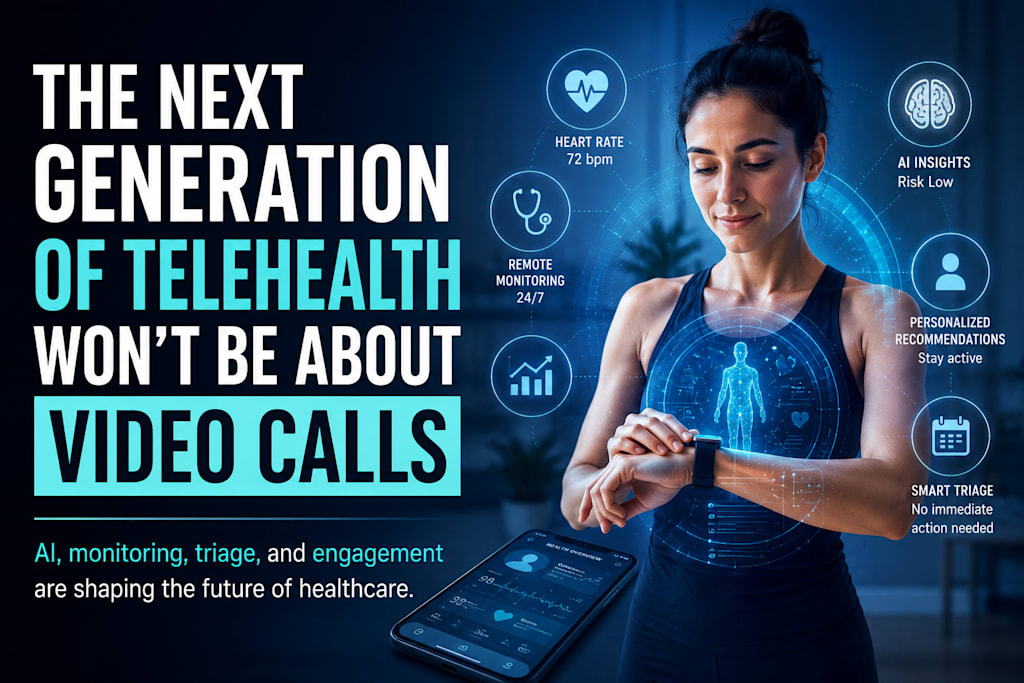
Not long ago, telehealth was viewed as a convenient alternative to visiting a doctor's office. A video call could save time, reduce travel, and improve access to healthcare services. During the pandemic, these platforms became essential, helping millions of patients receive medical care without leaving their homes.
But healthcare technology is already moving beyond virtual consultations.
The next phase of digital healthcare is being shaped by artificial intelligence, real-time monitoring, intelligent triage systems, and continuous patient engagement. Instead of interacting with healthcare providers only when something goes wrong, patients may soon benefit from systems that proactively identify risks, monitor health conditions, and provide personalized guidance before problems escalate.
A recent analysis by GeekyAnts explored how telehealth platforms are evolving into AI-powered healthcare ecosystems. The shift represents more than a technological upgrade, it signals a fundamental change in how healthcare may be delivered in the future.
Traditional telehealth solved a specific problem: connecting patients and providers remotely.
However, healthcare doesn't begin and end with appointments.
Most health journeys occur between consultations. Patients manage medications, track symptoms, recover from procedures, and make daily decisions that influence long-term outcomes. Historically, healthcare providers had limited visibility into these periods.
Artificial intelligence is beginning to close that gap.
Wearable devices, connected health applications, and remote monitoring systems can continuously collect data related to heart rate, activity levels, sleep patterns, blood pressure, and other health indicators. AI systems can analyze this information in real time, identifying trends and warning signs that might otherwise go unnoticed.
Rather than waiting for patients to report symptoms, future healthcare systems may detect potential issues early and trigger interventions before conditions worsen.
This proactive model could significantly improve outcomes while reducing pressure on healthcare systems.
Another major area of transformation is triage.
Today, patients often struggle to determine whether their symptoms require immediate medical attention, a routine consultation, or simple self-care. This uncertainty contributes to overcrowded emergency departments and delayed treatment for serious conditions.
AI-powered triage systems are emerging as a potential solution.
By analyzing symptoms, medical history, and contextual information, these systems can guide patients toward appropriate care pathways. While human healthcare professionals remain essential, intelligent triage tools can help prioritize resources and improve access to care.
As these systems mature, they may become the first point of interaction for many patients seeking medical assistance.
Patient engagement is also undergoing a dramatic evolution.
One of the biggest challenges in healthcare is ensuring that patients remain actively involved in managing their health. Treatment plans are often successful only when patients consistently follow recommendations and maintain healthy behaviors.
Future telehealth platforms are increasingly incorporating AI-driven engagement tools designed to encourage adherence and improve communication.
Imagine receiving personalized reminders tailored to your habits, intelligent wellness recommendations based on your health data, or automated follow-ups after treatment. These seemingly small interactions can have a significant impact on long-term health outcomes.
The future of healthcare may be less about isolated appointments and more about continuous support.
Of course, this vision introduces new challenges.
Healthcare organizations must address concerns around privacy, security, compliance, and trust. Patients are unlikely to embrace continuous monitoring if they feel uncertain about how their data is being used. Likewise, healthcare providers need confidence that AI systems are accurate, transparent, and accountable.
Building these systems requires more than innovative features.
It requires production-ready infrastructure capable of handling sensitive patient information while maintaining reliability at scale. Security frameworks, regulatory compliance, data governance, and system resilience become just as important as the AI models themselves.
The future of telehealth depends not only on what AI can do, but also on whether healthcare organizations can build platforms capable of delivering those capabilities safely and consistently.
Looking ahead, the boundaries between healthcare, artificial intelligence, and consumer technology will continue to blur.
Smartwatches are becoming medical devices. AI assistants are becoming health companions. Remote monitoring is becoming a routine part of care delivery. Patients increasingly expect healthcare experiences that are personalized, responsive, and available whenever they need them.
In this environment, video consultations may eventually become just one feature within a much larger digital health ecosystem.
The organizations that succeed will be those that understand healthcare as an ongoing relationship rather than a series of isolated interactions.
The future of telehealth isn't simply about connecting patients to doctors through screens.
It's about creating intelligent systems that support patients every day, anticipate problems before they become emergencies, and transform healthcare from reactive treatment into proactive care.
That future may be closer than many people realize.
Further Reading
This article was inspired by insights discussed in a healthcare technology analysis published by GeekyAnts.
Source:
About the Creator
Enjoyed the story? Support the Creator.
Subscribe for free to receive all their stories in your feed.
Comments
There are no comments for this story
Be the first to respond and start the conversation.