
The New Era of Artificial Intelligence: Latest Updates Transforming Technology, Business, and Human Life
An in-depth look at how modern AI advancements are reshaping industries, improving productivity, and redefining the future of work and creativity

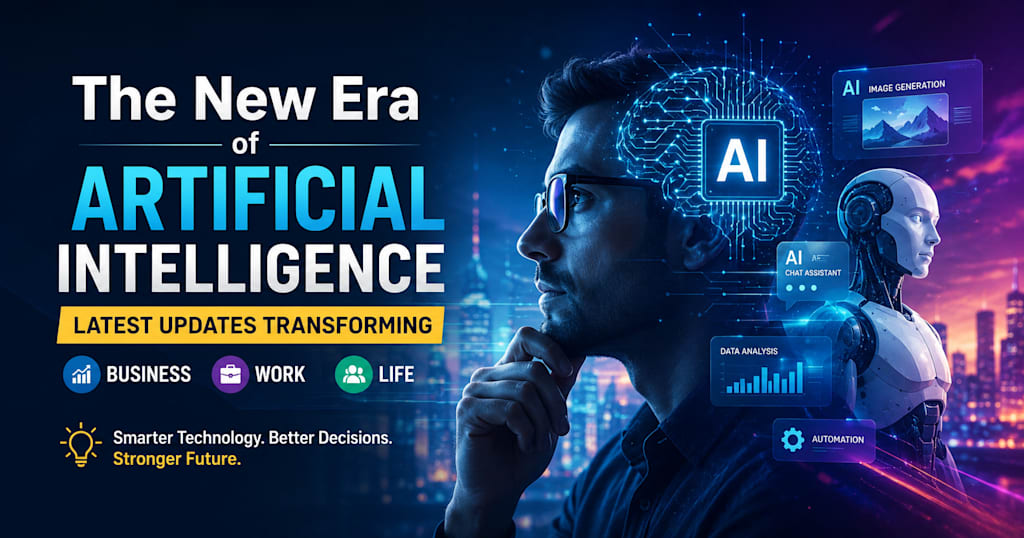
The New Era of Artificial Intelligence
Artificial Intelligence has moved far beyond being just a technical innovation or a futuristic idea. It is now a practical and powerful force that is actively shaping industries, economies, and everyday human behavior. The most recent wave of AI developments shows a clear shift toward systems that are more intelligent, more adaptive, and significantly more integrated into real-world applications.
What makes this phase of AI evolution important is not only its speed but also its depth. AI is no longer limited to simple automation tasks. It is now being designed to understand context, generate meaningful responses, analyze complex data, and support decision-making across multiple domains.
From Basic Automation to Advanced Intelligence
In earlier stages, AI systems were primarily rule-based or task-specific. They could perform limited functions such as answering questions, sorting data, or generating simple text outputs. However, modern AI systems have evolved into advanced models capable of reasoning, learning patterns, and producing highly contextual results.
This transformation has significantly changed how people interact with technology. Instead of being static tools, AI systems now behave more like adaptive assistants that respond dynamically to user needs. This shift is one of the key reasons AI adoption has accelerated globally.
Multimodal AI and the Expansion of Capabilities
One of the most important developments in recent AI updates is the rise of multimodal systems. These systems can process and understand different types of input such as text, images, audio, and in some cases video.
This means AI is no longer restricted to one type of data. It can analyze a chart, describe an image, summarize a document, or respond to voice commands in a unified way. This integration is making AI far more practical for real-world use cases, especially in industries like education, healthcare, marketing, and software development.
The ability to connect different types of information is what is pushing AI closer to human-like understanding.
The Impact on Business and the Digital Economy
AI is having a profound impact on how businesses operate. Companies are now using AI to reduce operational costs, improve efficiency, and increase productivity at scale. Tasks that once required multiple employees can now be completed with the help of AI-driven tools and systems.
In digital marketing, AI is being used for content generation, SEO optimization, customer engagement, and data analysis. In e-commerce, it helps with product recommendations, inventory forecasting, and customer behavior tracking. In freelancing and remote work, individuals are using AI to deliver faster and more professional services.
This shift is not just improving efficiency; it is also changing the competitive landscape. Businesses that adopt AI effectively are gaining a significant advantage over those that do not.
Content Creation in the Age of AI
Content creation has become one of the most heavily influenced areas by AI advancements. Writers, designers, marketers, and creators are now using AI tools to speed up ideation, drafting, editing, and optimization processes.
However, while AI can generate content quickly, the value of human creativity has not decreased. Instead, it has become more important. The best-performing content today is often a combination of human insight and AI assistance. Human creativity provides originality and emotional depth, while AI provides structure, speed, and scalability.
This balance is defining the future of digital content creation.
Changing Nature of Jobs and Skills
A common concern surrounding AI is job displacement. While it is true that automation is replacing certain repetitive tasks, the broader reality is more complex. AI is not simply eliminating jobs; it is transforming them.
Many roles are evolving to include AI-related skills such as prompt engineering, AI-assisted research, and automated workflow management. This means that professionals who learn to work with AI are likely to become more valuable in the job market.
The key difference in the future will not be between humans and AI, but between people who use AI effectively and those who do not.
Ethical Concerns and Responsible Use
As AI becomes more powerful, ethical considerations are becoming increasingly important. Issues such as data privacy, misinformation, bias in algorithms, and responsible usage are now central topics in AI development.
Organizations and developers are working toward creating more transparent and controlled AI systems. The goal is to ensure that AI remains a tool that benefits society while minimizing potential risks.
Responsible AI usage will play a major role in shaping public trust and long-term adoption.
The Future of Artificial Intelligence
The future of AI is expected to be deeply integrated into everyday life. From personal assistants to fully automated business systems, AI will continue to expand its presence across all sectors.
Education systems may become more personalized, healthcare may become more predictive, and businesses may operate with higher levels of automation and intelligence. Over time, AI will shift from being an external tool to an embedded layer within most digital experiences.
This evolution suggests that AI is not a temporary trend but a long-term structural change in how technology and society interact.
Conclusion
Artificial Intelligence is currently in one of its most important growth phases. Its capabilities are expanding rapidly, and its influence is reaching nearly every industry. Understanding these changes is essential for individuals and businesses that want to remain competitive in a rapidly evolving digital world.
The real transformation is not just technological—it is structural, economic, and social. Those who adapt early will be better positioned to take advantage of the opportunities this new era is creating.
About the Creator
Mind to Money Hub
Helping you learn how to manage money better, build wealth smarter, and achieve financial freedom through simple, practical finance insights.
Enjoyed the story? Support the Creator.
Subscribe for free to receive all their stories in your feed.
Comments
There are no comments for this story
Be the first to respond and start the conversation.