
The Matrix Was Written 2,000 Years Ago
What an ancient Buddhist text teaches us about anxiety, attachment, and the cages we build in our own minds


Let me start with a question: is the world you live in real, or is it a simulation?
In The Matrix, humanity sleeps inside pods, bodies wired with tubes. The machines harvest the electricity our bodies produce, and in exchange they feed our minds a dream: a convincing, shared illusion called the Matrix. Everyone is dreaming the same dream at the same time.
But it’s not a dream where anything goes. What happens inside it touches the body outside. You know the feeling. Scratch an itch in a dream and you wake up with marks on your skin. Clench your jaw through a stressful dream and your teeth ache in the morning.
The film’s most famous moment is a choice. Morpheus offers Neo two pills. Take the blue one and stay comfortable inside the illusion. Take the red one and wake up to the truth.
Neo takes the red pill.
It’s no accident that Morpheus is named after the Greek god of dreams, who could shape what sleepers saw. In the film he does the opposite: he pulls Neo out of the dream. But the pill alone doesn’t free him. As an old Chinese saying goes, the teacher opens the door; you walk through it yourself. Only after a long struggle does Neo grasp that everything around him is code. And the moment he truly sees it, the rules stop binding him. Agents fire a storm of bullets. Neo raises one hand, and they hang frozen in the air.
Here’s what fascinates me. A version of this idea was written down roughly two thousand years ago, in a Buddhist text that argues our everyday world is a kind of illusion and offers a way to see through it.
It’s called the Diamond Sutra.
Don’t let the religious name put you off. You don’t need to be Buddhist to get something out of it. Read it as a handbook for a calmer mind.
A diamond and a lightning bolt
The full title is the Vajracchedikā Prajñāpāramitā Sūtra, roughly “The Diamond That Cuts Through Illusion: The Perfection of Wisdom.” It belongs to the Mahayana “wisdom” texts and was likely composed in India around the first century CE.
The word vajra carries two images at once: a lightning bolt that pierces everything, and a diamond that nothing can scratch.
That’s the promise of the text. When worry strikes, its wisdom cuts through it like lightning, and your mind becomes like a diamond that worry can’t shake. And when joy arrives, it lets you see joy clearly too, so you don’t cling to it. As a classical Chinese line puts it: not elated by things, not dejected by oneself.
How do you build a mind like that? The sutra’s answer is prajñāpāramitā: the wisdom that carries you to “the other shore.” It isn’t cleverness in the everyday sense. It’s closer to a state of seeing clearly how things actually are.
The most beloved Chinese translation, by the monk Kumārajīva in the early 400s, gave the text its famous closing verse:
All conditioned things are like a dream, an illusion, a bubble, a shadow, like dew, like a flash of lightning. This is how you should see them.
Three people whose lives it changed
The Diamond Sutra is famous in East Asia for the stories told about the people it transformed. Three of them stand out.
The illiterate woodcutter. In 7th-century China, a poor young man named Huineng was delivering firewood when he overheard someone reciting the Diamond Sutra. One line stopped him cold: “Let your mind arise without dwelling on anything.” He couldn’t read, but that sentence cracked him open. He said goodbye to his mother, walked north, and eventually became the Sixth Patriarch of Chan (Zen) Buddhism. The record of his teachings, the Platform Sutra, is the only Chinese-authored Buddhist work traditionally honored with the title “sutra.”
The boy who was told he’d die at eighteen. A Buddhist legend tells of a young novice monk whose fortune was read by a famous face-reader: “You’re bright, but you won’t live past eighteen.” His teacher didn’t argue. He simply told the boy to recite the Diamond Sutra every day in a quiet place. Eighteen came and went. The monk lived to ninety-five. Did the sutra add years to his life? Maybe the real change was that he stopped waiting for death. He could live calmly, and when the time came, die calmly.
The diamond trader. In the 1970s, a young American named Michael Roach went to India to study Buddhism and later became the first Westerner to earn the Tibetan geshe degree. His teacher then gave him a surprising assignment: go back to America and go into business. A monastery is a good place to study, the teacher said, but a busy office is the real laboratory. Roach helped build Andin International Diamond Corporation into a company with more than $100 million in annual sales, and later wrote The Diamond Cutter about applying the sutra’s ideas to business. His view: money itself isn’t the problem. How you earn it, and how you hold it, is.

The question at the heart of it
For such an influential text, the Diamond Sutra is short (about 5,000 characters in Chinese) and surprisingly plain. No flowery praise, no dramatic miracles.
It opens on an ordinary day. The Buddha and his monks walk into town with their begging bowls, eat, wash their feet, and sit down together. Then a disciple named Subhuti asks a question:
If someone sincerely sets out on the path to awakening, how should they keep their mind steady, and how do they tame the restless thoughts inside it?
The rest of the sutra is the Buddha’s answer, given patiently and from different angles, as Subhuti keeps circling back to the same question.
The answer comes down to letting go of four “marks,” four mental fixations:
The mark of self: the belief in a solid, separate “me,” and the clinging to everything labeled mine: my money, my family, my career, my looks, my reputation.
The mark of others: once there’s a “me,” everyone else becomes “not me.” I’m smart, she’s not. I’m pretty, he’s plain. This is mine, that’s yours. Comparison and judgment are born here.
The mark of living beings: fixation on the whole world of things and creatures, from seasons and weather to birds and ants, as separate, fixed objects.
The mark of a lifespan: our clinging to time and continuity. Emperors chased elixirs of immortality. Ordinary people seek it through children and legacy.
The Buddha says even generosity should be free of these marks. Give without thinking I am the giver, so I deserve something back.
There’s a Zen story about this. A wealthy merchant brought a bag of five hundred pieces of gold to the master Seisetsu to help build a new hall. Seisetsu said, “All right, I’ll take it,” and turned back to his work. The merchant was annoyed. “There are five hundred pieces of gold in that bag!” “You told me already,” said Seisetsu. “That’s a lot of money, even for a rich man!” the merchant pressed. “Aren’t you going to thank me?”
Seisetsu replied: “Why should I thank you? The giver should be thankful.”
Burning the Buddha to stay warm
The sutra goes further. The Buddha asks Subhuti: Can you recognize the Buddha by his physical form? Subhuti says no. The Buddha agrees:
All forms are illusory. Whoever seeks me in appearances or sounds walks the wrong path and cannot see the Buddha
Chinese Buddhism has a legendary illustration of this. One freezing winter, the Tang dynasty Zen master Danxia Tianran took shelter in a drafty temple in Luoyang. There was no fire. So he took down a wooden Buddha statue, split it with an axe, and lit it.
The temple monks were horrified. “How dare you burn the Buddha!”
Danxia calmly poked the fire. “I’m burning it to find the relics.” (Relics are the crystal-like remains said to be left after a holy person’s cremation.)
“It’s a block of wood! How could it have relics?”
“Well then,” said Danxia, “if it has no relics, it isn’t the Buddha. So what’s the harm in burning it?”
Shocking, and very Zen. Danxia had taken the sutra seriously: the Buddha isn’t a carving. Whatever is sacred lives in the mind, not in the object.
“The world is not the world. That’s why we call it the world.”
This is where the Diamond Sutra starts to sound like The Matrix.
Throughout the text there’s a strange, repeating formula:
What the Buddha calls the perfection of wisdom is not the perfection of wisdom. That is why it is called the perfection of wisdom.
And:
The world is not the world. That is why it is called the world.
At first it reads like a word game. But the point is sharp: our names and concepts are labels, not reality. “World,” “success,” “failure,” “mine”: we invented these words, and then we forgot we invented them. We started living inside them.
Here’s an easier way to put it: every fixed form is a cage.
Picture yourself reading this in your bedroom. Look up and you see the ceiling. If your mind wants to fly up to the sky, the ceiling stops it.
Now picture a beautiful new coat. Your mind attaches to it. Spill coffee on it and you feel a real jolt of pain or anger, because your mind has fused with the coat.
The same goes for money, status, careers, even relationships. Someone insults you and you burn. You lose money and you can’t sleep. Your mind is locked inside the thing.
How do you get out? You could take a hammer to the ceiling. The sutra suggests something easier: see that the ceiling was never as solid as you thought. Everything arises from causes and conditions. It’s temporary, interdependent, and empty of a fixed self. Once you really see that, the ceiling stops confining you.
That’s the red pill.
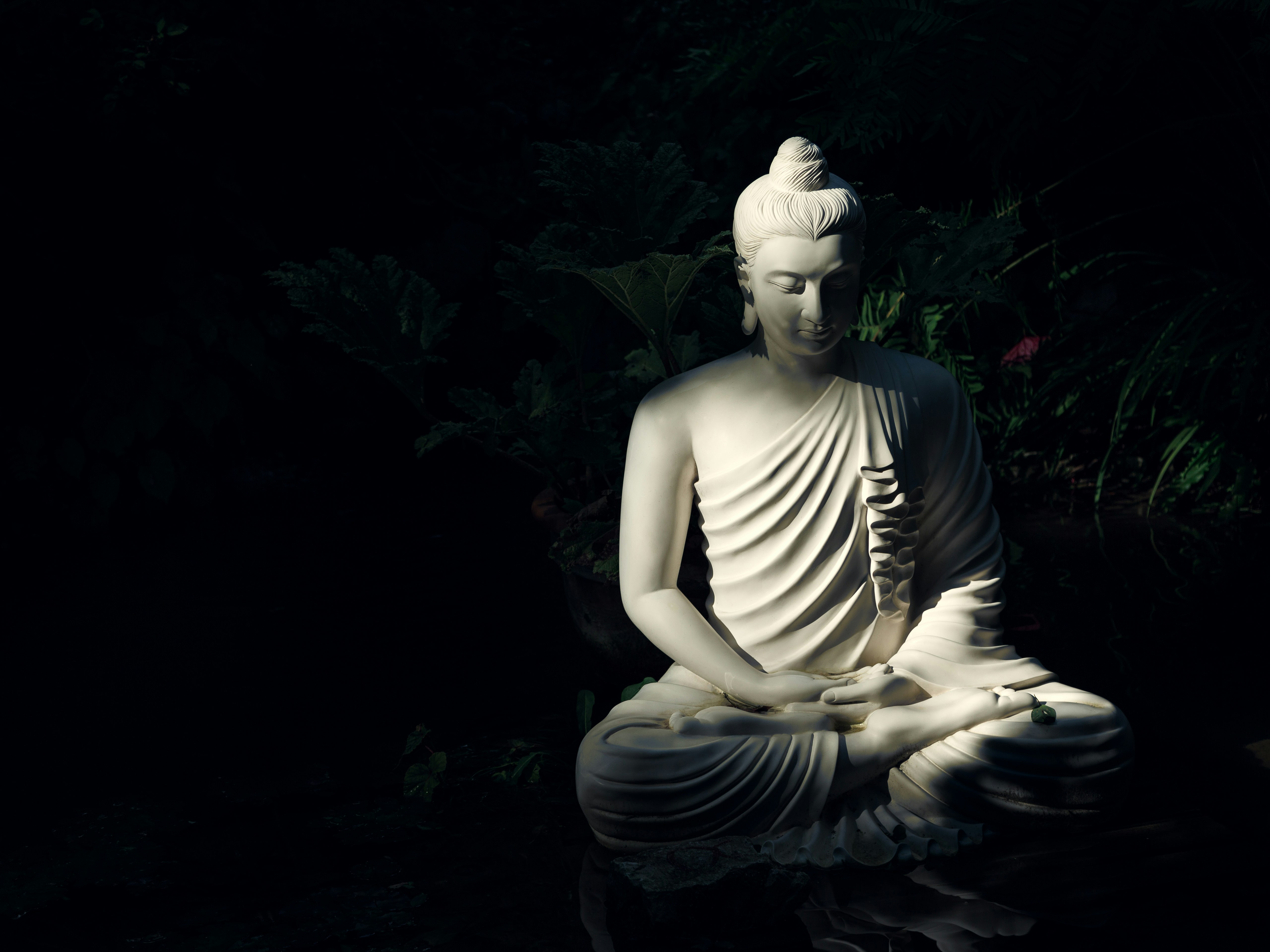
Letting go is not giving up
Here’s the part most people get wrong. Non-attachment isn’t checking out, giving up, or “lying flat.”
It’s easy to swing from one extreme to the other. Stop clinging to wealth and you start clinging to poverty. Stop clinging to pleasure and you start clinging to self-denial. Rejecting one thing often means grabbing its opposite, and forcing desire down is just another kind of grip.
Two Zen stories make this clear.
An old woman supported a hermit monk for twenty years. One day, to test him, she sent her beautiful young daughter to embrace him. The monk sat stiff and cold: “A withered tree on a cold rock. No warmth at all.” You’d think she’d be impressed. Instead she was furious, drove him out, and burned his hut. To her, he hadn’t freed his mind. He’d only frozen it. Feeling nothing in the face of beauty isn’t wisdom. It’s suppression.
In the second story, two monks, Tanzan and Ekido, came to a muddy crossing where a young woman couldn’t get across. Tanzan picked her up, carried her over, and set her down. Ekido stayed silent for hours, then finally burst out: “Monks shouldn’t go near women! Why did you do that?”
Tanzan said: “I put her down back there. Are you still carrying her?”
So the sutra isn’t telling you to suppress your desires or indulge them. It’s telling you to meet what comes and release what goes.
Look again at Huineng’s line: Let your mind arise without dwelling on anything. The key word is arise. That’s not a resigned word. It’s alive and full of energy.
Unless you become a monk, you’ll need money, a home, a job. Go after them wholeheartedly. Just don’t let the pursuit turn into a prison, and don’t mistake the means for the end. Some people make money and then need more, and spend their whole lives chasing what was only ever a tool. Others rush into marriage because “it’s time,” without ever asking what they actually want from it.
About the Creator
Lucy Guo
Born and raised in Shanghai, used to live in Helsinki, Syracuse, Chicago; now living in Fairfax, VA. Researcher at the intersection of artificial intelligence and education. Loves writing AI reflection stories and travel blogs.
Enjoyed the story? Support the Creator.
Subscribe for free to receive all their stories in your feed.
Comments
There are no comments for this story
Be the first to respond and start the conversation.