
The Machine That Answers Back
Science fiction became ordinary before we noticed

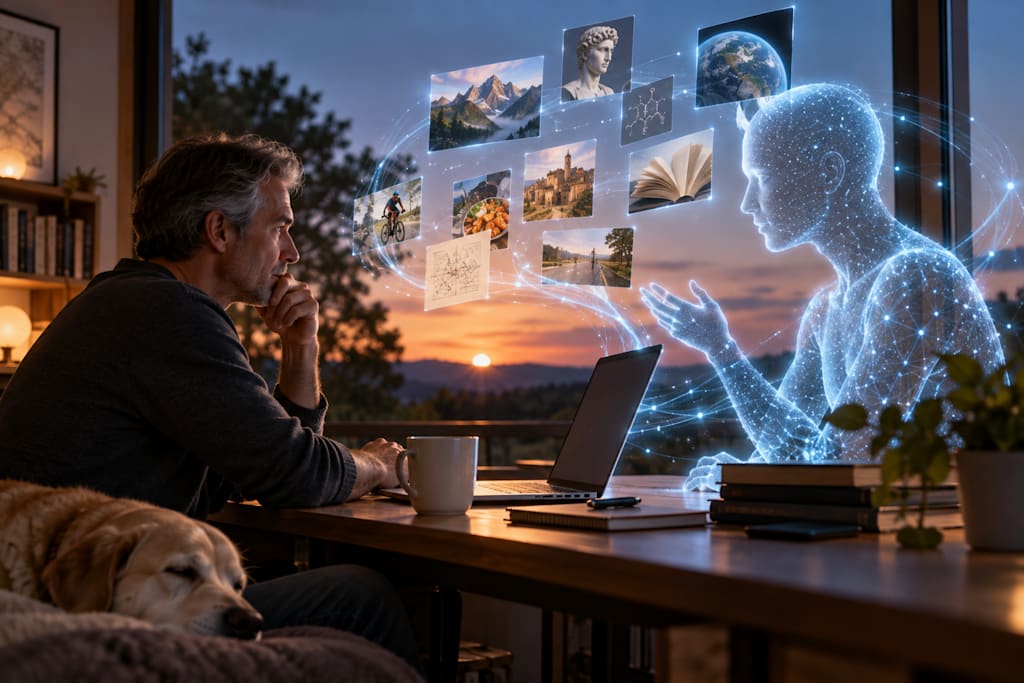
The most science-fictional object in my daily life is not a robot.
It does not walk through the house. It does not have a face. It does not prepare breakfast, drive a flying car, or announce that humanity has become obsolete.
It waits inside a screen.
I type a question.
Something answers.
That description sounds almost too ordinary now.
A few years ago, the idea of holding a sustained conversation with a machine capable of explaining a medical concept, rewriting a paragraph, comparing arguments, generating a poem, debugging code, planning a journey, or discussing why a sentence feels wrong would have belonged comfortably in speculative fiction.
Today, we complain when it takes five seconds.
That may be the strangest part of technological change: wonder has an extraordinarily short half-life.
The impossible becomes impressive.
The impressive becomes useful.
The useful becomes expected.
Then one morning, you are irritated because the machine that can discuss almost anything has misunderstood your request.
Science fiction has become customer service.
What interests me is not simply what artificial intelligence can do.
It is what using it quietly changes in us.
The obvious change is speed.
Questions that once required searching through websites, opening books, consulting several sources, or simply accepting uncertainty can now receive an immediate response.
The distance between curiosity and information has collapsed.
That sounds entirely positive.
Often it is.
But distance once had a function.
Searching forced us to wander.
We opened the wrong article and discovered something useful. We read around a subject. We encountered disagreement. We became bored enough to think.
Now the answer can arrive before curiosity has fully formed.
That changes the rhythm of thought.
I notice another change in writing.
For centuries, the blank page had a particular authority.
It waited.
Nothing happened until someone produced the first sentence.
That first sentence might be terrible, but it belonged to the writer. Then came the second. Revision followed invention.
Now the blank page can answer back.
Ask for ten openings and ten appear.
Ask for another tone.
Shorter.
Darker.
More humorous.
Less sentimental.
Try again.
In seconds, possibilities multiply.
This does not eliminate creativity.
It changes where creativity begins.
The writer can move from producing raw material to selecting, rejecting, redirecting, combining, and refining it.
That sounds like a small distinction.
It is not.
When machines become capable of producing plausible language instantly, scarcity moves elsewhere.
Words become abundant.
Judgment becomes valuable.
The difficult question is no longer always, "Can I make something?"
Increasingly, it is, "Which of these things deserves to exist?"
That may become one of the defining skills of the next decade.
Not generation.
Selection.
There is also something more intimate happening.
We are beginning to speak to machines in the language once reserved for people.
"Explain this."
"Help me understand."
"What do you think?"
"Make this better."
"Am I missing something?"
The machine does not need patience, yet we thank it.
It cannot become tired of our questions, so we ask the question again.
We can admit confusion without embarrassment.
We can test an idea before exposing it to another human being.
This creates an unusual kind of intellectual privacy: thought with a responsive surface.
The effect is subtle.
A person may become more willing to explore because exploration has become cheaper.
Or less willing to struggle because struggle has become optional.
Probably both.
That contradiction matters.
Every technology removes friction.
But some friction was inconvenience, and some friction was training.
Calculators spared us arithmetic.
GPS spared us navigation.
Search engines spared us memory.
Streaming spared us waiting.
Artificial intelligence may spare us parts of formulation itself.
The question is not whether this is good or bad.
Those categories are too simple.
The question is which capacities become stronger because of the tool, and which weaken because they are no longer required.
I think about navigation.
Before GPS, getting lost was an ordinary possibility. You watched road signs. You built a mental map. You remembered landmarks.
Now a calm voice tells you to turn left in two hundred meters.
You arrive more efficiently.
But sometimes you arrive without knowing where you are.
AI may create an intellectual version of the same phenomenon.
We may reach answers faster while understanding less of the territory between question and conclusion.
That does not mean we should throw away the map.
It means we should occasionally look out of the window.
The transformation is already visible in ordinary habits.
People ask machines to summarize messages they could read, compose replies they could write, choose meals, explain contracts, create schedules, generate images, translate conversations, analyze photographs, suggest gifts, plan workouts, and settle arguments.
None of these uses individually feels revolutionary.
Together, they represent something enormous.
We are gradually inserting an artificial layer between intention and action.
I want to say something.
Something helps me phrase it.
I want to know something.
Something organizes the answer.
I want to create something.
Something proposes a first version.
I want to decide.
Something offers possibilities.
For most of human history, tools extended the body.
The hammer strengthened the hand.
The wheel strengthened movement.
The telescope strengthened sight.
Computers extended calculation and storage.
These new systems are beginning to extend something harder to define: the intermediate space where we formulate thoughts.
That is why they feel different.
And perhaps why they make people uneasy.
We know what it means to outsource muscle.
We are still deciding what it means to outsource fragments of cognition.
There is an irony here.
For decades, science fiction imagined intelligent machines becoming visibly powerful.
They would seize control.
Issue commands.
Operate independently.
Perhaps destroy us.
Reality has been quieter.
The machine became useful.
That may be the more consequential path.
We rarely reorganize our lives around technologies we fear.
We reorganize them around technologies that save us ten minutes.
Convenience enters without ceremony.
Then habit locks the door behind it.
I do not think the interesting future question is whether artificial intelligence will "replace humans."
That phrase compresses too many different changes into one dramatic prediction.
A more useful question is simpler:
What will we stop doing because something else can do it for us?
And then:
Which of those things will we miss?
Perhaps very little.
Perhaps more than we expect.
There will also be new capacities we cannot yet see because every tool eventually produces behaviors its inventors did not anticipate.
Writing changed after the printing press.
Memory changed after photography.
Conversation changed after the telephone.
Identity changed after social media.
Thinking will change when responsive intelligence becomes permanently available.
It already is.
The strange thing is how ordinary it feels.
I sit at a desk.
There is no laboratory.
No android.
No glowing machine occupying half the room.
Only a keyboard and a screen.
I type a sentence.
The machine answers.
I disagree.
It answers again.
I revise the question.
The answer changes.
Somewhere inside that completely ordinary exchange, a boundary that seemed permanent for most of human history has already moved.
And tomorrow, we will probably notice something more mundane.
The response was too long.
The image wasn't quite right.
The machine misunderstood us.
We will sigh.
We will ask again.
That is how the future usually arrives.
Not with a trumpet.
With impatience.
About the Creator
Alain SUPPINI
I’m Alain — a French critical care anesthesiologist who writes to keep memory alive. Between past and present, medicine and words, I search for what endures.
Enjoyed the story? Support the Creator.
Subscribe for free to receive all their stories in your feed. You could also become a paid subscriber, letting them know you appreciate their work.
Comments
There are no comments for this story
Be the first to respond and start the conversation.