
The Long Search for a Car Powered by Water
Inventors have repeatedly promised that ordinary water could replace petrol, but the supposed breakthrough by Elon Musk, if confirmed, may finally be it!
Introduction
For more than a century, inventors have dreamed of producing a car that could be filled with water instead of petrol. The attraction is obvious because water is plentiful, relatively cheap and produces no smoke when it is formed from hydrogen and oxygen.
Numerous inventors have claimed that they found a way to make the idea work. Some produced experimental vehicles, while others demonstrated machines that appeared convincing. However, water is not an energy source in the same sense as petrol, diesel or a charged battery.
More recently, internet videos and articles have claimed that Elon Musk has finally developed a revolutionary water-powered Tesla. The story sounds believable because Musk is associated with electric cars, rockets and ambitious engineering projects. Unfortunately, there is no reliable evidence that this particular breakthrough exists.
The Scientific Problem with Water
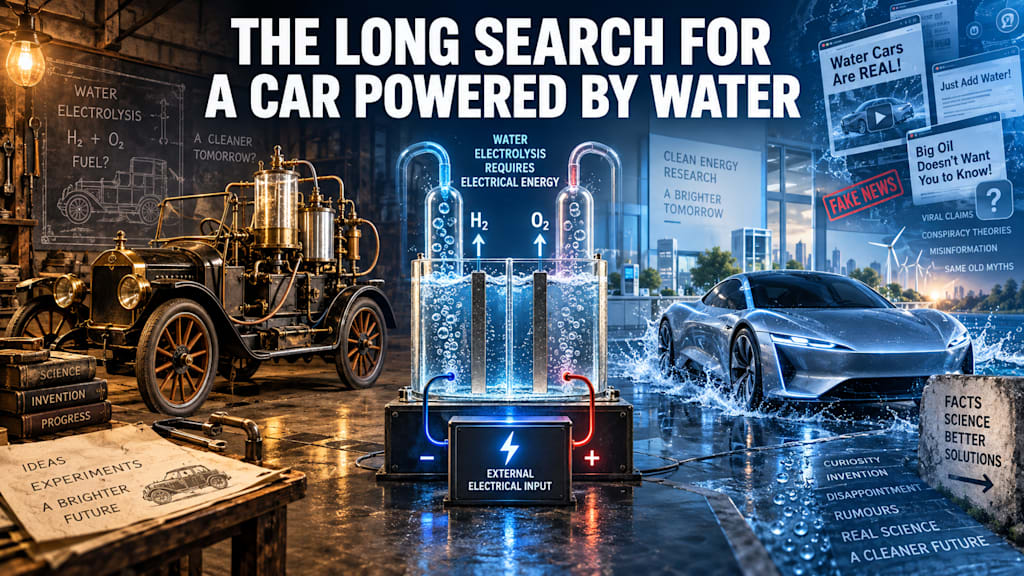
Water consists of hydrogen and oxygen, and hydrogen can certainly be used as a fuel. However, the hydrogen atoms in water are already chemically joined to oxygen atoms.
Energy must be supplied to separate them through a process called electrolysis. When the hydrogen is later burned or passed through a fuel cell, some of that energy can be recovered. The complete process cannot produce more energy than was originally supplied because energy is lost through heat, electrical resistance and mechanical inefficiency.
Therefore, a vehicle carrying water and separating it into hydrogen using only its own generated power would face an impossible energy deficit. It would be attempting to produce enough power to operate itself while also compensating for unavoidable energy losses.
Stories began circulating online during 2024 claiming that Elon Musk had announced a Tesla water-powered engine. Some versions described a new vehicle called the Tesla Model H, while others claimed that the engine could travel hundreds of miles on a small quantity of water.
This does not mean water has no place in transport technology. Hydrogen produced elsewhere by renewable electricity can power a vehicle, while water emerges from the exhaust. Such a vehicle is hydrogen-powered rather than water-powered.
The Earliest Hydrogen Experiments
The story began long before the modern motor car appeared. In 1800, William Nicholson and Anthony Carlisle demonstrated that electricity could separate water into hydrogen and oxygen. Their discovery established the principle of electrolysis.
In 1807, the Swiss inventor François Isaac de Rivaz constructed an early internal-combustion engine using hydrogen and oxygen. He later installed a larger version inside a primitive wheeled vehicle. The machine was far removed from a practical motor car, but it demonstrated that hydrogen could produce mechanical movement.
Welsh scientist William Robert Grove developed an early fuel cell during the 1830s. His device combined hydrogen and oxygen electrochemically to produce electricity and water. Modern hydrogen fuel cells still operate according to the same basic principle.
These experiments were scientifically valid, although none involved obtaining free energy from water. The hydrogen had to be manufactured before it could release useful energy.
Charles Garrett and His Water-Fuelled Car
One of the earliest widely reported water-powered car claims came from American inventor Charles H. Garrett. During the 1930s, Garrett patented an electrolytic carburettor that supposedly separated water into hydrogen and oxygen.
Newspaper reports claimed that Garrett demonstrated a car running briefly on gas produced from water. However, the electricity needed for electrolysis apparently came from the vehicle’s battery. Once the battery became discharged, another source of energy would have been required to recharge it.
Garrett’s apparatus may have produced enough hydrogen to run an engine under carefully controlled conditions. Nevertheless, this would not make water the true energy source because the battery supplied the energy that separated the water molecules.
Stanley Meyer and the Water Fuel Cell
The best-known water-powered car inventor was probably Stanley Meyer, an American who began promoting his system during the 1980s. Meyer converted a dune buggy and claimed that it could travel using water rather than petrol.
His device allegedly used electrical pulses to separate water into hydrogen and oxygen with much less energy than ordinary electrolysis required. The resulting gas was then fed into the engine and burned.
Meyer appeared on television and attracted considerable public attention. He claimed that his technology could end dependence upon oil, and he suggested that powerful interests might try to suppress it.
However, independent scientific validation never appeared. In 1996, an Ohio court found that Meyer had committed “gross and egregious fraud” in a dispute involving investors. Expert witnesses reportedly examined his equipment and concluded that it used conventional electrolysis rather than a revolutionary new process.
Meyer died suddenly in 1998 after dining at a restaurant. His death was officially attributed to a brain aneurysm, although conspiracy theories continue to claim that he was poisoned. No convincing evidence has emerged to support that allegation.
Other Inventors Enter the Story
Several later inventors made similar claims. In 2008, the Japanese company Genepax demonstrated a small vehicle that it said could operate using water and air. The company provided little technical information about the crucial energy-producing process.
Observers suggested that the system probably relied upon a material such as metal hydride reacting with water to release hydrogen. If this explanation was correct, the metal compound was being consumed and was therefore the real fuel.
In 2012, Pakistani engineer Agha Waqar Ahmad demonstrated another supposed water-powered vehicle. His system allegedly produced hydrogen through electrolysis and supplied it to an ordinary engine.
Pakistani scientists questioned where the necessary electrical energy originated. If the car’s alternator powered the electrolysis equipment, the engine would consume more energy driving the alternator than it could regain from burning the resulting hydrogen.
Similar devices are frequently marketed as HHO generators. Some sellers claim that adding hydrogen and oxygen to an engine improves fuel economy dramatically. Small efficiency changes might sometimes occur through altered combustion conditions, but such equipment cannot allow a vehicle to obtain unlimited energy from water.
Genuine Hydrogen-Powered Cars
Major manufacturers have developed vehicles that use hydrogen legitimately. The Toyota Mirai and Hyundai Nexo store compressed hydrogen inside reinforced tanks. A fuel cell combines that hydrogen with oxygen from the air and generates electricity for an electric motor.
Water vapour is the principal material leaving the vehicle during normal operation. This sometimes leads people to describe these vehicles as water-powered, although the description reverses the process. They consume hydrogen and produce water, rather than consuming water and producing energy.
Hydrogen also presents important difficulties. Producing it requires substantial energy, while compressing, transporting and storing it introduces further losses. Hydrogen filling stations are expensive, and the gas requires specialised tanks and safety equipment.
Why the Story Keeps Returning
The water-powered car survives because it combines several powerful ideas. It promises almost free transport, freedom from oil companies and a simple solution to pollution. It also fits comfortably into the belief that revolutionary inventions are routinely suppressed.
Modern artificial intelligence has made the problem worse. Convincing videos can now be created using artificial presenters, fabricated quotations and computer-generated vehicles. A professional voice and impressive diagrams can make an invented Tesla announcement appear authentic.
A genuine breakthrough would include detailed test results, independent verification and repeatable measurements. It would also explain exactly where the energy originates. Patents, dramatic demonstrations and internet videos cannot replace those requirements.
Conclusion
The history of the water-powered car contains genuine scientific experiments, misunderstood engineering and several highly questionable claims. Hydrogen can power a vehicle, but the energy needed to produce that hydrogen must come from somewhere.
Elon Musk has not personally announced a water-powered Tesla, and the supposed breakthrough may be an internet fabrication or a leaked invention of something real. The real progress is taking place in batteries, renewable electricity, hydrogen production and more efficient fuel cells.
Perhaps one day water will provide the hydrogen used throughout a cleaner transport system. Even then, the vehicle will ultimately be powered by the electricity that separated the water, rather than by the water itself.
About the Creator
Alan Spencer
Have been an author and writer for over 20 years. Have been a journalist, editor, proofreader, and a designer and presenter of training courses. Have written over 100 articles, two books, and around 20 training courses.
Enjoyed the story? Support the Creator.
Subscribe for free to receive all their stories in your feed. You could also become a paid subscriber, letting them know you appreciate their work.
Comments
There are no comments for this story
Be the first to respond and start the conversation.