
The Leasing Office Never Closes Now: What AI Really Does in Property Management
Most rental inquiries arrive after the office closes. Here’s how AI is filling that gap, where it still fails, and when a custom system makes sense.

It’s 9:47 on a Tuesday night. Someone is scrolling apartment listings on their couch, finds a two-bedroom they like, and sends a message: “Is this still available? Can I see it this weekend?”
The leasing office closed almost five hours ago.
A few years ago, that message would sit until the morning. By then, the renter may have moved on to another listing. That small gap between a question and an answer is where a lot of property management revenue has quietly disappeared.
It’s also where AI has started to make a real difference.
The problem is timing, not effort
Property management teams aren’t short on effort. They’re short on hours. According to data from Respage, a multifamily marketing platform, most rental inquiries come in after 5:00 PM, which is exactly when nobody is at the desk.
The same pattern shows up beyond leasing. Residents report a leaking pipe at midnight, ask about their balance on a Sunday, or want to renew their lease while they’re commuting. Humans can’t cover all of that. Software can.
Four jobs AI is already doing
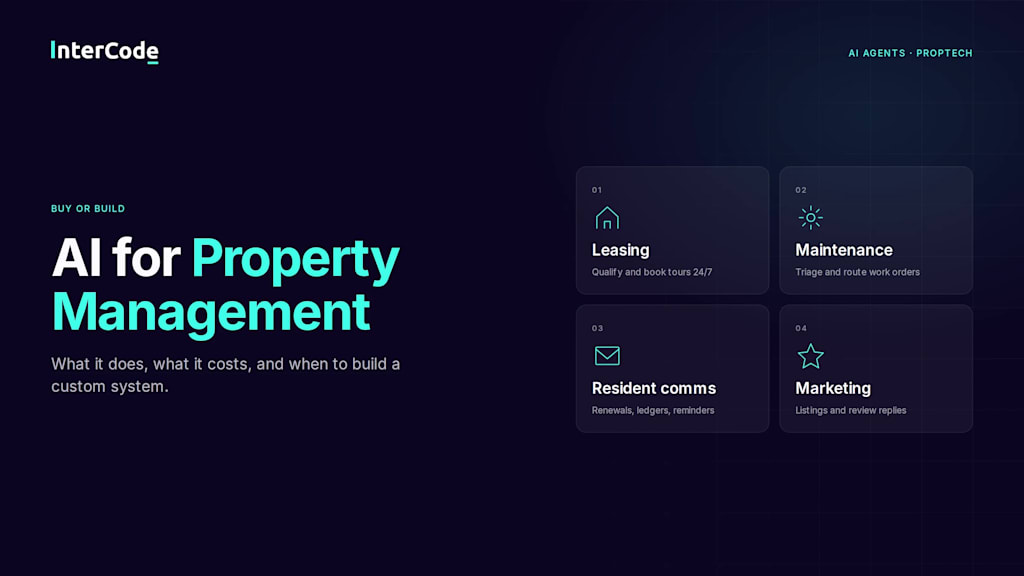
Strip away the buzzwords and AI in property management mostly comes down to four practical jobs.
1. Answering prospects. An AI leasing assistant replies to inquiries instantly, asks a few qualifying questions (move-in date, budget, pets), books the tour, and follows up if the prospect goes quiet. Respage reports that its AI leasing agent handles 62% of first-touch inquiries without a human. The other 38% are passed to staff.
2. Sorting maintenance requests. Instead of “something is broken” turning into a phone call, the AI asks diagnostic questions, helps the resident fix minor issues themselves, and routes real problems to the right vendor. Summit Property Management reported that 34% of emergency maintenance calls were de-escalated this way.
3. Handling routine resident questions. Rent reminders, ledger questions, and renewal nudges are repetitive, predictable, and perfect for automation. AppFolio reports an average message handling time of 26 seconds and about 10 hours of admin work saved per week.
4. Marketing and reviews. AI drafts listing descriptions, runs follow-up campaigns, and helps teams respond to reviews across dozens of locations without copy-pasting the same reply everywhere.
None of this replaces a property manager. It takes repetitive work off their plate so they can focus on the conversations that actually need a human.
Where it goes wrong
AI isn’t magic, and the failures tend to look the same:
No staff training. The tool goes live, but the leasing team doesn’t know when to step in or how to trust its handoffs. A maintenance supervisor uses AI very differently from someone in accounts payable, so training needs to fit each role.
Stale data. If the property management system says a unit is available when it isn’t, the AI will confidently book a tour for an apartment that’s already rented.
No guardrails after hours. A late-night “there’s water coming through the ceiling” needs a clear escalation path, not a friendly chatbot reply.
The teams that get results usually do one simple thing first: they write down their current numbers (response time, conversion, hours spent) before launch, then check again after the first month.
So should you buy a tool or build your own?
For most property operators, the answer is simple: buy. Mature products already cover the common jobs. EliseAI is a strong fit for multifamily leasing, AppFolio Realm-X and Yardi Agents work natively inside their own property management systems, and Showdigs suits scattered-site portfolios. Setup can take anywhere from a day for a basic chatbot to several weeks for deeper integrations.
Building a custom system only starts to make sense under specific conditions:
AI is part of what you sell. You’re a proptech platform, and the assistant is a feature your customers pay for.
You serve many clients from one platform. Each client needs its own data kept separate and its own rules.
Your volume is high enough that the engineering cost pays for itself.
If you’re managing a few hundred units and can’t name the one metric you want to move, skip the custom build. You’ll get more from a good off-the-shelf tool and a well-trained team.
But if you’re building the platform other property managers rely on, the calculation changes. Off-the-shelf tools give your clients the same features as everyone else’s. A custom AI layer is what can set your platform apart in the market, and that’s the kind of work behind proptech software development for real estate platforms.
The takeaway
That 9:47 PM message is going to keep coming. The only question is whether someone answers it in seconds or in hours.
For most operators, the fastest path is a proven tool, clean data, and a team that knows when to take over from the AI. For the platforms behind those operators, AI is quickly becoming part of the product itself, and that’s where building your own starts to make sense.
Either way, the leasing office never really closes anymore.
Disclosure: the author works at InterCode, the development team behind the Respage AI leasing agent mentioned above.
About the Creator
InterCode
InterCode is an AI-first B2B development boutique for SMBs, focused on agentic engineering, and a Claude Certified Services Partner. We build AI agents, AI integrations, cloud & DevOps, mostly for advertising and digital marketing firms.
Enjoyed the story? Support the Creator.
Subscribe for free to receive all their stories in your feed.
Comments
There are no comments for this story
Be the first to respond and start the conversation.