

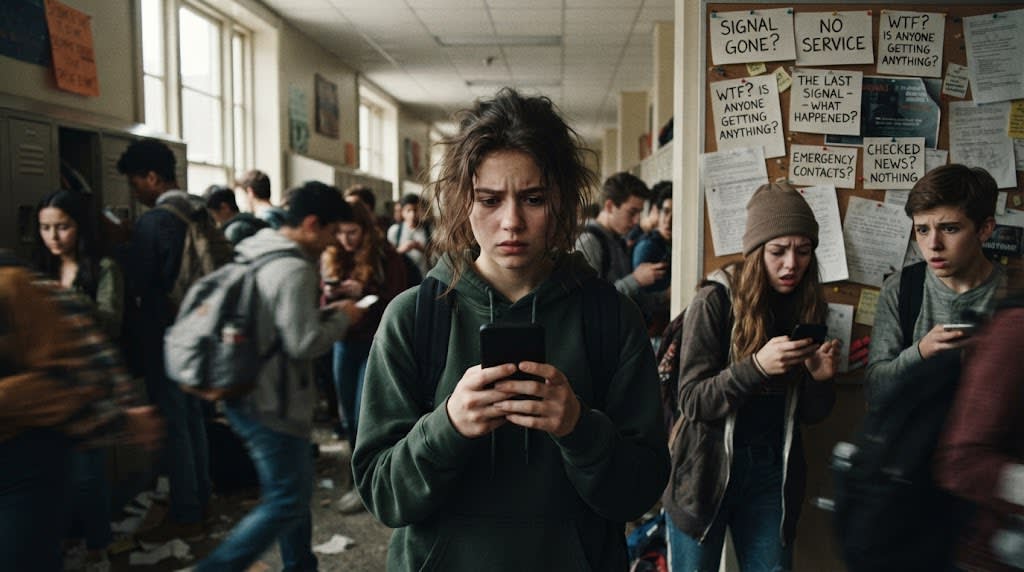
At 10:17 in English class, Kathy Torres felt her phone die against her leg. She pulled it from her pocket beneath the desk and stared at the black screen, pressing the side button twice before holding it down, then plugging in the charger she carried in her backpack every day because her mother had threatened to confiscate the phone after Kathy forgot to charge it three times in one week. The screen stayed dark, and when Caleb leaned across the aisle to see what had happened, his phone was dark too.
Kathy glanced around the classroom and saw the same thing happening everywhere. Students lifted their phones, tapped screens, switched chargers, and stared at one another with growing confusion, while Mr. Hanley stood beside his desk trying to keep his English lesson moving even though half the class had stopped listening. When he finally checked his own phone and got the same dead screen, he put it on the desk and said, “All right, everybody, keep your seats for a minute,” which sounded like something a teacher said when he had already realized something had gone badly wrong.
The hallway filled within seconds after the bell rang, with students crowding around one another and comparing dead screens as if somebody might discover the answer hiding inside another person's phone. Kathy tried her mother's number several times, then her grandmother's, then Caleb's number even though Caleb was standing three feet away, and each attempt ended the same way because the phone could not connect to anything. Caleb held his device beside hers and said, “This has to be the network,” while Kathy shook her head because a bad network still left a phone capable of doing plenty of things, and hers had become a black rectangle.
The intercom clicked on before anyone could settle down, and Principal Ruiz told every student to return to class while the staff gathered information. Her voice sounded controlled, although Kathy could hear the strain underneath it, and that made the students even more nervous because adults usually sounded certain when they knew what was happening. Mr. Hanley returned a few minutes later carrying an old telephone from the office, explaining that the school had discovered a problem with cellular service across the city and that technicians were trying to determine whether the failure had spread farther.
By lunchtime, the story had changed three times. First, the problem covered the city, then the entire state, and finally reports began coming through on radio broadcasts that people across the country and in other parts of the world had lost smartphone service at the same moment, leaving Kathy staring at the radio on the cafeteria counter as the announcer struggled to explain something that seemed impossible. Caleb sat across from her, pushing food around his tray, and said, “How does every phone on Earth break at once?” while Kathy kept thinking about her grandmother because Grandma kept her medical information and every important number inside her phone.
Parents began filling the school parking lot before the afternoon classes ended, with some driving in from work and others walking through the entrance carrying worried expressions and paper notes from relatives. Kathy's mother finally reached the school using an old landline at her office and came to get her, and the first thing she said when she saw Kathy was, “Your grandmother is fine,” because she had already spoken to a neighbor who lived nearby. Kathy felt the tension leave her shoulders, then realized she had spent several hours assuming that a person could disappear from her life simply because a small piece of technology had stopped working.
The drive home took nearly twice as long as usual because people had lost the directions and traffic information they depended on. Drivers stopped beside one another to figure out streets from memory, delivery workers carried paper addresses, and a man at an intersection stood beside his car holding a handwritten sign that pointed toward downtown. Kathy watched all of it from the passenger seat and kept thinking about how quickly everyone had forgotten things that had once lived inside their own heads.
At home, her mother found a stack of old address books in a drawer and placed them on the table. Grandma's number was written there in blue ink, along with the numbers of relatives Kathy had never called because her phone already knew how to reach them, and seeing those names made her feel embarrassed by how little she actually remembered. Her younger brother brought out a deck of cards, and after dinner the family sat together playing several rounds while the television carried news reports about the worldwide outage.
The next morning, the school had changed. The office printed lists of emergency numbers, teachers collected contact information from students, and a large bulletin board appeared beside the main entrance with sheets of paper where people could leave messages for friends and relatives. At first, the board held only a few notes, then students began filling it with messages such as “Meet me after class,” “Tell Mom I got home,” and “Caleb, call your grandmother from the office,” until the whole thing became crowded with handwriting.
Within a few days, students began treating the board like a new social network. They checked it between classes, laughed at messages meant for friends, copied down phone numbers, and left notes for people they had never spoken to before because those people needed information. Kathy started carrying a small notebook in her backpack, filling its pages with numbers, addresses, appointments, and reminders, and she discovered that writing something down made her remember it better than typing it into a device.
The adults struggled more than the teenagers expected. Businesses that depended on phone apps switched to paper receipts, printed schedules, cash payments, and landline calls, while restaurants posted menus outside and stores placed employees near entrances to explain changes. People learned to carry enough cash for emergencies, write down directions before leaving home, and tell family members where they planned to be because nobody could depend on a message sent from the road.
Three weeks into the outage, Kathy walked to Grandma's house after school with Caleb beside her. Grandma was sitting on her porch when they reached the house, and she laughed when Kathy explained that she had come to check on her even though they had already spoken several times that week. Grandma pointed toward the road and said, “You know, people used to visit each other because they wanted to see somebody,” and Caleb looked at Kathy with a grin that told her he knew exactly what Grandma was doing.
Months passed, and the world settled into a strange new routine. Scientists worked around the clock to understand what had happened, governments shared information through radio and television, and companies rebuilt systems that had depended heavily on smartphones, while schools taught students how to navigate places, memorize important numbers, and handle emergencies using tools that had once seemed outdated. Kathy became the person her friends called when they needed directions because she had learned the streets around town by walking them.
Then, one afternoon, the announcement came that technicians had discovered a way to restore smartphone service. The news spread through radio broadcasts, television reports, printed notices, and excited conversations, and by evening people were gathering around their devices waiting for the signal to return. Kathy kept hers on the table beside her, watching the blank screen as her mother counted down the minutes from the television.
When the phone finally came alive, the room erupted. Messages poured onto the screen from relatives, friends, classmates, stores, schools, and companies, with months of missed notifications appearing one after another until Kathy could barely read them. Caleb called her from across the street, and she laughed when his name appeared because for the first time in months the phone had become useful again.
She read through dozens of messages before reaching one from Grandma that had been sent before the outage. It said, “Come see me when you get this,” and Kathy smiled because Grandma lived close enough that the message had never been necessary.
She put the phone down, grabbed her jacket, and walked outside. Caleb was waiting near the sidewalk, already holding his own phone, and Kathy told him where she was going as they started toward Grandma's house together. They talked the whole way, passing the same streets they had learned during the outage, and Kathy realized that the world had regained its signal while she had gained something she had never expected to lose.
At school, the bulletin board remained beside the entrance even after the phones returned. Most of the paper had been cleared away, leaving only a few messages behind, including one Kathy had written during the first week, and she stopped to read it before leaving for home.
“Meet here when you need somebody.”
She smiled, took out her phone, and kept walking.
About the Creator
Nolan Reed
I write true stories, including unsolved mysteries and events that actually happened.
Enjoyed the story? Support the Creator.
Subscribe for free to receive all their stories in your feed.
Comments
There are no comments for this story
Be the first to respond and start the conversation.