
The Last Beacon of Zeta Prime
When the Stars Begin to Fade, Only One Light Remains

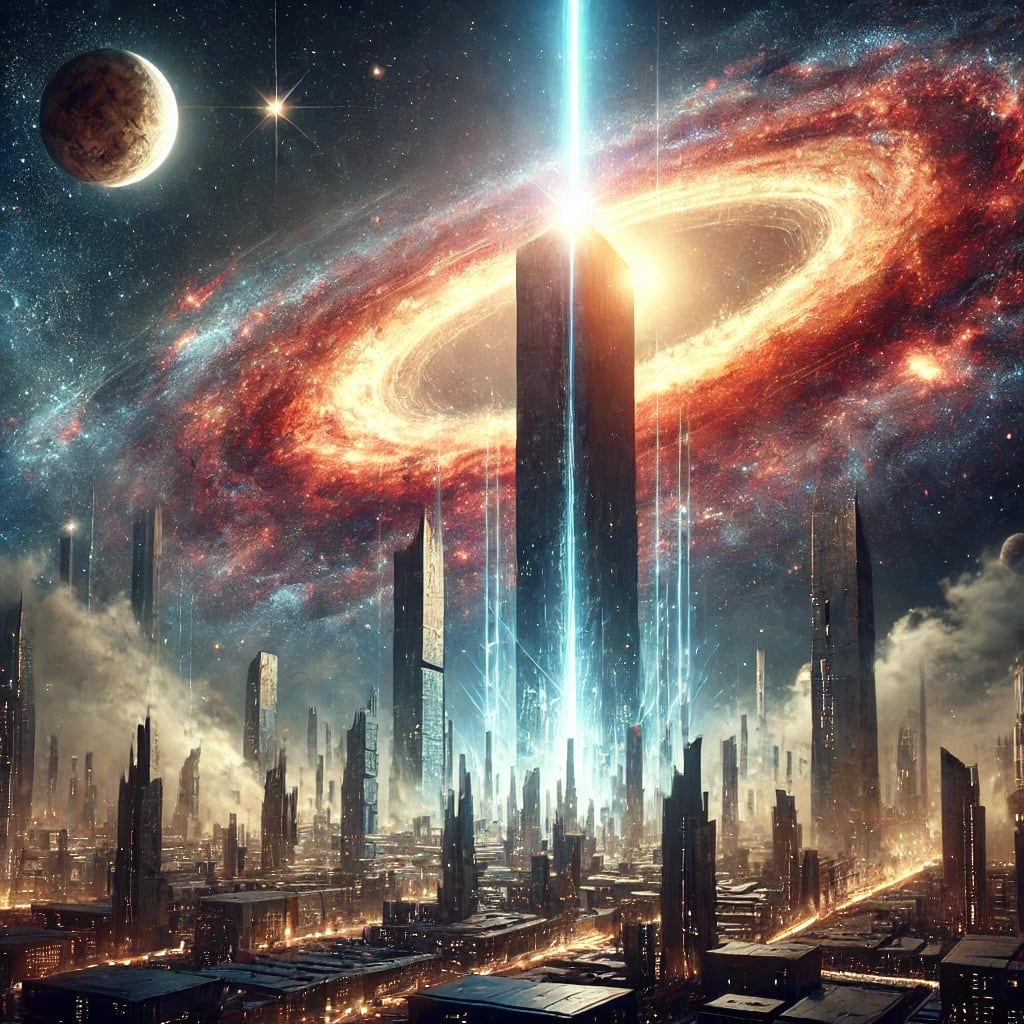
In the year 3145, humanity had become an interstellar species, spreading its influence across the galaxy. Planets once unreachable were now thriving colonies, with some systems rivaling Earth’s grandeur. Among these, Zeta Prime stood as a crown jewel—a lush, resource-rich planet orbiting a distant star at the edge of explored space. Its towering cities reached into the sky, powered by technology that blended human ingenuity with alien discoveries.
However, no one could foresee the catastrophe that would turn Zeta Prime from a thriving hub into the galaxy’s last hope.
It began with a simple observation from Dr. Miren Tavaris, an astronomer stationed at Zeta Prime’s orbital outpost. The stars beyond the system were dimming. Not just a few, but entire constellations were vanishing, swallowed by an encroaching darkness that had no discernible origin. At first, it seemed like a glitch in the telescope arrays, but soon, the phenomenon spread to all observational platforms across the system.
The scientific community was divided. Some believed it to be a temporary stellar event, while others whispered darker possibilities—cosmic anomalies, black hole clusters, or even the death of the universe itself. Dr. Tavaris was convinced it was something far more sinister.
As the weeks passed, the darkness closed in on Zeta Prime’s neighboring systems. Starships sent to investigate did not return. Communications with distant colonies became erratic, then fell silent. Whatever was consuming the stars was moving faster than anyone anticipated. Panic gripped the population as they watched the night sky fade into an all-consuming void.
Zeta Prime’s government declared a state of emergency. Massive starships were constructed to evacuate the planet, but the question remained: where could they go? Every corner of the galaxy seemed to be under threat, and time was running out.
Dr. Tavaris, consumed by the mystery, worked tirelessly with her team. In her desperation, she reexamined ancient alien artifacts discovered decades ago beneath Zeta Prime’s surface. These relics, from a long-dead civilization, had always fascinated researchers but had never revealed their true purpose. Now, in the face of the cosmic apocalypse, Tavaris believed the answer lay within their cryptic markings.
One relic, in particular, stood out—a massive obelisk etched with symbols no one had been able to decipher. With the help of an AI system, Tavaris uncovered a hidden message buried within the obelisk’s quantum structure. The symbols translated into a single phrase: The Last Beacon.
Realization hit Tavaris like a shockwave. The obelisk was not just a relic; it was a device. A beacon. But what did it signify, and how could it be used?
As the darkness crept closer, swallowing entire star systems in its wake, Tavaris and her team raced against time. The beacon was ancient, its technology barely understood, but it was the only hope left. Tavaris hypothesized that the beacon could create a pocket of space-time, a safe zone impervious to the cosmic anomaly devouring the stars. But the activation process required immense energy—more than the planet’s entire grid could produce.
The decision was made. Zeta Prime’s cities would be sacrificed. The planetary energy network was rerouted to the obelisk, causing blackouts across the surface. The towering structures that once defined the skyline of Zeta Prime went dark one by one, leaving the planet in eerie silence, save for the hum of the beacon powering up.
As the final moments approached, Dr. Tavaris stood with her team in the control center of the orbital outpost, watching the anomaly approach through the viewport. The blackness was unlike anything they had ever seen—a void not just of light but of existence itself. Stars, planets, even space itself was being consumed.
With a final surge of power, the obelisk activated. A pulse of light shot into the sky, spreading out across Zeta Prime and its surrounding space. For a moment, the darkness halted, as if confused by this sudden resistance. The beacon’s energy formed a shimmering dome around the planet, pushing back the encroaching void.
Hope surged through the people of Zeta Prime. The beacon was working—at least for now. But it wasn’t a permanent solution. The anomaly continued to press against the shield, and the power reserves were dwindling.
Tavaris knew what had to be done. The beacon needed more energy, far more than any planetary grid could provide. It required the energy of a star. Zeta Prime’s sun.
In a bold and dangerous maneuver, Tavaris ordered the construction of a stellar siphon—a device designed to channel the energy of Zeta Prime’s sun directly into the beacon. The risk was immense. If the siphon failed, the planet would be plunged into eternal darkness. If it worked, Zeta Prime could survive long enough to understand what the anomaly was and perhaps, one day, find a way to stop it.
The siphon was activated just as the anomaly pressed harder against the shield. A blinding beam of energy shot from the sun into the beacon, causing it to pulse with renewed strength. The shield expanded, pushing the void further back, holding the line between existence and annihilation.
Zeta Prime stood as the galaxy’s last beacon, a solitary light in an ocean of darkness. But the question remained: how long could it last, and what lay beyond the veil of the void?
About the Creator
Enjoyed the story? Support the Creator.
Subscribe for free to receive all their stories in your feed.
Comments
There are no comments for this story
Be the first to respond and start the conversation.