
The Invisible Power Behind the Digital Age: How Advanced Power Electronics Is Quietly Transforming the World
From EVs to AI Data Centers: The Billion-Dollar Rise of Advanced Power Electronics

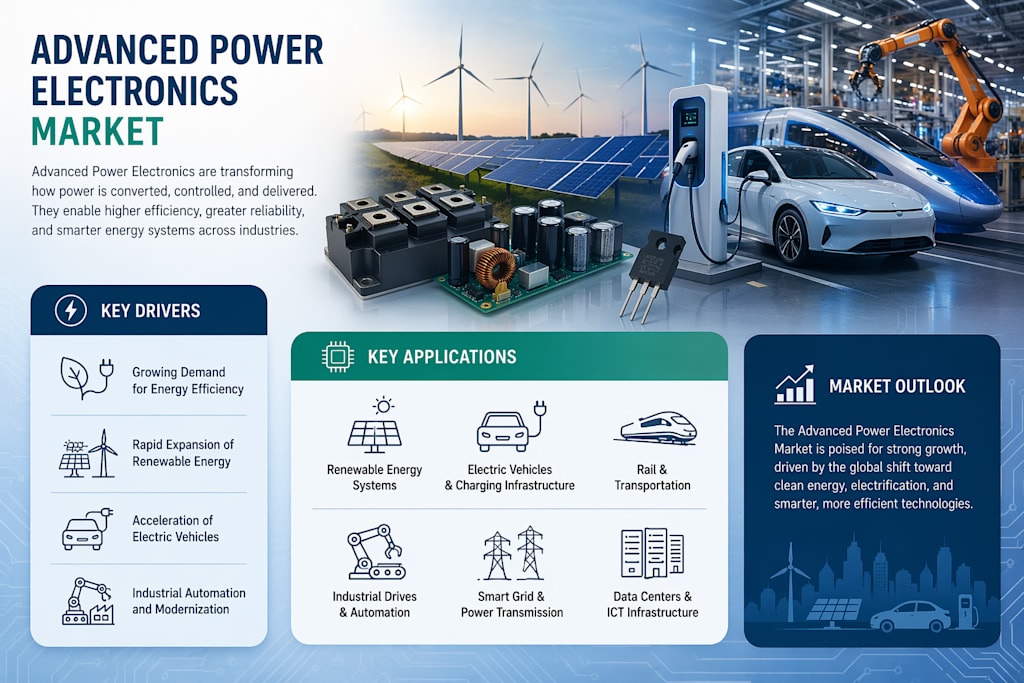
The Invisible Engine of the Modern World: Inside the Rise of Advanced Power Electronics
Every time a phone lights up, an electric car moves silently down a street, or a data center processes an AI request in milliseconds, something invisible is working behind the scenes.
It is not software. It is not the device itself.
It is advanced power electronics—the hidden system that controls how electricity is converted, managed, and delivered across modern infrastructure.
And over the next decade, this quiet industry is expected to reshape the global energy and technology landscape in ways most people will never directly see, but will absolutely depend on.
A Market Quietly Growing Into a Powerhouse
The global advanced power electronics market is valued at USD 53.7 billion in 2025. By 2035, it is projected to reach USD 130.67 billion, growing at a steady 9.3% CAGR between 2026 and 2035.
This growth is not driven by a single trend—it is the result of multiple global shifts happening at once.
Electric vehicles are scaling rapidly. AI data centers are expanding at record levels. Renewable energy systems are being deployed across continents. And all of them rely on one shared requirement: efficient power conversion.
But behind this growth lies a deeper shift that is changing the entire industry.
Companies are moving away from traditional silicon-based systems and toward advanced materials like Silicon Carbide (SiC) and Gallium Nitride (GaN)—technologies that can handle higher voltage, higher heat, and faster switching speeds.
Market Highlights
- The Global Advanced Power Electronics Market valued at USD 53.7 Billion in 2025, reaching USD 130.67 Billion by 2035 at a CAGR of 9.3%.
- Asia Pacific leads with 43.7% market share, valued at USD 23.5 Billion.
- Power Discrete dominates the By Device Type segment with 61.2% share.
- Silicon Carbide leads the By Material segment with 54.7% share.
- Power Management leads the By Application segment with 47.3% share.
- Telecommunication leads the By End Use segment with 39.4% share.
Why Silicon Is Losing Its Grip
For decades, silicon was the backbone of electronics. But modern energy demands are pushing it beyond its limits.
Electric vehicles, for example, require extreme efficiency in limited space. AI data centers require dense power delivery without overheating. Renewable grids require stable conversion across fluctuating loads.
Silicon struggles in all of these environments.
That is why SiC now holds 54.7% of the material market, becoming the dominant choice for EV traction systems and grid infrastructure. It performs better under heat and voltage stress, making it ideal for next-generation transportation and energy systems.
Meanwhile, GaN is rising quickly in high-frequency applications, especially in AI data centers where space and thermal efficiency are critical. It enables smaller, faster, and more efficient power systems, and is rapidly moving from niche use to mainstream adoption.
Together, these materials are redefining what power systems can achieve.
The Silent Rise of AI and Data Centers
One of the biggest drivers of this market is the explosion of artificial intelligence infrastructure.
Global data center investment reached nearly $500 billion in 2024, and electricity consumption from these facilities hit 415 TWh, or about 1.5% of global demand.
But what matters more than the numbers is what they represent.
Every AI model, every cloud application, every digital interaction passes through layers of power conversion systems. Electricity is not used directly—it is constantly transformed, regulated, and optimized.
Even a small improvement in efficiency can save millions of dollars at scale.
This is why power electronics are no longer seen as background components. They are now strategic infrastructure.
Electric Vehicles: Locking in Long-Term Demand
The shift to electric vehicles is another structural force reshaping the market.
Modern EVs are moving from 400V systems to 800V architectures, a change that permanently increases demand for SiC-based components. Once a platform is designed around SiC, it cannot easily revert without a full redesign.
This creates long-term, locked-in demand for manufacturers.
Automakers like Toyota have already integrated SiC into onboard chargers and DC/DC converters, signaling that wide bandgap materials are becoming standard rather than experimental.
Unlike consumer electronics, EV platforms last for years and scale across hundreds of thousands of units. This gives power electronics suppliers unusually stable visibility into future demand.
Where the Market Is Concentrated
Geographically, the market is uneven but highly structured.
Asia Pacific dominates with 43.7% market share, led by China’s massive production of EVs, solar panels, and electronics. The region is the center of both manufacturing and demand.
North America follows, driven by data center expansion and semiconductor reshoring policies. Europe is accelerating adoption due to strict emissions regulations and renewable energy mandates.
Emerging regions like Latin America and the Middle East are still in early stages but are investing heavily in renewable energy infrastructure, which will require large-scale deployment of power electronics in the coming years.
Applications Everywhere, Demand Everywhere
What makes this industry unique is its universality.
- Power electronics are not limited to one sector—they exist across nearly all modern systems.
- Power Management leads with 47.3% share, because every electronic device needs voltage regulation.
- Telecommunication holds 39.4% in end-use demand, driven by 5G infrastructure and global connectivity expansion.
- Renewable energy systems depend on inverters and converters for solar and wind power.
- Automotive systems are rapidly becoming one of the fastest-growing consumers of advanced components.
Each sector feeds the same underlying need: efficient control of electricity.
The Hidden Challenge: Supply Constraints
Despite strong demand, the industry faces a major bottleneck.
Wide bandgap materials are difficult to produce at scale. SiC substrates are limited. GaN manufacturing is still scaling. And production yields remain lower than traditional silicon.
This creates a gap between demand and supply that is expected to persist through the mid-2020s.
As a result, companies are securing long-term supply agreements and investing in vertical integration to control access to materials. In this industry, ownership of the supply chain is becoming as important as innovation itself.
A Market Built on Infrastructure, Not Hype
What makes advanced power electronics different from many fast-growing technology markets is its foundation.
This is not a speculative trend.
It is infrastructure.
Every EV, every data center, every renewable energy system depends on it working correctly—silently and continuously.
And as global electrification and AI adoption accelerate, the demand for efficient power conversion will only increase.
Conclusion: The Future Runs on Controlled Electricity
Advanced power electronics rarely appear in headlines. They do not have consumer branding. Most people will never know they exist. But they are becoming one of the most critical technologies of the modern era. Because the future is not just about generating more electricity. It is about controlling it with precision, efficiency, and intelligence.
About the Creator
Yash Mule
SEO Specialist with 10+ years of experience at Evolvance Market Research. Expert in technical SEO, content strategy, and data-driven optimization, with a proven track record of significantly increasing organic traffic and search rankings.
Enjoyed the story? Support the Creator.
Subscribe for free to receive all their stories in your feed.
Comments
There are no comments for this story
Be the first to respond and start the conversation.