
The Invisible Paperwork Crisis in Healthcare That AI Is Quietly Fixing
The reason your doctor stares at a screen instead of you has nothing to do with bad manners

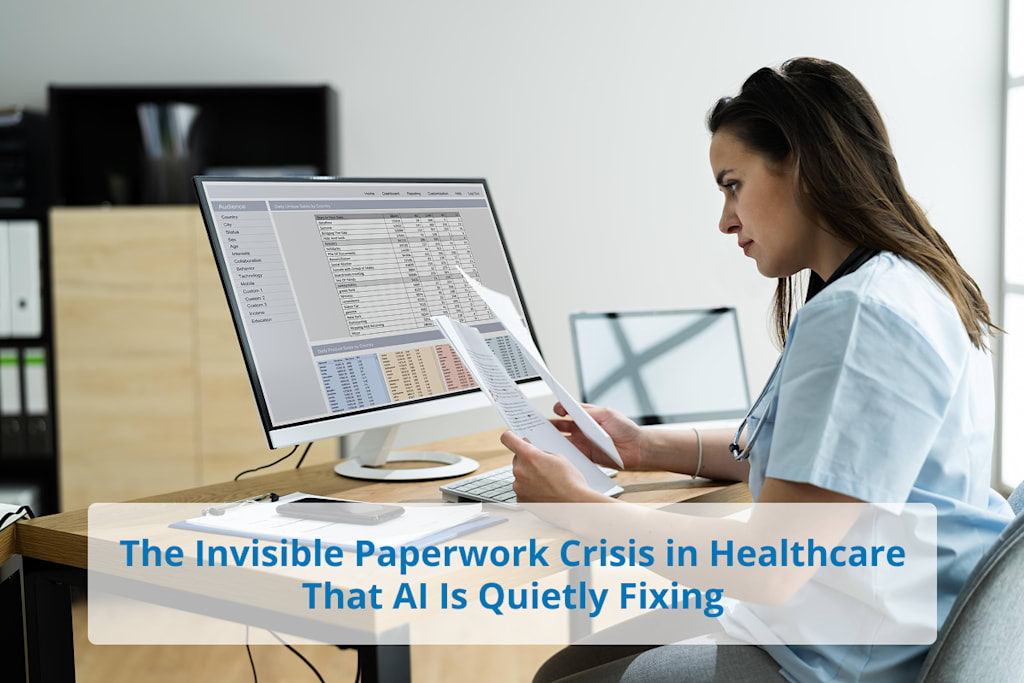
A few months ago, I sat in an exam room and watched my doctor apologize to her keyboard.
She would ask me a question, then swivel away to type the answer. Another question, more typing. By the time I left, I had spent fifteen minutes mostly studying the back of her head.
My first reaction was to feel slighted. I assumed she just wasn't much of a people person.
I was wrong. She wasn't being cold. She was being buried.
Because what I saw that day wasn't bad bedside manner. It was the visible tip of a crisis almost no patient ever notices: the heaps of paperwork that has quietly swallowed modern medicine.
The numbers are genuinely hard to believe.
Clinicians now spend roughly 28 hours a week on administrative work, which is nearly a second full-time job stacked on top of actually treating people.
And it doesn't stop when the clinic closes.
Doctors average close to 1.77 hours every night on documentation after hours, a ritual the profession grimly calls "pajama time."
It gets more absurd from there.
One recent analysis concluded that a primary care physician would need about 27 hours in a single day to deliver all recommended care plus the required paperwork, with three of those hours going to documentation alone.
That isn't a time-management problem. That's a mathematical impossibility.
So I'm not surprised that 62% of physicians blame bureaucratic busywork for their burnout, or that nearly one in four now say they're thinking about leaving medicine entirely.
And here's the part that should make the rest of us angry… we pay for this twice.
Administrative overhead eats up to a quarter of every dollar spent on American healthcare, money that buys no treatment and cures nothing.
This, I'd argue, is the most fixable disaster in medicine, and we've ignored it for years simply because paperwork is boring.
Cancer is dramatic. Prior-authorization forms are not. Yet those forms are quietly burning out the very people we're counting on to fight the cancer.
I keep coming back to the real cost of it all. Every hour a doctor spends wrestling a form is an hour not spent with someone who is scared and sick. That's the bill that never shows up on any invoice.
The smallest practices feel it worst. A solo doctor or a two-person clinic has no billing department to absorb the damage, so every denied claim and every unbilled hour lands straight on the people trying to see patients.
But something is finally shifting, and it's happening in the least glamorous corner of the whole system.
While the headlines obsess over AI that spots tumors, the quieter transformation is unfolding at the front desk, doctor’s room, and in the billing office.
Take clinical notes. Ambient AI "scribes" now listen to a visit and draft the note on their own, which means the doctor can look at you instead of the screen. At one large health system, those tools handed physicians back around 15,700 hours in a single year.
Then there's the billing swamp. In 2025, providers lost more than $48 billion to denied claims and bills they never collected, much of it from preventable clerical mistakes made at check-in.
This is exactly where the new wave of AI tools built to run the back office of a medical practice is making the biggest difference for everyday clinics.
These systems check insurance eligibility in real time, flag a claim that's likely to bounce before it's ever submitted, and quietly handle the repetitive tasks that used to eat a receptionist's entire afternoon.
The payoff is that practices leaning on AI in their billing report 30% to 40% lower administrative labor costs and denial rates cut by as much as 42%.
No wonder roughly 63% of healthcare organizations already use AI somewhere in their revenue cycle.
Still, I want to be honest about what this is. Nobody serious is talking about replacing doctors with robots.
What's actually being deleted is the clerical sludge that was never supposed to be a clinician's job in the first place.
And the smartest setups keep a human firmly in the driver's seat.
The AI drafts, people decide.
I still think about that exam room, sometimes.
I don't need my doctor to be faster. I need her to be there.
And for once, the technology and I want the exact same thing .
About the Creator
Alex Mitch
A tech optimist and futurism buff, fascinated by AI's expanding presence in art, work, and beyond.
Enjoyed the story? Support the Creator.
Subscribe for free to receive all their stories in your feed.
Comments
There are no comments for this story
Be the first to respond and start the conversation.