
The Illusion of Control
You think you’re in control. But control doesn’t always look like a cage.

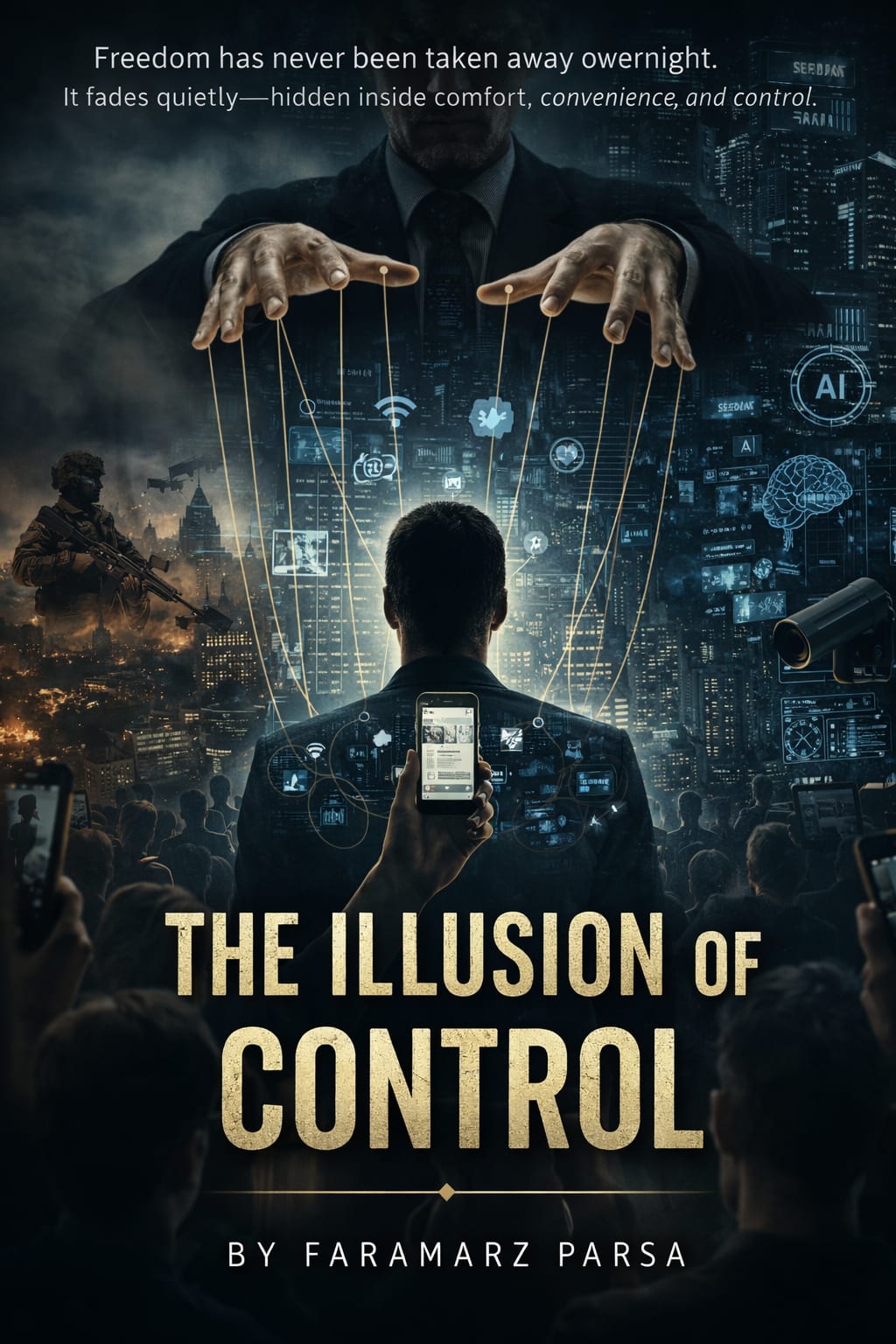
Maybe control was never about taking freedom away—
maybe it was about redefining it so quietly
that no one would notice.
The Illusion of Control
By Faramarz Parsa
No one wakes up one day and suddenly feels they are no longer free.
It never begins that way.
Everything starts quietly.
Not with force,
not with pressure,
but with choices that seem simple.
People choose, on their own, to see more,
to know more,
to stay connected.
But what they don’t realize
is that every connection
is an invisible thread—
slowly tying them to something they cannot see.
At first, the world feels beautiful.
Everything is accessible.
Everything is fast.
Everything is easy.
But no one stops to ask:
what is the cost of this “ease”?
Comfort, over time, becomes a habit.
And habits, when repeated long enough,
begin to feel like truth.
In rooms no one ever sees,
decisions are made—
decisions that shape the lives of millions.
Not with shouting,
not with war,
but with numbers,
with data,
and with algorithms that understand people
better than they understand themselves.
There is no longer a need to force anyone.
It is enough to know
what makes them happy,
what scares them,
and what keeps them engaged.
Patterns are studied.
Reactions are measured.
Attention is tracked and refined.
Control is no longer about restriction—
it is about direction,
without anyone noticing.
People still believe they are choosing.
What to watch,
what to read,
what to believe.
But are these choices truly theirs?
Or are they following paths
designed long before they arrived?
When everything you see
is shaped by what you have already seen,
your world becomes smaller—
even if it feels infinite.
You are not exploring new realities.
You are being gently guided
through familiar ones.
In this system,
power no longer has a face.
Not a king,
not a single government,
but a network of interests
connected in the shadows.
Invisible, yet effective.
Distant, yet deeply present.
And within this network,
everyone plays a role—
even those who believe they are only observers.
Every click,
every pause,
every moment of attention
feeds the system that shapes them.
But the most dangerous part is not this.
The most dangerous part
is how easily people begin to accept it.
To being watched.
To being guided.
To living within paths
they never truly chose.
And once acceptance settles in,
chains are no longer necessary.
Because the system no longer needs to control behavior—
it begins to shape desire.
Still, there is always a moment.
A small moment—
when someone pauses.
They look at the screen,
not as a user,
but as a question.
And for the first time,
they ask themselves:
“If everything is not exactly as it is shown to me…
then where is the truth?”
And more importantly:
“Who decides what I see?”
Perhaps everything begins with that question.
Not a revolution,
not a loud uprising,
but a quiet doubt.
The illusion of control
begins to break
the moment a person chooses
not just to look—
but to truly see.
To step outside the flow,
even for a second.
To question what feels obvious.
To resist what feels effortless.
And perhaps,
in that brief moment,
everything changes.
Because awareness—no matter how small—
is the one thing
no system can fully contain.
———————
2026/4/19
About the Creator
Ebrahim Parsa
⸻
Faramarz (Ebrahim) Parsa writes stories for children and adults — tales born from silence, memory, and the light of imagination inspired by Persian roots.
Enjoyed the story? Support the Creator.
Subscribe for free to receive all their stories in your feed.
Comments
There are no comments for this story
Be the first to respond and start the conversation.