
The Hidden Trade of Power in the Age of Technology
How technology, wealth, and power are quietly reshaping the fate of nations

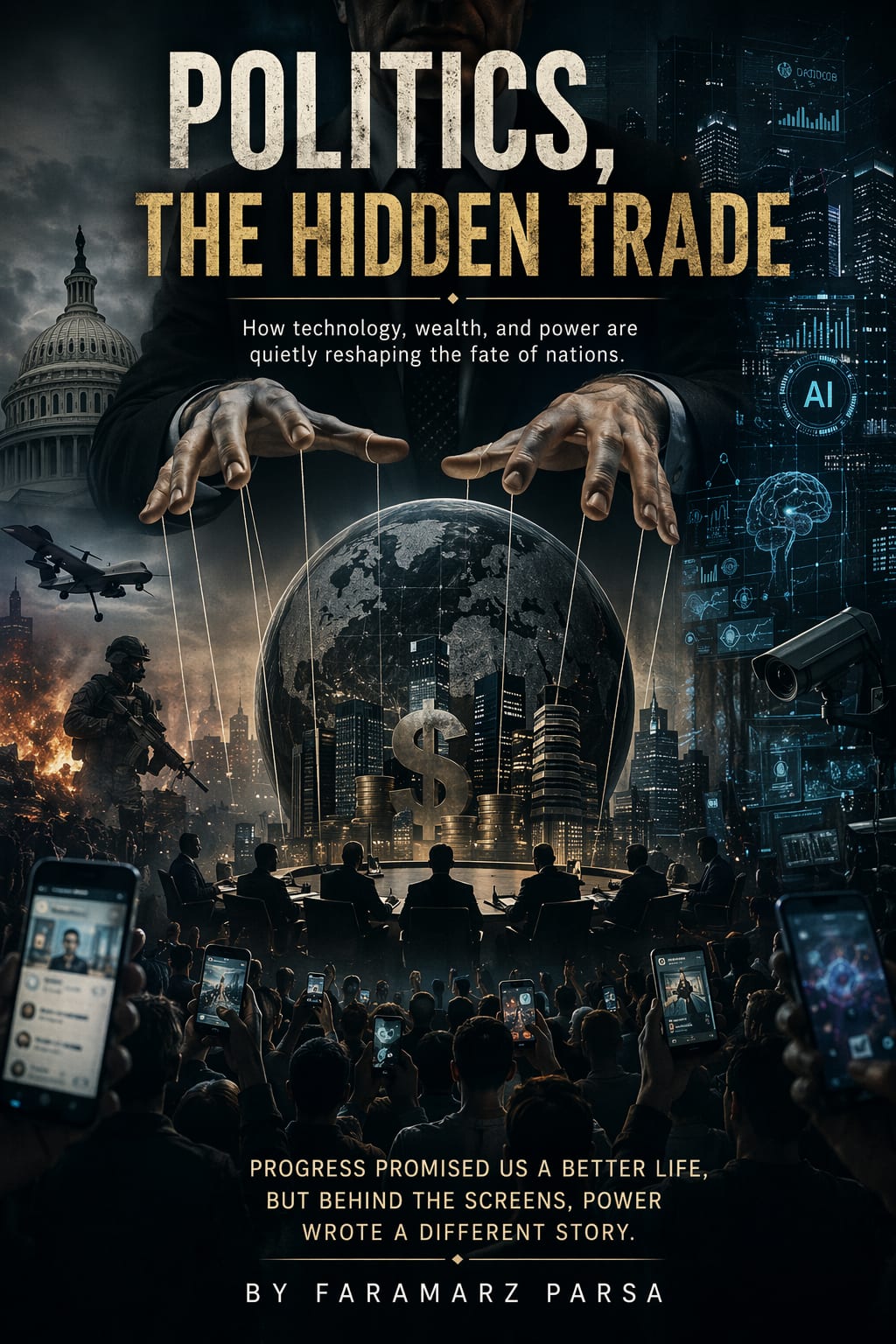
In a world shaped by rapid technological advancement, power is no longer defined by borders alone. This article explores the hidden relationship between politics, wealth, and science—and questions whether humanity is still in control of its own future.
The Hidden Trade of Power in the Age of Technology
By Faramarz Parsa
The world did not change with the sound of explosions,
but in the quiet rhythm of progress.
Technology arrived under the promise of improving human life,
yet behind the scenes, it began rewriting the rules of power.
Politicians were no longer the only players on the stage.
Wealth took the leading role,
and politics slowly became a tool to protect and expand it.
In the past, domination over nations was defined by war and occupation.
Today, that domination has taken on a far more complex form.
Powerful countries, equipped with advanced technologies,
are no longer limited to what is visible on the surface.
They reach deep beneath the earth,
identifying and extracting hidden resources with unprecedented precision.
Control is no longer just about land—
it is about data, energy, and the future itself.
At the center of this transformation stand scientists.
Not necessarily driven by greed,
but by an endless desire to discover and understand.
Yet knowledge does not advance without funding,
and this is where a dangerous bond begins to form:
capital starts to shape the direction of science.
Medicine advances,
space is explored,
artificial intelligence becomes more powerful each day,
and weapons grow more destructive than ever before.
But in the middle of this relentless race,
one question remains:
Where does the human being stand?
Screens have become one of the greatest inventions of our time—
not only as tools of connection,
but as instruments of constant engagement.
People are immersed in an endless stream of images and information,
rarely finding the time to reflect on what is happening around them.
Not because they are incapable,
but because they are overwhelmed.
Meanwhile, life for a small group—
politicians, wealthy elites, and parts of the intellectual class—
has reached levels of comfort and control once unimaginable.
At the same time,
poverty, unemployment, and inequality
continue to expand across societies.
Discontent begins to grow.
Sometimes silent,
sometimes erupting into the streets.
And governments that were meant to protect their people
in some parts of the world
turn against them—
quietly or in full view.
Politics is no longer solely about governing nations.
In many cases,
it has transformed into a layered and complex form of trade—
a trade where the benefits belong to a few,
and the cost is carried by many.
Yet even within this darkness,
a question remains:
Can societies break free from this cycle?
Is awakening possible in a world
where attention itself has become a battlefield?
The answer may not be simple.
But history has shown
that no system, no matter how powerful,
remains unchallenged forever.
If awakening is to happen,
it will not come as a sudden moment.
It will begin with small, continuous acts of awareness—
with questioning,
with doubt,
and with the refusal to accept everything as it is presented.
Perhaps it is not too late.
Perhaps the future does not belong solely
to politicians or the wealthy,
but to those who choose to be aware—
to those who decide
not to remain mere spectators.
—————-
2026/4/18
About the Creator
Ebrahim Parsa
⸻
Faramarz (Ebrahim) Parsa writes stories for children and adults — tales born from silence, memory, and the light of imagination inspired by Persian roots.
Enjoyed the story? Support the Creator.
Subscribe for free to receive all their stories in your feed.
Comments
There are no comments for this story
Be the first to respond and start the conversation.