
The Hidden Market Measuring Everything That Leaks: Permeation Analyzers in Focus
From pharma blister packs to hydrogen fuel cells, permeation testing is becoming infrastructure.
The Quiet Instruments Keeping Your Packaging, Drugs, and Fuel Cells Honest
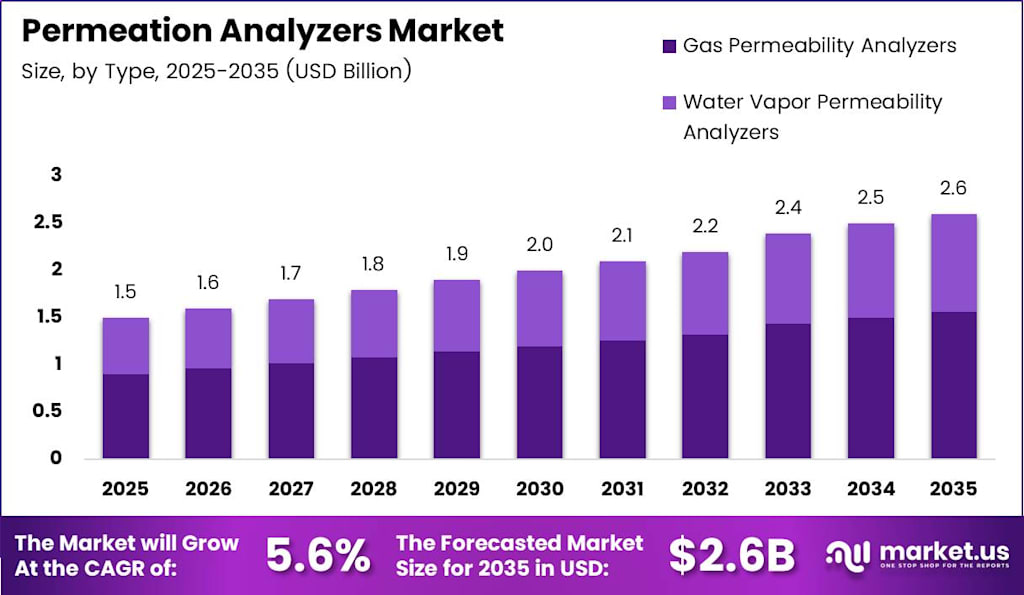
There is a good chance you have never heard of a permeation analyzer. There is an equally good chance that something you used today — a blister pack of aspirin, a pouch of vacuum-sealed coffee, a lithium-ion battery casing — was tested by one before it reached you. These instruments measure how gases and vapors move through solid materials: plastic films, rubber seals, polymer membranes, pharmaceutical coatings. The science is unglamorous. The market is not. The global permeation analyzers market size currently sits at approximately USD 1.5 billion and is projected to reach USD 2.6 billion by 2035 — a compound annual growth rate of 5.6% — according to a permeation analyzers industry overview published by Market.us.
That number surprises people when they first encounter it. An instrument that measures gas transfer through a membrane does not sound like a billion-dollar story. But pull on the thread and the logic becomes obvious fast.
Why Packaging Engineers Are Driving the Biggest Slice of Demand
Flexible packaging is everywhere, and its failure modes are invisible until they are not. Oxygen transmission through a poorly sealed film can spoil a pharmaceutical product with no outward sign until a patient opens the blister pack. Moisture vapor moving through a food pouch accelerates spoilage in ways that are chemically predictable but commercially catastrophic. Companies like Amcor and Berry Global, two of the largest flexible packaging manufacturers in the world, spend significant resources qualifying barrier materials before anything goes to a production line — and that qualification process requires permeation testing.
Regulatory pressure amplifies this. The U.S. Food and Drug Administration's guidance on packaging for drug products specifies that manufacturers must characterize moisture and oxygen transmission rates for primary packaging materials. The European Medicines Agency holds similar requirements. That is not a suggestion; it is a compliance condition. When regulations mandate measurement, instruments get purchased.
The Fuel Cell Connection Most Analysts Underplay
Here is where the story gets more interesting than the packaging angle alone. Hydrogen fuel cells depend on proton exchange membranes — thin polymer films that must allow protons to pass while blocking electrons and, critically, hydrogen gas. The permeability of these membranes is not just a performance parameter; it is a safety one. A membrane that allows too much hydrogen crossover creates explosion risk. Companies like Ballard Power Systems, a Canadian manufacturer that has shipped fuel cell modules into buses and trains across Europe and China, require precise permeation data at every stage of membrane qualification.
As hydrogen infrastructure investment accelerates — Germany alone committed €9 billion to its national hydrogen strategy — the demand for instruments capable of testing membrane materials at elevated temperatures and pressures is climbing in parallel. This is not a niche addendum to permeation analyzer demand. It is becoming a primary growth driver, particularly in Europe and East Asia.
The Numbers Behind Permeation Analyzers Market Growth
The permeation analyzers market growth story is not uniformly distributed. North America retains the largest share of current demand, anchored by pharmaceutical manufacturing clusters in New Jersey and the Research Triangle in North Carolina, as well as active food packaging innovation in the Midwest. But Asia-Pacific is where the trajectory is steepest. China's domestic packaging industry has expanded rapidly, and its pharmaceutical regulatory framework — remodeled after FDA-style standards through the National Medical Products Administration — now requires the same kind of material characterization that Western manufacturers have been doing for decades. India is following a similar arc, with its generic pharmaceutical sector under increasing export compliance scrutiny.
Germany, Japan, and South Korea contribute meaningfully to demand through advanced materials R&D. The South Korean chaebol conglomerates, for example, are deeply invested in next-generation battery separator films for electric vehicles — another material category where permeation properties are engineered with extreme precision and verified with laboratory instruments. Detailed figures on regional segmentation and end-use breakdowns for permeation analyzers market growth and size are covered in the Market.us research.
Instrumentation That Is Getting Smarter, Slowly
The technology itself has not stood still, though the pace of innovation is measured rather than dramatic. Traditional coulometric and manometric detection methods are being supplemented — not replaced — by mass spectrometry-based systems that can resolve multiple gas species simultaneously. This matters for complex real-world applications where a membrane might be exposed to mixed gas environments rather than a single analyte.
Automation is creeping in as well. MOCON, an American instrument manufacturer that has been building permeation testing equipment since the 1960s, has moved toward more integrated, semi-automated platforms designed for higher-throughput quality control environments. The customer base has shifted from purely academic and R&D settings toward production floor applications, where speed and repeatability matter more than maximum precision.
What drives the next decade of this market is not a single technology or a single industry vertical. It is the convergence of stricter material compliance requirements across pharmaceuticals, food, and clean energy sectors — industries that rarely talk to each other but are all placing growing demands on the same category of instrument. The companies building those instruments, and the engineers specifying them, are quietly shaping how reliably the products of modern industry hold together.
About the Creator
Mark K. Belton
I’m Mark K. Belton, 26 years old, currently working as a Digital Marketing Intern. I have a strong interest in digital marketing and have been developing my skills in SEO, social media marketing, content creation, and online campaign
Enjoyed the story? Support the Creator.
Subscribe for free to receive all their stories in your feed.
Comments
There are no comments for this story
Be the first to respond and start the conversation.