
The Hailstone Problem: A Simple Puzzle Nobody Can Prove
Pick a number, follow two easy rules, and watch it rise and fall. Mathematicians still cannot prove that it will always reach one.
Introduction
Some mathematical problems require years of study before you can even understand the question. The Collatz conjecture is different. You can explain it to a child in less than a minute, try it with a pencil, and immediately see why people find it fascinating.
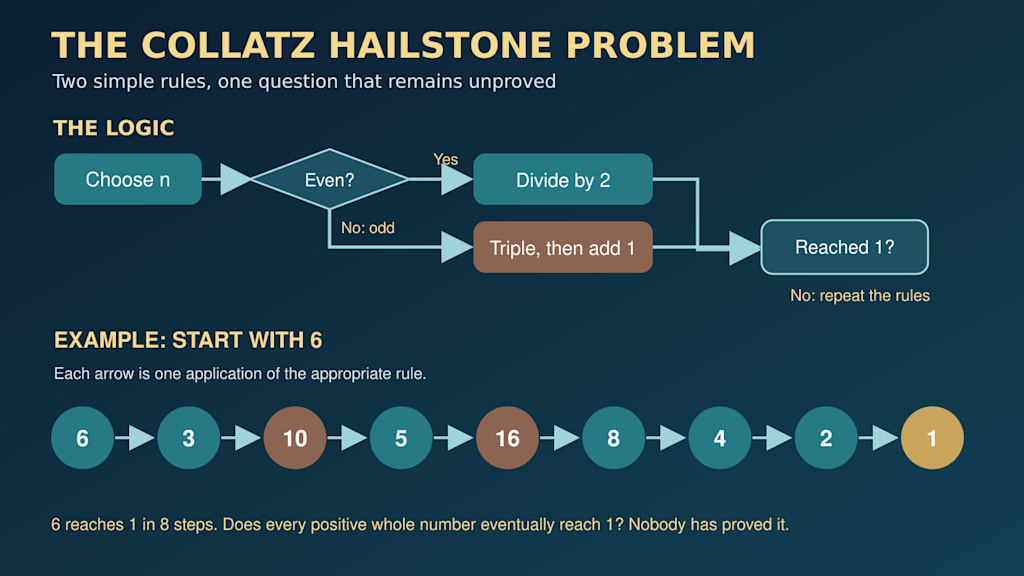
Choose any positive whole number. If it is even, divide it by two. If it is odd, multiply it by three and add one. Keep applying whichever rule fits the new number. The conjecture says that, whatever number you choose at the start, you will eventually reach one. Despite its simplicity, nobody has proved that this happens for every positive whole number.
Why It Is Called a Hailstone
Try starting with six. It is even, so it becomes three. Three is odd, so it becomes ten. Continue, and the numbers run through five, sixteen, eight, four, two and finally one. The route wanders upwards and downwards before it reaches its destination.
That movement gives the sequence its nickname. A hailstone rises and falls inside a storm cloud before eventually coming down, and these numbers appear to do much the same thing. The comparison is memorable, although the word eventually contains the entire difficulty. We have seen the numbers come down in countless examples, but we cannot prove that they all must do so.
Once a sequence reaches one, continuing the rules sends it to four, then two, then back to one. The question is whether every starting number joins that familiar loop. Perhaps one number leads to a different loop, or perhaps its sequence climbs for ever. Nobody has found such a number, but nobody has ruled out its existence either.
The Surprise Hidden in Twenty-Seven
Starting with a small number does not guarantee a short journey. The number twenty-seven is a favourite example because its sequence takes 111 steps to reach one. Before it comes down, it climbs as high as 9,232. A number you could count on your fingers and toes, with a little help, suddenly produces a much larger one.
This is what makes the problem so compelling to try for yourself. You might start with a number expecting it to descend quickly, only to watch it shoot upwards. Another number may behave calmly and reach one almost at once. Even when two sequences take different routes, they may meet along the way and then share every remaining step.
The behaviour can seem almost wilful, as though the numbers are choosing their own paths. Of course, they are doing nothing of the kind. Every move follows an exact rule. The surprise comes from the fact that exact rules can produce journeys that are remarkably difficult to predict.
Why Checking Numbers Is Not a Proof
A computer can start with a number, apply the rules and record what happens. It can repeat that process for an enormous range of starting numbers. Such checks offer strong evidence that the conjecture is true, and they might also discover a counterexample if one lies within the range examined.
They cannot finish the job on their own. There is no largest positive whole number, so a computer can always be given another starting number beyond those it has checked. Even if trillions upon trillions of numbers reach one, the next unchecked number remains a separate question. A proof must explain why the rule works for every possible starting number.
This distinction matters well beyond the Collatz problem. Testing examples tells us what has happened in the cases examined. A mathematical proof tells us why a claim must hold in all the cases it covers. The first can make us confident; only the second can settle a claim about infinitely many numbers.
Why the Rules Are So Difficult
The odd-number rule pushes the value upwards, while the even-number rule pulls it down. That sounds like a balance we ought to be able to measure. Unfortunately, each change also affects whether the next number is odd or even. A rise may be followed by several falls, while a fall may soon be followed by another rise.
The problem is not simply that the numbers can grow large. Mathematicians are accustomed to working with enormous numbers. The difficulty is proving what happens after an unlimited number of steps for every possible starting point. A sequence might behave as expected for a very long time before doing something nobody anticipated.
There is another tempting thought. If a number eventually falls below where it started, perhaps we can use what we already know about smaller numbers to show that it will reach one. That reasoning would be powerful if we could prove every starting number eventually falls below its initial value. Establishing that for all numbers is itself part of the unresolved problem.
A Major Step That Did Not Finish It
Mathematician Terence Tao published an important result concerning the Collatz process. Roughly speaking, he showed that the sequences starting from almost all numbers, in a particular mathematical sense, eventually fall to values that are remarkably small compared with where they began. It was substantial progress on a problem famous for resisting progress.
The words almost all require care. They do not mean all, and falling to a much smaller value does not by itself mean reaching one. A possible exception could still prevent the conjecture from being true. Tao’s work reveals something deep about the behaviour of the sequences, while the final question remains unanswered.
That is one reason the Collatz conjecture has endured. It resists the shortcuts that seem most promising when we first encounter it. Computers have checked vast numbers of examples, and mathematicians have proved meaningful partial results, yet the simple claim at the centre has survived every attempt at a complete proof.
Could the Conjecture Be False?
It is possible but to disprove it, someone would need to find a positive whole number whose sequence never reaches one. It might enter a different repeating loop, or it might continue without bound. Either discovery would overturn the familiar expectation and become a major mathematical result.
On the other hand, every example we can readily try behaves as the conjecture predicts. That makes a counterexample hard to imagine, but imagination is not proof. Mathematics has a long history of patterns that looked certain until somebody found an exception. The hailstone problem asks us to keep both possibilities in view.
Conclusion
The Collatz conjecture begins with two instructions that anyone can follow: halve an even number, or triple an odd number and add one. The resulting sequence may fall, climb or take an astonishing detour, but it always seems to find its way to one. We still do not know whether that apparent rule holds without exception.
Perhaps a future mathematician will find the missing argument, or perhaps an unexpected counterexample is waiting beyond every number we have tested. Until then, the hailstone problem remains a wonderful reminder that understanding a question and answering it are very different achievements.
About the Creator
Alan Spencer
Have been an author and writer for over 20 years. Have been a journalist, editor, proofreader, and a designer and presenter of training courses. Have written over 100 articles, two books, and around 20 training courses.
Enjoyed the story? Support the Creator.
Subscribe for free to receive all their stories in your feed. You could also become a paid subscriber, letting them know you appreciate their work.
Comments
There are no comments for this story
Be the first to respond and start the conversation.