
The Green Shift: How Bio-Based Chemicals Are Transforming Industry
From plant-powered materials to cleaner production, a fast-growing market is reshaping the future of everyday products and global sustainability

The Rise of Bio-Based Chemicals – A Greener Future Taking Shape
In a world where climate change and pollution are becoming harder to ignore, industries are searching for better, cleaner ways to operate. One of the biggest changes happening quietly—but powerfully—is in the chemicals industry. A new wave of products, known as bio-based chemicals, is transforming how everyday items are made.
These chemicals are not created from fossil fuels like oil or gas. Instead, they come from natural sources such as plants, agricultural waste, and even microorganisms. This shift may sound technical, but its impact is simple: fewer emissions, less pollution, and a more sustainable future.
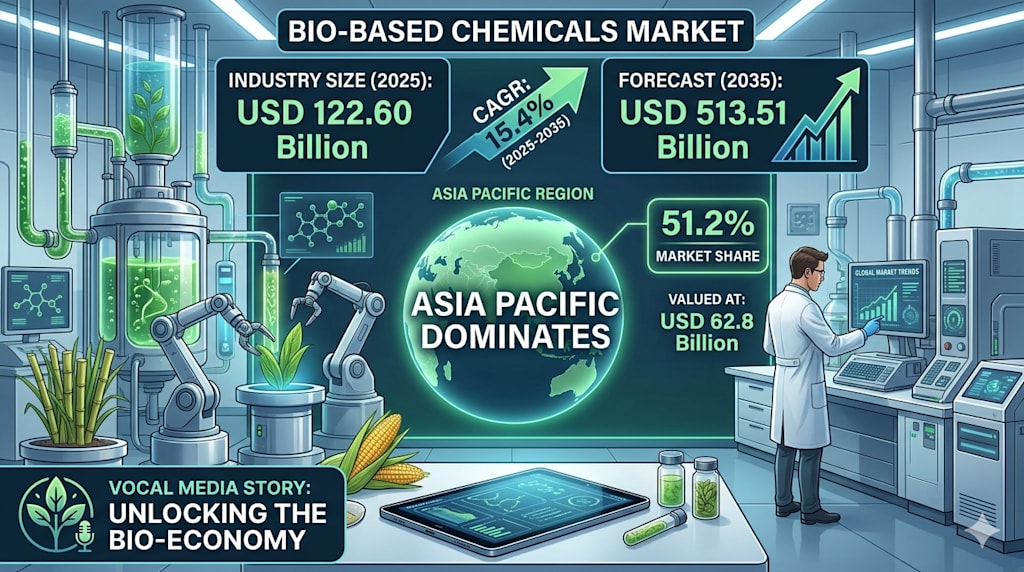
Right now, this market is growing fast. By 2025, bio-based chemicals are expected to be worth over 122.60 billion dollars globally. And that number could rise to more than 513.51 billion dollars by 2035. That’s a huge jump, showing just how quickly industries are embracing greener alternatives.
Market Highlights
- The Global Bio-Based Chemicals Market valued at USD 122.60 Billion in 2025, projected to reach USD 513.51 Billion by 2035, at a CAGR of 15.4% during the forecast period 2026-2035.
- Asia Pacific dominates with 51.2% market share, valued at USD 62.8 Billion.
- Bio-Based Ethanol segment dominates by type with 39.4% market share in 2025.
- Liquid form segment leads with 43.6% share driven by solvent and surfactant applications.
- Plant-Based source segment holds 47.1% share due to abundant agricultural feedstock availability.
- Agriculture end-use sector commands 46.3% market share in 2025.
So, what’s driving this change?
One major reason is pressure. Governments around the world are setting strict rules to reduce carbon emissions. Companies are being asked to rethink how they produce goods. Consumers are becoming more aware. People now prefer products that are environmentally friendly, whether it’s packaging, cosmetics, or even car parts.
This growing demand is pushing companies to replace traditional chemicals with bio-based ones.
Take ethanol, for example. It’s one of the most widely used bio-based chemicals today. It’s commonly blended with fuel to reduce emissions. But it’s not just used in energy—it’s also found in cosmetics, cleaning products, and even food processing. Because of its versatility, ethanol alone makes up a large share of this market.
Anothr important group is bio-based acids. These are used in food preservation, cleaning products, and manufacturing. They are safer and break down more easily in the environment compared to traditional chemicals.
Then there are bio-based plastics. These are becoming increasingly popular, especially in packaging. Many global brands are now choosing plant-based plastics for bottles, containers, and wraps. These materials look and perform like regular plastic but have a much lower environmental impact.
The way these chemicals are produced is also evolving. Many are made in liquid form, which makes them easier to transport and use in existing systems. This means companies don’t have to completely rebuild their factories to switch to greener options.
Most of these chemicals come from plant-based sources like corn, sugarcane, and vegetable oils. These crops are widely available and already part of global agriculture, making them a reliable source of raw materials. At the same time, scientists are exploring new sources like waste materials and microbes, which could make production even more sustainable.
One of the biggest users of bio-based chemicals is the agriculture sector. Farmers are turning to bio-based pesticides and fertilizers because they are safer for the soil and surrounding environment. This is especially important as organic farming continues to grow worldwide.
But agriculture is not the only industry benefiting. The food and beverage sector uses these chemicals for natural preservatives and eco-friendly packaging. Personal care brands are using them in skincare and beauty products, appealing to customers who want natural ingredients. Even the automotive industry is getting involved, using bio-based plastics and materials to make vehicles lighter and more sustainable.
Geographically, the Asia-Pacific region is leading the way. Countries like China are investing heavily in bio-based production, aiming to make a large portion of their chemical industry renewable within the next decade. The region benefits from strong agricultural resources and lower production costs.
North America and Europe are also key players. In these regions, government policies and environmental regulations are pushing companies to adopt greener practices. Investments in research and innovation are helping improve production methods and reduce costs.
However, the transition is not without challenges.
Producing bio-based chemicals can still be expensive. The technology required is complex, and the processes are not always as efficient as traditional methods. Companies often need significant investment to build new facilities or upgrade existing ones. This can slow down adoption, especially for smaller businesses.
But there is good news. Technology is improving rapidly. Advances in biotechnology, especially in enzyme development and fermentation processes, are making production faster and cheaper. Scientists are also developing ways to use non-food materials, like agricultural waste, which reduces competition with food supplies.
Another exciting development is the idea of carbon-negative production. In simple terms, this means the process removes more carbon dioxide from the atmosphere than it produces. If scaled successfully, this could turn the chemical industry into part of the climate solution, rather than part of the problem.
Looking ahead, the future of bio-based chemicals seems strong. Governments are continuing to introduce supportive policies, companies are investing more in sustainable solutions, and consumers are demanding change.
This is not just a trend—it’s a transformation.
The shift from fossil-based to bio-based chemicals represents a major step toward a cleaner, more sustainable world. While challenges remain, the direction is clear. Industries are moving away from dependence on oil and toward renewable, natural resources.
And as this transition continues, it will touch almost every part of daily life—from the fuel in cars to the packaging of food, from cleaning products at home to materials used in buildings and vehicles.
In many ways, this is a quiet revolution. But its impact could be enormous.
Because at its core, this movement is about more than just chemicals. It’s about rethinking how we use the planet’s resources—and finding smarter, greener ways to build the future.
About the Creator
Yash Mule
SEO Specialist with 10+ years of experience at Evolvance Market Research. Expert in technical SEO, content strategy, and data-driven optimization, with a proven track record of significantly increasing organic traffic and search rankings.
Enjoyed the story? Support the Creator.
Subscribe for free to receive all their stories in your feed.
Comments
There are no comments for this story
Be the first to respond and start the conversation.