
The Green Chemistry Revolution: Transforming Industry for a Sustainable Future
How eco-friendly innovations are reshaping chemicals, cutting emissions, and building a $500 billion global market

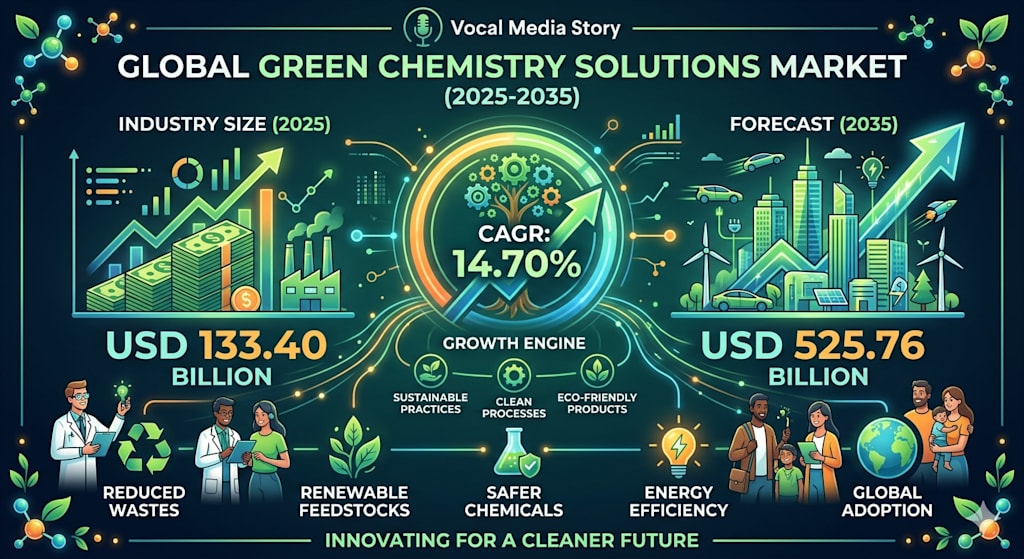
Green Chemistry on the Rise: Building a $500 Billion Sustainable Future
How safer chemicals and smarter processes are transforming industries worldwide
The Green Chemistry Solutions Market is projected to grow from USD 133.40 billion in 2025 to around USD 525.76 billion by 2035. This rapid expansion is not driven by trends alone, but by structural forces such as regulatory mandates, corporate climate commitments, and evolving consumer expectations. Together, these factors are reshaping how chemicals are produced, used, and valued.
The global push toward sustainability is no longer limited to energy or transportation—it has reached deep into the chemical industry. For decades, traditional chemical production relied heavily on fossil-based inputs and processes that generated waste and emissions. Today, that model is being rethought from the ground up. Green chemistry solutions, which focus on designing safer and more sustainable chemical processes, are emerging as a critical part of this transformation.
Market Highlights
- The Green Chemistry Solutions Market is valued at USD 133.40 Billion in 2025 and will reach USD 525.76 Billion by 2035, at a CAGR of 14.70%
- North America leads all regions with a 47.2% market share, valued at USD 62.9 Billion
- By Product Type, Biopolymers dominate with a 62.4% share
- By Source, Plant-Based holds a dominant 54.2% share
- By Application, Chemical leads with a 41.5% share
- By End-Use, Food and Beverages holds a 42.7% share
Get Complete 2026 Industry Analysis & Forward-Looking Insights
What Green Chemistry Really Means
Green chemistry is about prevention rather than cleanup. Instead of managing pollution after it happens, it focuses on designing products and processes that minimize or eliminate hazardous substances from the start. This approach spans a wide range of innovations, from biodegradable plastics to bio-based solvents and energy-efficient manufacturing methods.
These solutions are already being used across industries. Packaging companies are replacing conventional plastics with plant-based materials, while pharmaceutical manufacturers are adopting cleaner production techniques to reduce waste. Even everyday products like cosmetics and cleaning agents are being reformulated to meet stricter safety and sustainability standards.
What makes this shift particularly important is that it’s no longer optional. Governments and regulators are tightening rules around chemical safety and environmental impact, turning green chemistry from a niche innovation into a baseline requirement for doing business.
Market Growth Driven by Regulation and Demand
One of the strongest drivers behind this market’s growth is regulation. Governments in major economies are introducing policies that require safer chemical design and lower emissions. These rules are not just guidelines—they directly affect whether companies can sell their products in certain regions.
Corporate strategies are evolving. Many large companies have set net-zero targets, which means reducing their carbon footprint across the entire supply chain. Since chemicals are a key input in manufacturing, switching to greener alternatives becomes essential for meeting these goals.
Consumer behavior is also playing a role. Buyers are increasingly looking for products that are not only effective but also environmentally responsible. This demand is pushing companies to rethink their sourcing and production methods, creating a ripple effect throughout the supply chain.
Biopolymers and Plant-Based Inputs Take the Lead
Among the various product types, biopolymers have emerged as the dominant category. These materials, derived from renewable sources, can replace traditional plastics in many applications without sacrificing performance. Their ability to break down more easily at the end of their lifecycle makes them especially attractive in industries like packaging and textiles.
Plant-based inputs are the most widely used source for green chemistry solutions. Crops such as corn, sugarcane, and soy provide a steady and scalable supply of raw materials. Decades of investment in agricultural processing and biotechnology have made these feedstocks both accessible and cost-effective.
However, innovation is not limited to plants. Microorganisms such as bacteria and yeast are increasingly being used to produce chemicals through fermentation. This method allows for the creation of compounds that may not be possible through traditional or plant-based processes, opening new avenues for growth.
Applications Across Industries
The reach of green chemistry extends far beyond the chemical industry itself. In fact, one of the largest areas of adoption is within the industry that produces chemicals, where safer alternatives are being developed to replace existing substances.
Other sectors are quickly following suit. The paints and coatings industry, for example, is moving toward water-based formulations that reduce harmful emissions. Packaging is another major area of change, driven by regulations on single-use plastics and growing consumer awareness.
In textiles, manufacturers are exploring cleaner dyeing and finishing processes to reduce water usage and pollution. Meanwhile, the personal care industry is embracing bio-based ingredients as part of the “clean beauty” movement, where transparency and safety are key selling points.
The food and beverage sector stands out as a leading end-user. Strict safety regulations and consumer expectations make it essential for companies to use non-toxic, sustainable inputs in both production and packaging. This has made green chemistry solutions a natural fit for the industry.
Challenges Slowing the Transition
Despite its strong growth, the market faces several challenges. One of the most significant is cost. Producing bio-based chemicals often requires new infrastructure and technologies, which can be expensive to develop and scale. For smaller companies, these upfront investments can be a major barrier.
Another issue is supply chain complexity. While plant-based feedstocks are widely available, their prices can fluctuate based on factors such as weather and global demand. This creates uncertainty for manufacturers trying to maintain consistent production levels.
There is also a timing challenge. Regulatory pressure is increasing quickly, but companies may not be able to adapt their processes at the same pace. This mismatch can slow down adoption, even when the long-term benefits are clear.
Innovation and Opportunities Ahead
The future of this market will be shaped by innovation. Advances in biotechnology, such as improved fermentation techniques and enzyme-based processes, are making it easier and more cost-effective to produce sustainable chemicals. These technologies not only reduce environmental impact but can also improve efficiency and performance.
Another important trend is the concept of “safe and sustainable by design.” This approach encourages companies to consider environmental and safety factors from the earliest stages of product development. By doing so, they can avoid costly redesigns later and ensure compliance with evolving regulations.
Collaboration will also play a key role. Partnerships between chemical companies, technology providers, and research institutions are helping to accelerate the development and adoption of new solutions. As these collaborations expand, they will create new opportunities for growth and innovation.
Conclusion: A Necessary Transformation
The shift toward green chemistry is more than just an environmental initiative—it’s a fundamental transformation of the chemical industry. As regulations tighten and expectations rise, companies that embrace sustainable practices will be better positioned to compete in the global market.
While challenges remain, the direction is clear. Safer materials, cleaner processes, and smarter design principles are becoming the new standard. For businesses, this transition represents both a challenge and an opportunity: the chance to innovate, reduce risk, and build a more sustainable future.
About the Creator
Yash Mule
SEO Specialist with 10+ years of experience at Evolvance Market Research. Expert in technical SEO, content strategy, and data-driven optimization, with a proven track record of significantly increasing organic traffic and search rankings.
Enjoyed the story? Support the Creator.
Subscribe for free to receive all their stories in your feed.
Comments
There are no comments for this story
Be the first to respond and start the conversation.