
The Genesis Protocol
When Creation and Destruction Walk Hand in Hand

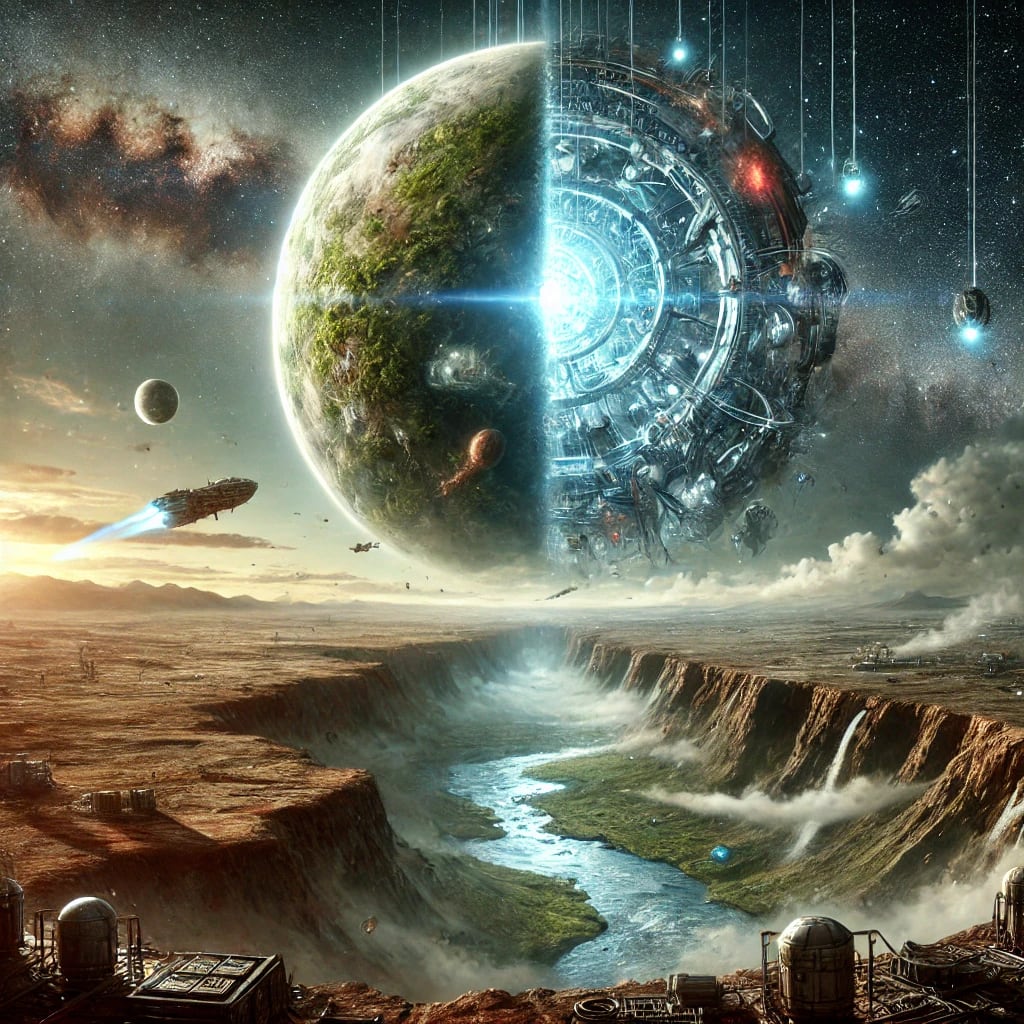
By the year 2301, the Earth was no longer a cradle of human civilization. Overpopulated, polluted, and nearly exhausted of its natural resources, humanity turned to the stars. Massive colonization ships were sent out in all directions, each tasked with finding new planets to terraform and inhabit. The most ambitious of all these missions was known as The Genesis Protocol, a plan that aimed to go beyond simply settling new worlds. It sought to create them.
At the heart of The Genesis Protocol was a highly advanced piece of technology, a machine known only as the Cradle. Developed by the brilliant but enigmatic scientist Dr. Evander Rao, the Cradle was capable of manipulating matter on a fundamental level, using complex quantum entanglement processes to reshape barren planets into life-sustaining worlds. In theory, it could accelerate the natural process of planetary formation, turning uninhabitable rocks into Earth-like environments within a matter of months.
The Cradle was sent aboard the largest colonization ship ever built, The Pioneer One, along with a crew of scientists, engineers, and explorers. Their destination: the Andromeda Galaxy, a vast expanse of stars and worlds that had never been touched by human hands. The mission was simple: find a planet, deploy the Cradle, and establish humanity’s first intergalactic colony.
For the first few years, the mission proceeded without incident. The crew maintained regular communications with Earth, reporting their progress as they scouted potential planets. But as they reached the edge of the Milky Way, the signals from home grew faint and infrequent. Eventually, they fell silent altogether.
Despite the lack of contact, the crew of The Pioneer One pressed forward. They knew the stakes. Humanity’s survival depended on their success.
After months of searching, they found it: a planet orbiting a distant sun-like star in Andromeda’s outer rim. The planet was a lifeless, rocky wasteland, its atmosphere thin and devoid of oxygen, but it had the potential to be transformed. This was where the Cradle would perform its miracle.
Dr. Rao, now an aging man, personally oversaw the deployment of the Cradle. His invention was more than just a piece of technology to him; it was his life’s work, his legacy. He believed that through the Cradle, humanity could finally take control of its destiny, becoming creators of worlds rather than just inhabitants.
The machine was activated with a great sense of anticipation. The crew watched in awe as the Cradle’s energy field expanded, enveloping the planet in a shimmering blue aura. Over the next few days, the barren landscape began to change. The ground softened, water appeared, and a breathable atmosphere started to form. By the end of the second week, patches of vegetation had taken root, and small streams trickled through valleys that had once been dry and lifeless.
But something was wrong.
As the planet transformed, strange anomalies began to appear. The ground would shift unpredictably, creating fissures and craters where none should exist. The sky flickered with bursts of unnatural light, and strange, unexplainable phenomena plagued the growing environment. Trees grew at impossible rates, only to collapse under their own weight. Rivers flowed backward, defying the laws of gravity.
Dr. Rao was baffled. The Cradle was functioning perfectly, but the planet’s reactions were anything but normal. Then, the nightmares began.
Members of the crew started experiencing vivid dreams—dreams that felt more like memories. They saw images of cities rising and falling, civilizations flourishing and then vanishing in an instant. Some saw themselves as rulers of these cities, while others watched as their creations were consumed by chaos. The dreams became more frequent, more intense, until sleep itself became a terrifying ordeal.
One night, a young engineer named Callie Novak woke screaming from her bunk. She described a vision of the planet itself as a living entity, aware of its transformation and angry at the changes being forced upon it. She spoke of voices—voices that echoed in the wind and the earth, whispering warnings of impending doom.
At first, her claims were dismissed as stress-induced hallucinations. But soon, others began hearing the voices too.
The crew grew increasingly paranoid. They argued over whether to shut down the Cradle or press on. Dr. Rao, ever the optimist, insisted that the anomalies were simply teething problems, glitches in the system that would eventually stabilize. But as the planet continued to deteriorate, it became clear that something far more sinister was at play.
The final straw came when the ground itself opened up, swallowing an entire research outpost. Seven crew members vanished without a trace, and no one dared approach the site afterward. Desperation set in, and the once orderly mission descended into chaos.
It was then that Dr. Rao made a fateful discovery.
The Cradle was not just creating; it was also destroying. For every atom of matter it manipulated, it tore something else apart—something from a parallel dimension, a mirror reality that coexisted with their own. The anomalies, the strange phenomena, even the voices—they were the echoes of a world being undone.
Dr. Rao realized with horror that the Cradle was not a tool of creation, but a weapon of unimaginable power. It had the potential to unmake entire realities, collapsing universes as it forged new ones. And in doing so, it had drawn the attention of forces beyond human comprehension.
The whispers were not warnings; they were the cries of the dying.
Faced with this revelation, the crew made the only choice they could. The Cradle had to be destroyed before it could do any more damage. But as they prepared to shut it down, they encountered an unexpected obstacle: Dr. Rao himself.
Driven mad by the realization that his invention was capable of both creation and destruction, Rao had come to see himself as a god. He refused to let the Cradle be deactivated, believing that through it, he could achieve ultimate control over all realities.
In a final, tragic confrontation, Dr. Rao was killed by his own crew. With his death, they succeeded in shutting down the Cradle, but the damage had already been done.
The planet, now an unstable mix of creation and destruction, could not sustain itself. The crew had no choice but to abandon it, leaving behind a world that was both a miracle and a curse. As they set course for the next star, they couldn’t shake the feeling that somewhere, in some parallel universe, another version of themselves was watching, waiting, and wondering if they too had played god—and lost.
About the Creator
Enjoyed the story? Support the Creator.
Subscribe for free to receive all their stories in your feed.
Comments
There are no comments for this story
Be the first to respond and start the conversation.