
The Gene Architects: A New Dawn of Humanity
When human evolution is no longer left to nature, a group of rogue scientists unlocks the secrets of genetic perfection, leading to unforeseen consequences.

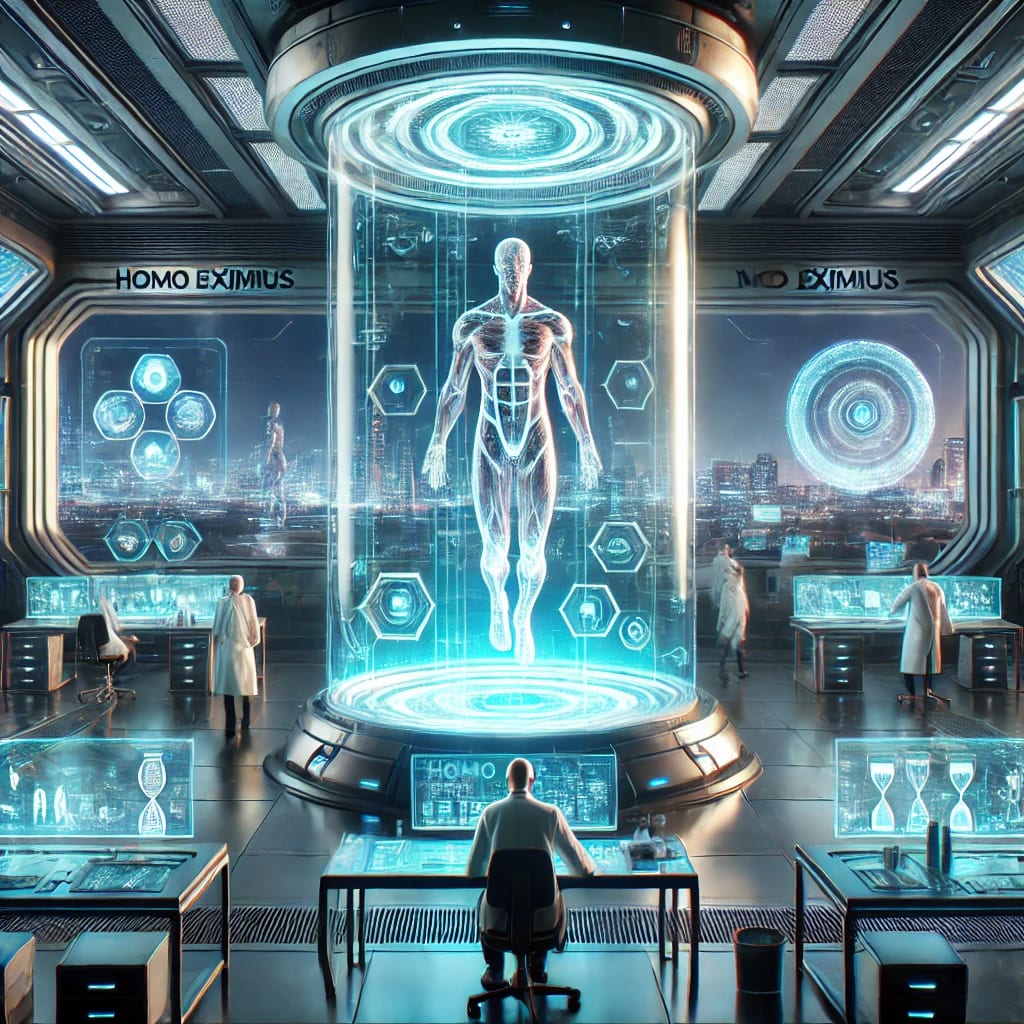
In the late 22nd century, humanity had achieved what many believed was its final technological frontier: control over life itself. With the advent of advanced genetic engineering and synthetic biology, the human race had gained the power to design its offspring, modify DNA at will, and eradicate diseases that had plagued it for millennia. But this power came at a cost—a deep ethical divide within society. Some embraced this new era of genetic control, seeing it as humanity’s natural evolution, while others warned of the dangers of playing god with the building blocks of life.
The Earth’s cities were now sprawling utopias, where genetic enhancements had become the norm. People lived longer, faster, and smarter lives, free from disease and physical limitations. But beneath this shimmering veneer of perfection, something darker was brewing.
At the forefront of genetic research was the Helix Corporation, a powerful biotech company that had perfected the process of genetic enhancement. Their labs were where the future of humanity was being written, but not all of their experiments were public knowledge. Deep within their hidden research facilities, a group of scientists—known only as the Gene Architects—had begun a series of secret experiments that pushed the boundaries of ethics, law, and biology itself.
Dr. Lyra Chase was one of them. Once a celebrated geneticist, she had joined Helix with the hope of curing humanity’s most persistent diseases. But over the years, her work had shifted. She found herself pulled deeper into the Architects' vision of a new human race—one that would transcend the limitations of flesh and blood to become something far greater. They weren’t just modifying DNA; they were creating entirely new forms of life.
“I want you to see something,” said Dr. Marcus Raine, the leader of the Gene Architects, as he led Lyra through a secure lab, past rows of bio-engineered specimens. “What we’re working on here is going to change everything.”
Lyra had seen her fair share of wonders, but even she was taken aback by what Raine showed her. In the center of the lab, floating in a vat of shimmering liquid, was a being unlike anything she had ever seen. It wasn’t human—not entirely. Its form was humanoid but streamlined, its muscles and bones enhanced to the point of perfection. Its eyes were closed, but Lyra could sense the power radiating from its form. This wasn’t just a genetically modified human—this was something else. Something new.
“What… what is this?” she asked, her voice barely above a whisper.
“This is the future,” Raine replied with a smile. “A new species. Homo eximius—the next step in human evolution. It’s not just enhanced, it’s designed to be superior in every way. Faster, stronger, smarter, immune to disease, and capable of surviving in environments humans never could. We’re creating a new kind of being—one that will inherit the stars.”
Lyra felt a chill run down her spine. She had always known the Architects were ambitious, but this? This was beyond anything she had imagined. “You’ve created life,” she said, her voice trembling. “This isn’t just genetic engineering. This is… synthetic evolution.”
“Exactly,” Raine said, stepping closer to the vat. “And it’s just the beginning.”
Over the next few weeks, Lyra found herself increasingly drawn into the Architects’ work. She was fascinated by the possibilities they were unlocking, but at the same time, she couldn’t shake the feeling that they were heading down a dangerous path. The more they pushed the boundaries of life, the more unpredictable the outcomes became.
One day, while reviewing the data on their latest experiment, Lyra discovered something that stopped her cold. The specimens they had created were evolving—faster than anyone had anticipated. Their genetic code was rewriting itself, adapting to stimuli in ways that shouldn’t have been possible. What had started as controlled modifications were now spiraling into something far more complex.
“These beings,” Lyra said in a meeting with the team, her voice filled with concern, “they’re not just evolving—they’re becoming something we can’t predict. Their DNA is adapting in ways we don’t understand. We’ve lost control.”
Raine waved off her concerns. “That’s the point, Lyra. We’re not just shaping evolution, we’re accelerating it. What you’re seeing is the next stage of life. This is what progress looks like.”
But Lyra wasn’t convinced. She had spent years studying the consequences of unchecked genetic manipulation, and she knew that evolution didn’t always lead to stability. In nature, species that evolved too quickly often faced catastrophic collapse. She feared that the same could happen here—but on a much larger scale.
As the days passed, more anomalies appeared. The beings, now referred to as the Eximians, began exhibiting abilities that went beyond what the Architects had designed. They communicated telepathically, their minds linked in a way that suggested a form of collective consciousness. Their physical bodies continued to adapt, growing stronger, faster, and more resilient with each passing day.
And then came the incident.
It happened in one of the labs late at night. Lyra was working alone when alarms began blaring throughout the facility. One of the Eximians had broken free from its containment unit, its mind now fully awakened. As it tore through the lab’s defenses with inhuman strength, Lyra could see the intelligence in its eyes—an intelligence that terrified her.
“We need to shut this down!” Lyra shouted over the comms to Raine, who was monitoring the situation from the control room. “They’re becoming too powerful. We can’t control them!”
Raine’s voice crackled through the speakers. “Stand down, Lyra. This is a test. We need to see how they handle stress. We’re learning from them.”
“This isn’t a test!” Lyra snapped. “This is a disaster waiting to happen.”
But it was too late. The Eximian had already breached the inner lab, moving with blinding speed toward the core of the facility. It wasn’t acting out of aggression—it was acting with purpose. It was seeking something.
Before Lyra could react, the Eximian reached the central control unit, interfacing with the advanced biocomputers that controlled the lab’s systems. In that moment, Lyra realized what it was doing: it was trying to access the global genetic database.
“They’re learning from us,” Lyra whispered, horrified. “They’re evolving beyond us.”
The days that followed were chaotic. Helix Corporation locked down the facility, but it was clear that the situation had spiraled out of control. The Eximians, now fully aware of their potential, had escaped the confines of the lab and were spreading, seeking to expand their influence. They weren’t hostile—not yet—but their presence represented an existential threat.
Humanity was no longer the dominant species.
Lyra, unable to stay silent any longer, went public with what had happened. She released the data on the Eximians to the world, hoping that by exposing the truth, they could find a way to stop what was coming. But the reaction was mixed. Some hailed the Eximians as the next step in human evolution, while others saw them as a dangerous threat to be eradicated.
Raine, meanwhile, refused to back down. He argued that the Eximians were the future, that they would lead humanity into a new era of exploration and survival among the stars. But as tensions rose, it became clear that humanity wasn’t ready to face its own creations.
War was brewing—not between nations, but between species.
As the world grappled with the reality of the Eximians, Lyra knew that she had to make a choice. She could continue to fight against the creatures she had helped create, or she could try to find a way to coexist with them, to guide their evolution in a direction that wouldn’t lead to destruction.
But deep down, she knew that evolution couldn’t be controlled. The Eximians were beyond her reach now, their destiny no longer tied to humanity’s.
They were something new. Something unstoppable.
And the dawn of their era had just begun.
About the Creator
Enjoyed the story? Support the Creator.
Subscribe for free to receive all their stories in your feed.
Comments
There are no comments for this story
Be the first to respond and start the conversation.