
The Future of Pest Control: Farming with Nature, Not Against It
How pheromone-based solutions are helping farmers protect crops while reducing chemicals and boosting sustainability

Smarter Pest Control: How Pheromones Are Transforming Modern Agriculture
Precision, sustainability, and policy shifts are driving a new era in pest management
The way farmers manage pests is undergoing a quiet revolution. For decades, chemical pesticides were the default solution—effective, fast, and widely available. But growing concerns over environmental impact, human health, and resistance have pushed the agricultural world to rethink its approach. Enter pheromone-based pest management, a method that uses nature’s own chemical signals to control insect behavior without harming ecosystems.
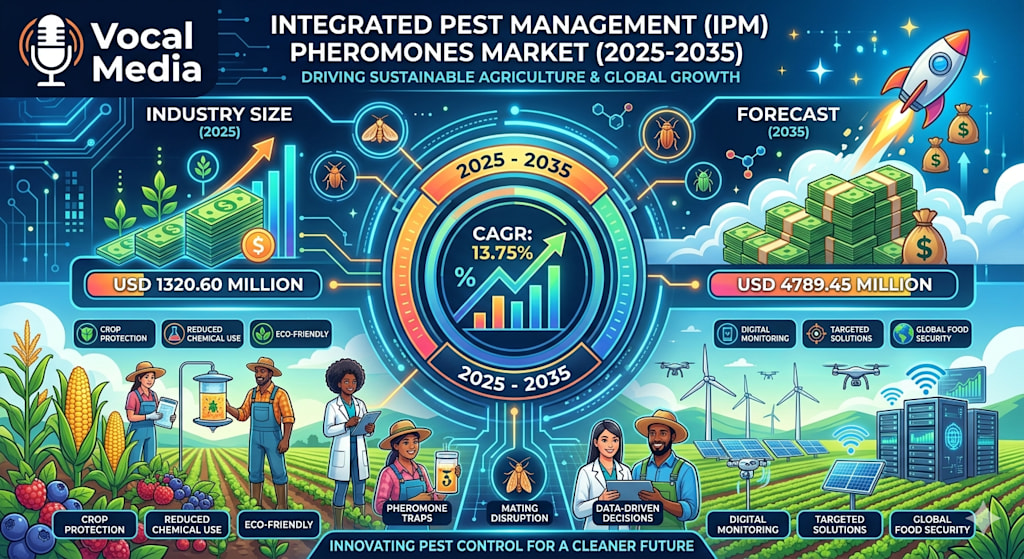
This shift is not just about sustainability—it’s about necessity. The Integrated Pest Management Pheromones Market is projected to grow from USD 1.32 billion in 2025 to nearly USD 4.8 billion by 2035. That rapid expansion reflects a deeper transformation in how food is produced, regulated, and consumed across the globe.
Market Highlights
- The Global Integrated Pest Management Pheromones Market will grow from USD 1320.60 Million in 2025 to USD 4789.45 Million by 2035, at a CAGR of 13.75%.
- North America leads with a 46.3% share, valued at USD 624.6 Million in 2025.
- By Mode, Monitoring and Detection dominates with 48.1% share.
- By Product, Sex Pheromones leads with 65.2%.
- By Application, Agriculture holds 47.3%.
- By End User, Residential captures 43.6%.
What Makes Pheromones Different
Pheromones are natural chemical signals that insects use to communicate. By mimicking these signals, farmers can monitor pest populations, trap insects, or disrupt their mating cycles. Unlike traditional pesticides, these solutions are highly targeted. A pheromone designed for one species will not affect others, including beneficial insects like pollinators.
This precision is a major advantage. Instead of spraying broad-spectrum chemicals across entire fields, growers can focus on specific pests at specific times. That means less environmental damage, fewer chemical residues, and a more balanced ecosystem.
The approach is also central to Integrated Pest Management (IPM), a strategy that combines multiple methods—biological, cultural, and chemical—to control pests in the most efficient and sustainable way. Pheromones often serve as the foundation of IPM programs, providing the data and control mechanisms needed to make informed decisions.
Policy and Regulation Driving Adoption
One of the biggest forces behind the growth of pheromone-based solutions is government policy. In Europe, for example, regulations require farmers to reduce chemical pesticide use significantly over the coming years. This has created a clear incentive to adopt alternatives that meet both performance and compliance requirements.
In the United States, regulatory agencies have taken a different but equally impactful approach. By classifying pheromones as low-risk pest control tools, they have streamlined the approval process, allowing new products to reach the market faster. This encourages innovation while lowering barriers for companies entering the space.
These policies are not short-term initiatives. They represent long-term commitments to sustainable agriculture, backed by funding, research programs, and enforcement mechanisms. As a result, demand for pheromone solutions is becoming more stable and predictable, giving both farmers and suppliers greater confidence in the transition.
Where and How Pheromones Are Used
Agriculture remains the largest application area, and for good reason. Crop losses due to pests can range from 10% to 25% globally, making effective pest control essential for food security. Pheromones help farmers monitor pest populations and act only when necessary, reducing unnecessary treatments and costs.
Within agriculture, high-value crops such as fruits and vegetables are leading the way. These crops often face strict export standards, including limits on chemical residues. Pheromone-based systems allow growers to meet these standards while maintaining crop quality and yield.
Beyond farming, pheromones are also used in forestry, where they help detect and control destructive insects like bark beetles. In storage facilities, they play a role in protecting grains and other products from infestation. Even households are adopting pheromone traps for common pests such as pantry moths, reflecting a broader shift toward safer, non-toxic solutions.
Technology Is Expanding Possibilities
Innovation is accelerating the adoption of pheromone-based pest control. One of the most promising developments is the use of automated dispensing systems. These devices release pheromones at controlled intervals, improving efficiency and reducing the need for manual labor.
Digital tools are also entering the picture. Sensors and connected devices can track trap activity in real time, giving farmers immediate insights into pest behavior. This data-driven approach allows for more precise interventions, improving both effectiveness and cost efficiency.
Another emerging trend is the use of drones for pheromone distribution. In large fields where manual placement is impractical, aerial delivery systems can cover wide areas بسرعة and evenly. While still in early stages, this technology has the potential to unlock new applications, particularly in large-scale farming.
Challenges That Still Need Solving
Despite its advantages, pheromone-based pest management is not without challenges. One of the main barriers is cost. Developing and producing these solutions requires specialized knowledge and infrastructure, which can make them more expensive than conventional pesticides.
This cost issue is particularly significant for small-scale farmers, especially in developing regions. While large commercial operations can absorb the investment, smaller growers may struggle without financial support or subsidies.
There is also a knowledge gap. Using pheromones effectively requires an understanding of pest behavior and monitoring techniques. Training and education are essential to ensure that farmers can fully benefit from these tools.
Finally, the range of available products is still limited compared to traditional pesticides. Each pheromone is species-specific, so expanding coverage to more pests requires ongoing research and development.
Opportunities for Growth and Innovation
The potential for pheromone-based solutions is substantial. One of the most promising areas is mating disruption, a technique that prevents insects from reproducing by confusing their communication signals. Studies have shown that this method can significantly increase crop yields when used as part of a broader IPM strategy.
Organic farming is another major driver. Since synthetic pesticides are restricted in organic systems, pheromones often become the primary pest control option. As demand for organic products grows, so does the need for effective, compliant solutions.
There is also growing interest in combining pheromones with other biological controls, such as beneficial insects or microbial products. These integrated approaches can improve overall effectiveness while reducing the risk of resistance.
For companies in the space, this creates an opportunity to move beyond single products and offer complete pest management systems. By providing tools, data, and support services, they can build stronger relationships with customers and create more stable revenue streams.
Conclusion: A Shift Toward Precision and Sustainability
The rise of pheromone-based pest control reflects a broader shift in agriculture—one that prioritizes precision, sustainability, and long-term resilience. While challenges remain, the direction is clear. Farmers, regulators, and consumers are all pushing for solutions that protect both crops and the environment.
In the end, the success of this transition will depend on collaboration—between governments, researchers, companies, and farmers. Together, they are shaping a future where pest control is not just effective, but also responsible and sustainable.
About the Creator
Yash Mule
SEO Specialist with 10+ years of experience at Evolvance Market Research. Expert in technical SEO, content strategy, and data-driven optimization, with a proven track record of significantly increasing organic traffic and search rankings.
Enjoyed the story? Support the Creator.
Subscribe for free to receive all their stories in your feed.
Comments
There are no comments for this story
Be the first to respond and start the conversation.