
The Future of Car Repairs May Not Require a Workshop Visit
Connected vehicles, AI-powered diagnostics, and over-the-air updates are transforming the future of automotive maintenance.

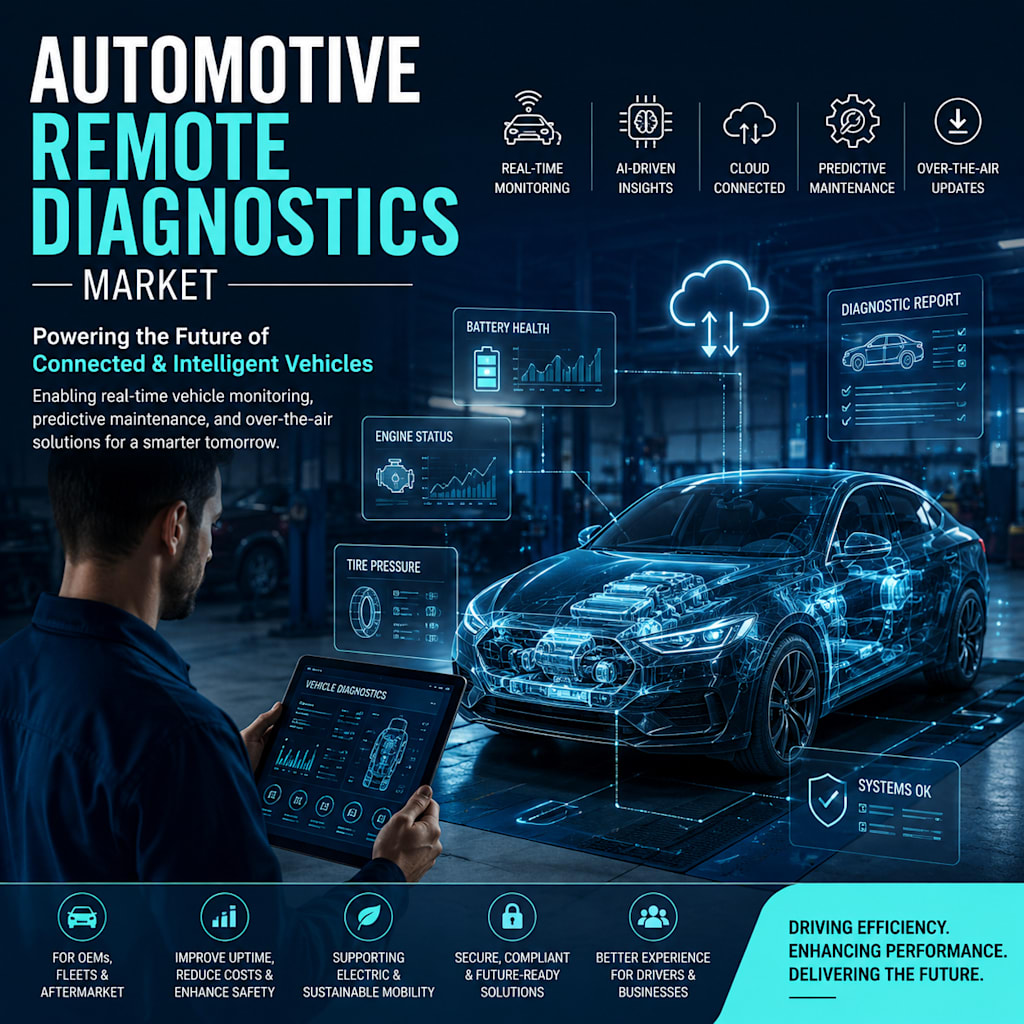
Gone are the days when cars were just mechanical machines with engines and wheels. Cars today are becoming smart devices, capable of monitoring themselves, detecting issues in real time, and even receiving over-the-air updates without the need for a physical workshop visit.
This is fueling the hyper-growth of the automotive remote diagnostics market. As connected cars, electric vehicles (EVs), and advanced driver-assistance systems (ADAS) become mainstream, automakers and fleet operators are increasingly turning to remote diagnostics for boosted efficiency, enhanced uptime, and a smarter driving experience. What once needed a mechanic and a garage visit can now often be diagnosed, or sometimes even fixed, remotely through cloud connected systems.
Market Experiencing Unprecedented Growth
Valued at approximately USD 17.8 billion in 2025, the global automotive remote diagnostics market size is forecast to hit close to USD 55 billion by 2034, with a significant compound annual growth rate (CAGR) of about 12.9% from 2026 to 2034. This explosive growth is attributed to the increasing connectivity, digitalization, and software reliance of vehicles. The focus of automotive manufacturers is no longer on just building cars, but on creating connected ecosystems with a deep reliance on data, cloud computing, AI, and real-time diagnostics.
What Exactly is Automotive Remote Diagnostics?
Automotive remote diagnostics is the ability to remotely check a vehicle’s system, utilizing telematics systems, on-board sensors, cloud based platforms, and wireless connectivity. These systems collect constant real-time information regarding:
- Engine Performance
- Battery Condition
- Braking System
- Tire Pressure
- Fuel Consumption
- Software Status
- Sensor Performance
The data collected from the system is relayed to cloud-based platforms, which utilize intelligent data analysis tools to detect anomalies, predict potential failure, and in some cases send Over-The-Air (OTA) software updates to the vehicle. This preemptive measure of spotting issues before they become real problems not only benefits automakers in avoiding physical repairs but also contributes to the overall customer experience. It’s this paradigm shift from reactive to proactive maintenance that is changing the face of the automotive industry.
Connected Cars are the Main Driver of Growth
Connected cars are arguably the primary driving force behind the rapid expansion of the remote diagnostics market. The presence of embedded telematics systems within vehicles is allowing for uninterrupted communication between the vehicle and external networks, paving the way for:
- Real-time monitoring of vehicles
- Remote diagnostics and troubleshooting
- Proactive alerts on vehicle health
- Over-the-air software updates
- Enhancement of in-car safety features
The increasing global adoption rate of connected cars is transforming the remote diagnostics system into a standard feature from a premium option, with estimations suggesting hundreds of millions of connected vehicles globally in the coming decade, creating an enormous opportunity for solutions related to remote monitoring.
Electric Vehicles Present a Unique Diagnostic Need
Electric Vehicles (EVs) are also revolutionizing the way remote diagnostics are performed. Given their reliance on battery systems, thermal management systems, and software dependent architecture, regular monitoring is essential for ensuring efficient performance and safety. Remote diagnostics enable:
- Real-time checking of battery health
- Remote monitoring of charging performance
- Tracking of energy consumption patterns
- Real-time monitoring of the thermal management system
- Verifying software integrity
As EV adoption picks up pace globally, these diagnostics capabilities are becoming increasingly indispensable. Automakers and service providers are relying on diagnostic platforms to both identify and resolve problems, as well as to extend the life of their battery systems through remote maintenance strategies.
AI Is Transformational for Vehicle Maintenance
Artificial Intelligence (AI) is undeniably one of the most important technologies impacting the automotive diagnostics industry today. While traditional systems are solely reliant on the triggering of fault codes, AI based systems are capable of analyzing massive amounts of telematics data to predict potential vehicle failures, before they occur. This is helping businesses to mitigate the risk of expensive repairs and unexpected vehicle downtime by implementing predictive maintenance schedules. AI has the ability to detect minute deviations in the way a vehicle behaves, which might easily go unnoticed by human operators, and therefore provides a vital advantage in improving maintenance and operational efficiency.
OTA Updates Change the Game of Car Servicing
The ability to receive over-the-air (OTA) software updates represents one of the most significant innovations to occur in vehicle design over the past few decades. These updates not only fix software bugs and improve system performance, but also allow new features to be implemented, completely revolutionizing the concept of car servicing. Rather than having to visit a workshop for an issue, which could be addressed digitally through a connected system, remote software updates ensure that most software-related problems can be fixed from the convenience of one's own home. This is particularly important for EVs, ADAS, infotainment systems, and connected car services, as vehicle software continues to grow in complexity, increasing the importance of remote software updates in modern vehicles.
Fleet Operators Discover Substantial Cost Savings
Fleet operators in particular stand to benefit from a wider implementation of the remote diagnostics technology. The impact of a down vehicle on revenue can be immense, leading logistics and transport providers to actively seek ways to improve vehicle uptime and reduce unexpected downtime. By identifying potential issues before they can cause major malfunctions, predictive maintenance driven by the diagnostic system minimizes disruptions, extends the lifespan of vehicles, and thereby offers significant cost benefits, facilitating adoption throughout the world.
Europe leads while Asia-Pacific races ahead
Europe is the largest and most developed market for automotive remote diagnostics, thanks to the continent’s stringent emissions standards, robust automotive manufacturing sector, and high connected car penetration. The automotive manufacturers in the region are investing heavily in software-defined cars and security compliance for diagnostic systems. However, the Asia-Pacific region has emerged as the fastest-growing market for the sector, with the increasing pace of EV manufacturing in China and India, alongside improvements in connected car infrastructure and the development of 5G networks, creating immense opportunities in the segment. The North American region continues to be a significant player, with a strong focus on fleet telematics solutions and the rapid growth in demand for usage-based insurance models.
Cybersecurity remains a Critical Area of Focus
As cars become increasingly reliant on connected technology, the risks associated with cyber-attacks on vehicle systems are growing significantly. The sheer amount of sensitive vehicle and driver data transmitted by the system is making data protection extremely vital. Therefore, car manufacturers and tech providers are increasing investment in robust cloud infrastructure, encrypted communication, cybersecurity compliance systems, and cyber threat monitoring services. The government, with its increasing data security regulations, is forcing the automotive industry to take cybersecurity as a serious consideration, possibly as important as the diagnostic functionality itself in the future.
Shift Toward Software-Based Revenue Models
The future of automotive diagnostics sees a large shift from the traditional hardware-centric revenue model to subscription-based software and service-based revenue streams. Automakers are tapping into new monetization strategies for connected cars through:
- Vehicle health monitoring subscription services
- Premium remote diagnostic packages
- Predictive maintenance services
- Fleet management software
- Remote feature activation
These initiatives not only offer a continuous revenue source but also cement the role of remote diagnostics as a fundamental business model within the automotive industry.
Challenges to Overcome
While the market has seen a tremendous expansion, there are still several challenges that need to be addressed. These include:
The lack of standardization across vehicle systems and communication protocols, which creates complexity in integration.
Older vehicles which lack the necessary embedded systems to support remote diagnostics.
Concerns related to the privacy of user data which pose regulatory and customer trust issues.
The future of automotive diagnostics is inextricably linked with the broader development of connected mobility. The adoption of technologies such as 5G connectivity, edge computing, AI-driven data analytics, vehicle-to-everything (V2X) communication, and blockchain-based service records will undoubtedly lead to further advancements and greater capabilities for the system in the coming decade.
Final Thoughts
The automotive industry is well and truly in the midst of a digital revolution, with cars morphing into smart, connected entities that continuously interact, analyze, and optimize their own performance. Automotive remote diagnostics is at the forefront of this transformation.
About the Creator
Robert
Senior Market Researcher at IMARC Group, specializing in global market analysis, industry trends, and data-driven insights across diverse sectors.
Enjoyed the story? Support the Creator.
Subscribe for free to receive all their stories in your feed.
Comments
There are no comments for this story
Be the first to respond and start the conversation.