
The Future of Banking Isn't Digital. It's Intelligent.
As AI reshapes financial services, the institutions that thrive will be the ones built for intelligence, not just digitization.
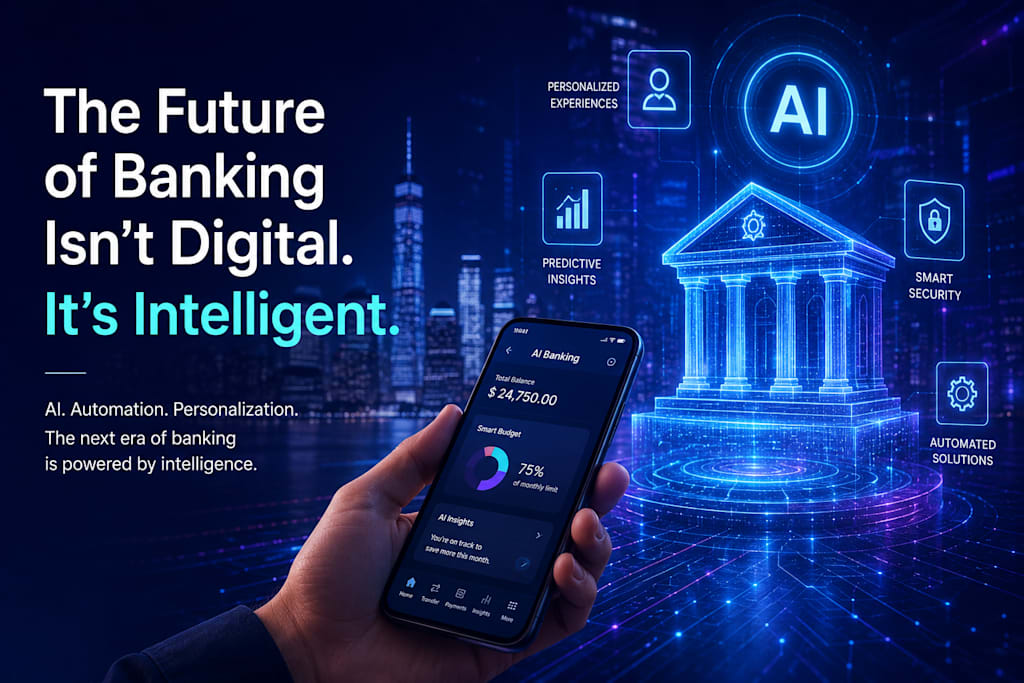
For years, the banking industry has been obsessed with digital transformation.
Banks launched mobile apps. Financial institutions invested in online services. Fintech startups promised to disrupt everything. The conversation revolved around becoming digital, as though digitization itself was the destination.
But we are rapidly discovering that digital was never the end goal.
It was merely the first step.
The next era of banking will not be defined by who has the best app or the sleekest interface. It will be defined by intelligence. Artificial intelligence, predictive systems, automated decision-making, and adaptive financial experiences are becoming the forces reshaping how people interact with money.
The future of banking isn't digital.
It's intelligent.
The Mobile Banking Revolution Is Already Over
Not long ago, mobile banking was considered innovative.
Today it is expected.
Checking balances, transferring funds, paying bills, and depositing checks from a smartphone are no longer competitive advantages. They are baseline requirements.
Consumers now expect financial services to understand their needs before they ask. They want personalized recommendations, proactive fraud protection, smarter budgeting tools, and support that is available instantly.
In other words, people no longer want access to their bank.
They want their bank to work intelligently on their behalf.
That shift changes everything.
Why Traditional Banking Models Are Being Challenged
Most financial institutions still operate on infrastructure built for a very different world.
Many systems were designed decades ago, long before cloud computing, artificial intelligence, and real-time data processing became central to modern business operations.
As customer expectations evolve, those systems create limitations. Banks can no longer rely solely on brand recognition or large customer bases to remain competitive.
They need technology that allows them to adapt quickly.
This challenge has led organizations down two paths.
Some are building entirely new digital-first banking experiences through neobanks. Others are modernizing existing platforms by integrating advanced technologies into established systems.
Both approaches aim to solve the same problem: creating financial experiences capable of keeping pace with a rapidly changing world.
AI Is Becoming the New Financial Infrastructure
Artificial intelligence is no longer a futuristic concept within banking.
It is becoming infrastructure.
AI systems can identify suspicious transactions in milliseconds, analyze lending risks more accurately, automate customer support, and provide highly personalized financial insights.
Tasks that once required large teams and significant time can now happen continuously in the background.
This changes the economics of financial services.
Banks gain efficiency. Customers receive better experiences. Smaller organizations gain access to capabilities that were once available only to the largest institutions.
As AI continues to mature, the gap between traditional banks and digital challengers may become less important than the ability to use intelligence effectively.
The institutions that learn fastest may ultimately outperform those that simply spend the most.
The Builders Behind the Transformation
While banks often receive the spotlight, much of this transformation is being driven by the companies building the technology that powers modern financial experiences.
Product engineering firms, fintech specialists, and AI-focused development teams increasingly influence how financial services evolve.
Companies like GeekyAnts are helping organizations modernize banking platforms, develop AI-powered financial products, and create digital experiences capable of scaling with changing customer expectations. Their work reflects a broader trend across the industry: innovation is no longer happening exclusively inside banks.
The future of finance is being shaped by collaboration between financial institutions and technology experts who understand how to build adaptable, intelligent systems.
The Real ROI Comes From Adaptability
Whenever new technology emerges, businesses often focus on immediate returns.
But the most valuable investment may be adaptability itself.
Financial organizations that can quickly integrate AI, respond to changing regulations, launch new services, and improve customer experiences gain a significant advantage over competitors locked into rigid systems.
This is why modernization efforts are attracting so much attention across the financial sector.
The goal is not simply to become digital.
The goal is to become capable of continuous evolution.
In a world where technology changes faster than ever, adaptability becomes a competitive asset.
Banking May Eventually Disappear Into Everyday Life
The most fascinating possibility is that banking becomes nearly invisible.
Consumers already access financial services through shopping platforms, ride-sharing apps, digital wallets, and countless online experiences. As embedded finance continues to expand, people may interact with financial services without ever thinking about the institution behind them.
Money management could become proactive rather than reactive.
AI could automatically optimize savings, identify financial risks, suggest investment opportunities, and manage routine decisions with minimal human intervention.
Banking would still exist.
It would simply become woven into everyday life.
The organizations that succeed in this future will not necessarily be those with the most branches, the biggest budgets, or even the most customers.
They will be the ones capable of combining trust, technology, and intelligence into experiences that feel effortless.
The future of banking is no longer about going digital.
That race has already been won.
The next race is about becoming intelligent.
About the Creator
Enjoyed the story? Support the Creator.
Subscribe for free to receive all their stories in your feed.
Comments
There are no comments for this story
Be the first to respond and start the conversation.