
The Fractured Time Horizon
In a future ruled by quantum anomalies, one scientist must decipher the fabric of time before reality unravels.

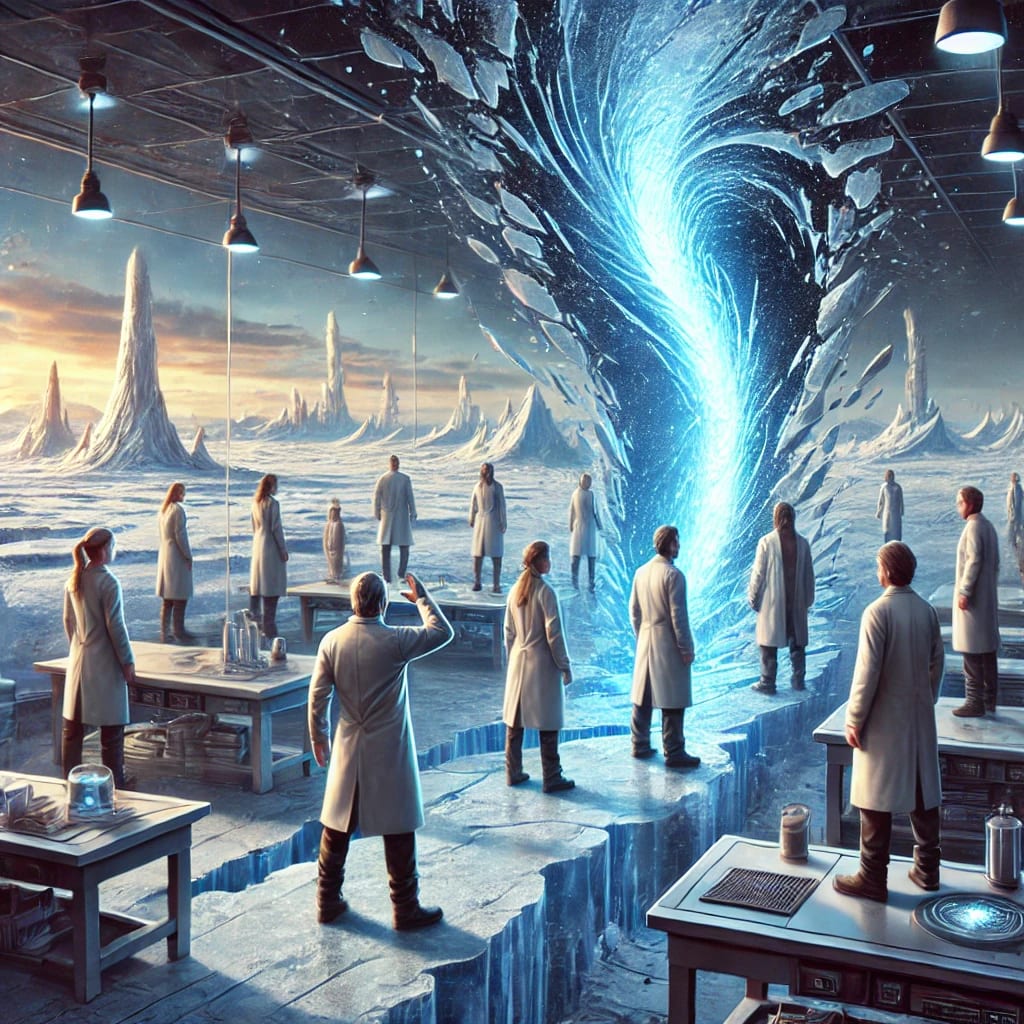
In the year 2147, humanity had mastered many frontiers—space travel, artificial intelligence, and even the manipulation of matter at a quantum level. But one mystery had eluded them: time. For decades, the brightest minds worked tirelessly to unravel the complexities of temporal mechanics, hoping to bend the fabric of time to their will. What they didn’t expect was that time, once touched, would bend back.
Dr. Linnea Shaw was one of these pioneers, a physicist renowned for her work on quantum entanglement and spacetime anomalies. For years, she had chased the concept of “temporal folding,” the theoretical ability to fold different moments in time like pages in a book, allowing instantaneous travel from one era to another. It was the ultimate dream: not just space travel, but time travel.
Her laboratory, deep within the Antarctic’s subterranean research complex, was as cold as the void it sought to understand. The icy winds outside howled against the metallic walls, a constant reminder of the isolation required for such delicate work. Her colleagues had long since abandoned the project, citing the dangers. They warned her that meddling with time could unleash untold chaos.
Linnea didn’t listen.
For years, she worked in solitude, fine-tuning the equations, developing a temporal stabilizer that would allow her to pierce through the layers of time safely. The device, a sleek orb encased in transparent nanotubes, hummed softly in the dimly lit lab. It was beautiful in its simplicity—a device that, if successful, would alter the course of human history forever.
On the eve of her breakthrough, Linnea activated the machine. The room shimmered as reality distorted around her. She had folded time, or so she thought. But as the initial success settled in, something went wrong. The temporal fold didn’t collapse back into a linear sequence as expected. Instead, it stayed open—unstable, fracturing the timeline into infinite, coexisting realities.
Suddenly, Linnea found herself standing face-to-face with a version of herself from the past. Her younger self, wide-eyed and full of hope, reached out in confusion.
“What... what is this?” the younger Linnea asked, fear creeping into her voice.
“I made a mistake,” the older Linnea whispered. “We all did.”
The fracture in time widened, and more versions of Linnea appeared, some older, some younger, some from realities where her life had taken drastically different paths. One version of her had never become a scientist at all; instead, she was a nomad, wandering the wastelands of a post-apocalyptic Earth. Another had ascended to the highest echelons of government, while yet another was nothing more than a shadow, a remnant of a failed experiment that had left her half-existent.
The lab was now filled with these different versions of Linnea, each one a reminder of the infinite possibilities that time contained. The sight was overwhelming, and the timelines started to bleed into one another. Past, present, and future collided in a chaotic storm of existence.
Linnea realized too late that the fracture in time wasn’t just affecting her. Outside, the world began to shift. Entire cities blinked in and out of existence, replaced by their counterparts from different timelines. In one reality, New York was a thriving metropolis under the sea; in another, it was nothing but a crater, a casualty of nuclear war.
She had to act fast. The stabilizer was the key to fixing this, but using it meant making an impossible choice. She could only close the fold by selecting one timeline to preserve, and in doing so, she would erase all the others. Billions of lives, billions of futures, and countless realities—all gone in an instant.
But which one would she choose?
As the versions of Linnea argued amongst themselves, each pleading for their reality to be spared, the true weight of her mistake settled on her. Every decision she had ever made, every tiny choice, had led to this moment. The timelines stretched out before her like a web of possibilities, and now she was caught in its center.
Her hands trembled as she approached the stabilizer. There was no time left. The fractures were growing wider, and soon the entire fabric of existence would tear apart. Linnea took a deep breath and placed her hand on the control panel.
“Forgive me,” she whispered to the countless lives and futures that would be lost.
With a flick of a switch, the device hummed to life once more. The timelines collapsed inward, folding over each other like crumpled paper. Linnea closed her eyes, unable to bear the sight of so many versions of herself disappearing into the void. The lab shimmered, and then, everything went still.
When she opened her eyes, the world was quiet.
She was alone.
Linnea stood in the empty lab, the hum of the stabilizer now silent. The fracture in time was sealed, and reality had returned to its singular state. But which timeline had she chosen? She had no way of knowing. The memories of the fractured timelines were gone, erased from existence, leaving only echoes of what once was.
Linnea stepped outside the lab into the icy Antarctic landscape. The world looked the same, but she knew it wasn’t. Somewhere, deep within the fabric of time, the consequences of her choice would ripple through the future. She had saved one reality, but at what cost?
As she gazed out at the endless horizon, Linnea wondered if time could ever truly be mastered—or if, in the end, it was time that mastered us.
About the Creator
Enjoyed the story? Support the Creator.
Subscribe for free to receive all their stories in your feed.
Comments
There are no comments for this story
Be the first to respond and start the conversation.